
Choosing between a 16 gauge vs 18 gauge stainless steel sink can affect how sturdy your sink feels, how well it resists dents, and how much noise it makes during everyday use. Both options can work well in a residential kitchen, but the right choice depends on your budget, cooking habits, sink design, and installation requirements.
Quick answer: A 16-gauge stainless steel sink is thicker and generally more rigid than an 18-gauge sink. It is worth considering for large single-bowl sinks, workstation sinks, and kitchens that see heavy use. An 18-gauge sink can offer excellent value for a typical home kitchen, especially when it has quality construction and effective sound-dampening features.
Before buying, compare more than the gauge number. Stainless steel grade, bowl dimensions, sound insulation, mounting style, and manufacturer specifications also matter.
What Does Gauge Mean in a Stainless Steel Sink?
Gauge measures the thickness of the metal sheet used to manufacture a sink. Unlike measurements in inches or millimeters, the gauge scale works backward: a lower number means thicker metal.
For stainless steel sinks, 16 gauge is thicker than 18 gauge.
Typical nominal thickness references are:
- 16 gauge: approximately 0.0625 inches, or 1.59 mm.
- 18 gauge: approximately 0.0500 inches, or 1.27 mm.
These are common reference values, not a guarantee of the exact thickness of every finished sink. Manufacturing specifications and measurement conventions can vary, so check the manufacturer’s stated thickness when available.

For additional guidance on choosing a sink, see the Elkay sink buying guide.
16 Gauge vs. 18 Gauge Stainless Steel Sink: Comparison Table
16 Gauge vs. 18 Gauge Stainless Steel Sink
Compare thickness, durability, noise, cost, and overall value before choosing your kitchen sink.
| Feature | 16-Gauge Sink | 18-Gauge Sink |
|---|---|---|
| Steel thickness | Thicker | Thinner |
| Rigidity | Generally more rigid | Depends on design and construction |
| Dent resistance | Generally better, all else being equal | Suitable for normal household use when well made |
| Noise | Thickness can help reduce vibration | Sound pads and undercoating can make a difference |
| Weight | Usually heavier | Usually lighter |
| Cost | Often more expensive | Often more budget-friendly |
| Best suited for | Heavy-use and premium installations | Everyday residential kitchens |
| Workstation sinks | A useful option for added rigidity | Can work when adequately constructed |
| Overall value | Worth considering when extra rigidity matters | Can balance cost and performance |
Quick tip: A lower gauge number means thicker steel. Compare the sink’s construction, sound-dampening features, dimensions, and manufacturer specifications too.
Important: These are general comparisons, not guarantees. A well-built 18-gauge sink may perform better than a poorly designed 16-gauge model.
1. Durability and Dent Resistance
Durability is one of the main reasons buyers consider a 16-gauge stainless steel sink.
Because the steel is thicker, a comparable 16-gauge sink generally resists flexing and dents better than an 18-gauge model. This can be useful when washing heavy cookware, handling large pots, or using a spacious single-bowl sink.
However, thicker steel does not make a sink immune to damage. Heavy impacts, poor installation, low-quality materials, and inadequate support can affect either gauge.
An 18-gauge sink can also provide years of dependable service when it is made from suitable stainless steel and manufactured well.
Choose 16 gauge if: You frequently wash heavy cookware, want a more rigid basin, or are investing in a premium workstation sink.
Choose 18 gauge if: You want a dependable sink for normal household tasks without paying extra solely for thicker steel.
2. Which Sink Is Quieter?
Stainless steel sinks can produce a hollow or metallic sound when running water, dishes, or utensils hit the basin.
A 16-gauge sink may vibrate less because it has more material, but gauge is not the only factor affecting noise. Sound-dampening pads and protective undercoating can also make a noticeable difference.
Before purchasing, check whether the sink includes:
- Sound-dampening pads on the bowl walls or base.
- Protective undercoating, if offered.
- Adequate support beneath the sink.
- Manufacturer information about noise reduction.
A properly damped 18-gauge sink may be quieter in practice than a 16-gauge sink with little sound insulation.

If reducing noise is your main priority, compare the actual sound-dampening construction rather than relying on the gauge alone.
For more advice, link this sentence to your published article on reducing kitchen sink noise: How to Reduce Kitchen Sink Noise.
3. Cost and Overall Value
A 16-gauge sink often costs more because it uses thicker steel, although the actual price difference depends on the brand, dimensions, finish, bowl configuration, and included accessories.
An 18-gauge sink can be a smart purchase if you want a quality stainless steel basin at a more accessible price. The money saved may be better spent on a suitable faucet, a compatible drain assembly, or professional installation.
On the other hand, if you are installing a large undermount sink that will be difficult to replace later, paying more for a well-made 16-gauge model may be worthwhile.
Compare the complete specifications and installation requirements before deciding that one option offers better value.
When Is Paying More for 16 Gauge Worth It?
Consider the upgrade if:
- You use your sink heavily every day.
- You prefer a rigid, substantial-feeling basin.
- You are purchasing a large single-bowl or workstation sink.
- The price difference is reasonable for your budget.
- The model also offers suitable steel quality and sound-dampening features.
An 18-gauge sink is still a reasonable choice when it meets your household’s needs and offers better overall value.
4. Installation and Cabinet Compatibility
Gauge can influence the sink’s weight, but it does not determine whether the sink will fit your kitchen.
Before purchasing either option, check the following:
Cabinet width: Confirm that the sink’s required minimum cabinet size fits your existing cabinet.
Sink dimensions: Compare the overall width, front-to-back measurement, bowl depth, and available workspace.
Mounting style: Undermount, drop-in, and workstation sinks can have different installation requirements.
Countertop compatibility: Undermount installations require compatible countertop materials and proper support.
Drain and disposal: Check the drain opening, drain assembly compatibility, and any garbage disposal requirements.
Support and sealing: Follow the manufacturer’s installation instructions, including the recommended support system and sealing method.
If you are replacing an existing sink, measure the current opening instead of assuming that sinks with similar external dimensions will fit.
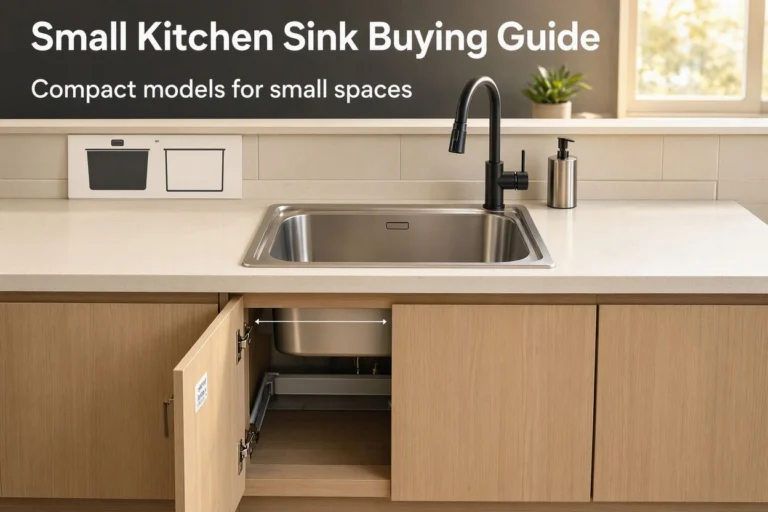
For further planning, see the small kitchen sink dimensions guide.

5. Stainless Steel Grade Matters Too
Gauge is only one part of sink quality. The stainless steel grade also matters because it affects corrosion resistance and other material properties.
Type 304 stainless steel is widely used for residential kitchen sinks because of its corrosion resistance. However, not every sink advertised as 16 gauge or 18 gauge necessarily uses the same steel grade.
When comparing two products, check:
- Whether the manufacturer specifies Type 304 stainless steel.
- Whether the material grade is clearly documented.
- The quality of the finish and construction.
- The warranty and installation requirements.
- The availability of replacement parts, if needed.
Do not assume that a thicker sink automatically has better corrosion resistance. Gauge describes thickness, while the steel grade describes the material’s composition.
6. Best Choice by Kitchen Type
The best gauge depends on how you use your sink rather than simply choosing the thickest available option.
Which Sink Gauge Is Right for Your Kitchen?
Compare these common kitchen situations before choosing a 16-gauge or 18-gauge stainless steel sink.
| Kitchen Situation | Suggested Option | Why It May Fit |
|---|---|---|
| Busy family kitchen | 16 gauge | Added rigidity may help with frequent heavy use. |
| Large single-bowl sink | 16 gauge | Thicker steel may help reduce flexing. |
| Workstation sink | Compare both | Accessory support and overall construction matter. |
| Standard home kitchen | Quality 18 gauge | May balance everyday performance and cost. |
| Budget-conscious renovation | Quality 18 gauge | May offer good performance without a premium price. |
| Quiet kitchen priority | Compare both | Sound pads and undercoating matter alongside thickness. |
| Small bar or prep sink | Either gauge | Fit, construction quality, and budget may matter more. |
Note: These are general guidelines, not guarantees. Compare the specific sink’s construction, sound-dampening features, dimensions, and manufacturer specifications before buying.
These are starting points, not strict rules. A small, well-made 18-gauge sink may suit your needs better than a larger, poorly constructed 16-gauge sink.
7. What to Check Before Buying a Stainless Steel Sink
Use this checklist to compare products fairly.
- Confirm the stated gauge and, where available, the actual sheet thickness.
- Check the stainless steel grade.
- Compare the sink’s overall dimensions and bowl depth.
- Look for sound-dampening pads and undercoating.
- Verify cabinet and countertop compatibility.
- Check the drain opening and disposal compatibility if applicable.
- Review the manufacturer’s warranty and installation instructions.
- Compare the total cost, including necessary accessories and installation.
If you need help narrowing down suitable sink sizes, link to your relevant sink-size calculator or sink-type finder here. Use the exact tool URL rather than the homepage.
8. Stainless Steel Sink Recommendations: What to Compare
When comparing actual sinks, prioritize products with clearly published specifications.
Option 1: 16-Gauge Stainless Steel Sink
Look for a model that specifies its gauge, steel grade, dimensions, mounting style, and sound-dampening features. Compare it with similar-sized sinks before paying a premium.
Check the product specifications and current availability before choosing your stainless steel sink.
Check Price on AmazonOption 2: 18-Gauge Stainless Steel Sink
Look for a well-constructed model with documented material specifications, suitable dimensions, and sound-dampening features. This may be the better choice when cost is a priority.
Explore the product details and check current availability on Amazon.
Check Price on AmazonOption 3: Premium Workstation Sink
If you want a sink with integrated ledges or accessories, compare the gauge alongside the accessory system, bowl dimensions, installation requirements, and overall construction.
Explore the product details and check current availability on Amazon.
Check Price on AmazonOption 4: Compact Stainless Steel Sink
For a smaller kitchen, bar area, or prep space, prioritize the sink’s fit and usable bowl dimensions. A thicker gauge is not useful if the sink does not suit the available cabinet or intended use.
Explore the product details and check current availability on Amazon.
Check Price on AmazonFrequently Asked Questions
Is a 16-gauge stainless steel sink better than an 18-gauge sink?
A 16-gauge sink is thicker and generally more rigid, with better dent resistance under comparable conditions. An 18-gauge sink can still be an excellent residential choice, particularly when it has good construction and sound insulation.
Is an 18-gauge stainless steel sink too thin?
No. Eighteen-gauge stainless steel is a common thickness for residential kitchen sinks. Its suitability depends on the sink’s construction, material quality, size, and intended use.
How much thicker is 16 gauge than 18 gauge?
Using common nominal stainless steel sheet values, 16 gauge measures approximately 1.59 mm, while 18 gauge measures approximately 1.27 mm. That makes 16 gauge roughly 25% thicker by these reference measurements.
Does a 16-gauge sink rust less than an 18-gauge sink?
Not necessarily. Corrosion resistance depends primarily on the steel’s composition, finish, environment, and maintenance—not gauge alone. Compare the stainless steel grade and manufacturer specifications.
Is a 16-gauge sink quieter?
It can be, because thicker steel may vibrate less. However, sound-dampening pads, undercoating, and installation also influence noise. Compare these features before buying.
Can an 18-gauge sink support a garbage disposal?
Many 18-gauge kitchen sinks are designed to accommodate compatible garbage disposals. Check the manufacturer’s instructions, drain opening, sink construction, and disposal mounting requirements for the specific model.
Is 16 gauge worth the extra money?
It may be worth the upgrade if you want greater rigidity, regularly wash heavy cookware, or are buying a large workstation sink. For ordinary kitchen use, a quality 18-gauge sink may provide better value.
Which gauge is best for an undermount sink?
Both 16 and 18 gauge can work for undermount installations. Consider the sink’s rigidity, dimensions, countertop material, mounting system, and manufacturer-approved support requirements.
Should I choose gauge or stainless steel grade first?
Consider both. Gauge helps you compare thickness, while the steel grade helps you evaluate material composition and corrosion resistance. A good buying decision considers both along with construction and sound-dampening features.
Does a thicker stainless steel sink last longer?
Thicker steel can provide better resistance to dents and flexing, but lifespan also depends on steel quality, installation, maintenance, and manufacturing. Gauge alone cannot guarantee a longer service life.
Final Verdict: 16 Gauge vs. 18 Gauge Stainless Steel Sink
Choose a 16-gauge stainless steel sink if you value added rigidity, use heavy cookware regularly, or want a substantial sink for a large bowl or workstation setup.
Choose a quality 18-gauge stainless steel sink if you want dependable everyday performance and a more budget-friendly option.
Before deciding, compare steel grade, sound-dampening features, dimensions, mounting requirements, and overall construction. The best sink is the one that fits your kitchen, suits your daily routine, and delivers the right balance of performance and cost.
Get Helpful Sink Tips
Subscribe for practical sink planning tips and helpful resources for small kitchens and compact spaces.

Khadija is the writer and founder of Tiny Sink Solution. She creates practical guides about small kitchen sinks, faucets, and compact kitchen maintenance, helping homeowners and renters choose solutions for limited spaces. Some articles contain affiliate links, and as an Amazon Associate, she earns from qualifying purchases at no extra cost to readers




One Comment