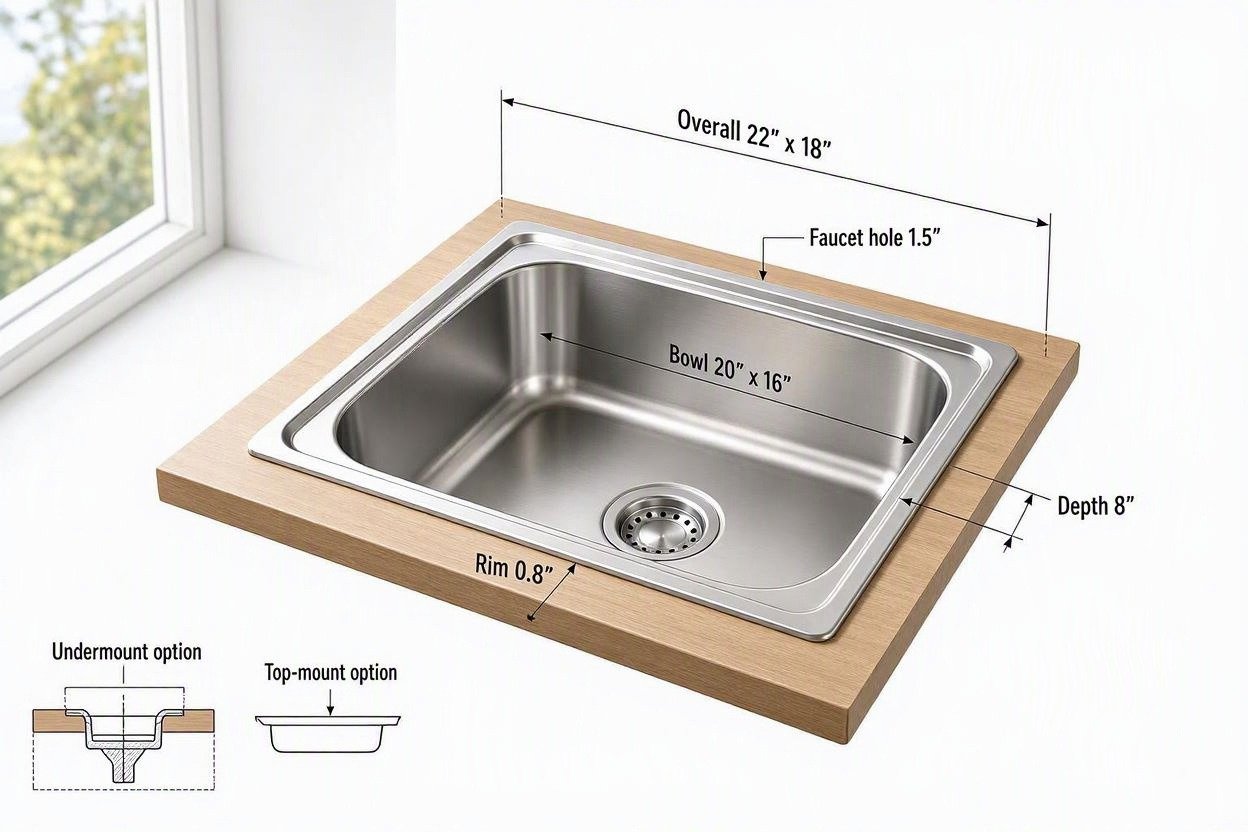
Choosing the right sink for a compact kitchen starts with understanding single-bowl compact sink dimensions rather than simply picking the smallest model available. The overall length and width determine how much countertop space the sink uses, while bowl dimensions show how much usable washing space you get. You also need to consider bowl depth, cabinet clearance, countertop cutout requirements, and installation type before buying. A sink that looks small may still require more cabinet space than expected. By comparing these measurements with your available kitchen space, you can find a practical sink that fits properly and remains comfortable for everyday tasks without wasting valuable countertop or storage space.
Quick Answer
Single-bowl compact sink dimensions vary by model, so there is no single standard size. Before choosing one, compare the sink’s overall length and width, bowl depth, minimum cabinet requirement, countertop cutout, and installation requirements with your available space.
A compact sink should fit the complete installation chain:
Cabinet → Countertop → Cutout → Sink → Plumbing → Installation
What Are Single-Bowl Compact Sink Dimensions?
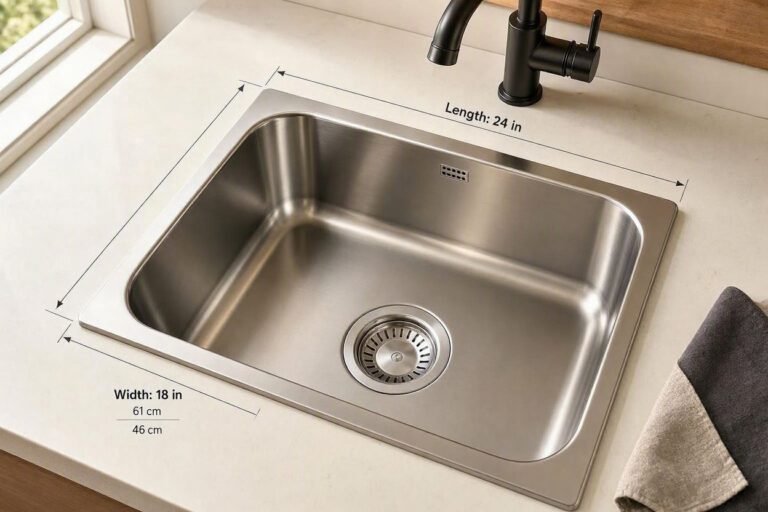
Single-bowl compact sink dimensions describe the overall size and usable basin measurements of a sink designed for a smaller kitchen or limited countertop area.
The measurements that matter most are:
- Overall length: The sink’s side-to-side measurement.
- Overall width: The sink’s front-to-back measurement.
- Bowl length: The inside length of the basin.
- Bowl width: The inside width of the basin.
- Bowl depth: The vertical depth of the basin.
- Minimum cabinet size: The cabinet width required by the specific sink.
- Cutout dimensions: The opening required in the countertop.
These measurements are related but they are not interchangeable. A sink’s overall dimensions describe its footprint, while the bowl dimensions tell you how much usable basin space you actually have.
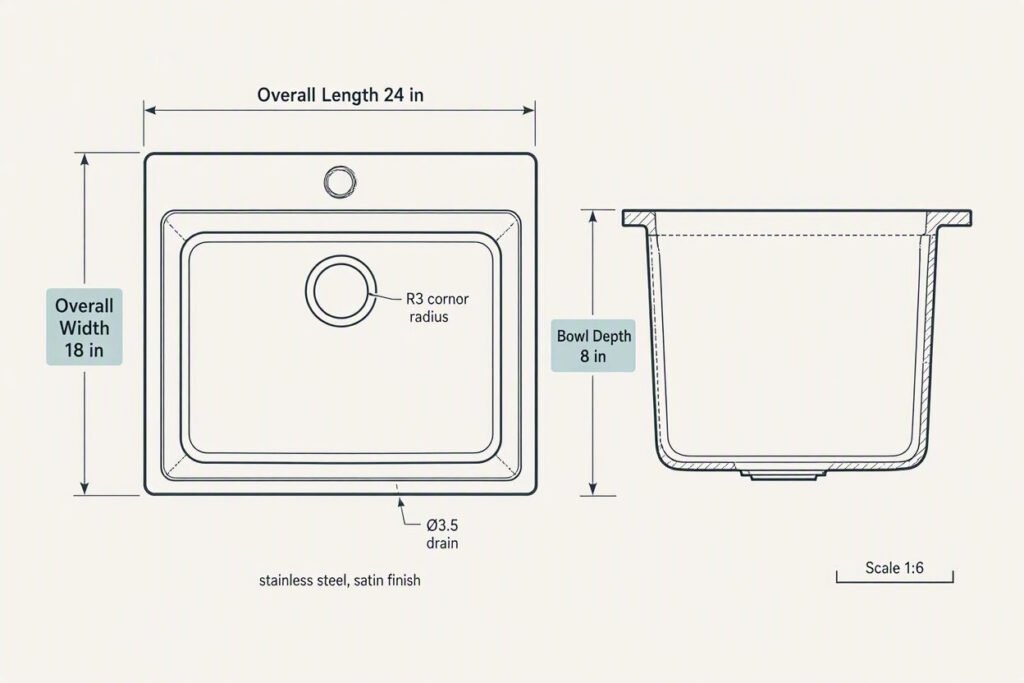
What Size Is a Compact Single-Bowl Sink?
There is no universal dimension that defines a compact single-bowl kitchen sink.
Different manufacturers produce sinks with different proportions, bowl depths, installation requirements, and cabinet requirements. A sink that fits one small kitchen may not fit another because cabinet width and countertop configuration can differ.
Instead of choosing a sink based only on its advertised width, compare these measurements:
| Measurement | Why It Matters |
|---|---|
| Overall length | Determines how much counter space the sink occupies |
| Overall width | Important for front-to-back countertop space |
| Bowl length | Shows usable basin space |
| Bowl width | Helps determine what can fit inside |
| Bowl depth | Affects basin space and space underneath |
| Minimum cabinet size | Helps determine whether the sink can physically fit |
| Cutout dimensions | Determines the countertop opening required |
| Installation type | Determines how the sink is installed |
For a compact kitchen, the goal is not simply to find the smallest footprint. You want a sink that fits the available space without sacrificing the basin dimensions you actually need.
For a broader explanation of small-sink sizing, see our guide to small kitchen sink dimensions.
Single-Bowl Compact Sink Size Chart
Rather than relying on a universal size category, use the manufacturer’s specifications for the particular sink you are considering.
| What to Check | What to Compare |
|---|---|
| Overall sink length | Available countertop length |
| Overall sink width | Available countertop depth |
| Bowl dimensions | Usable washing area |
| Bowl depth | Vertical basin space |
| Minimum cabinet size | Available cabinet width |
| Cutout dimensions | Existing or planned countertop opening |
| Installation type | Undermount, drop-in/top-mount, or other |
| Drain configuration | Plumbing compatibility |
This approach is more reliable than assuming every compact sink follows the same sizing formula.
What Cabinet Size Do You Need for a Compact Sink?
Cabinet compatibility is one of the most important parts of choosing a small single-bowl sink.
The sink must fit the available cabinet space, but the cabinet is not the only measurement that matters. You also need to consider the countertop, cutout, bowl depth, and plumbing.
Check the Manufacturer’s Minimum Cabinet Requirement
Always check the sink manufacturer’s stated minimum cabinet size.
Generic rules can be useful for initial planning, but the manufacturer’s specification should be the final fit check.
For example, two sinks with similar overall dimensions may still have different cabinet requirements because of their construction, bowl shape, mounting method, or other design details.
Measure Your Cabinet
Before buying, measure the cabinet where the sink will be installed.
Record:
- Cabinet width
- Available front-to-back space
- Existing sink opening, if replacing a sink
- Plumbing location
- Space below the countertop
If you need help checking cabinet compatibility, use our Cabinet Size Checker before selecting a sink.
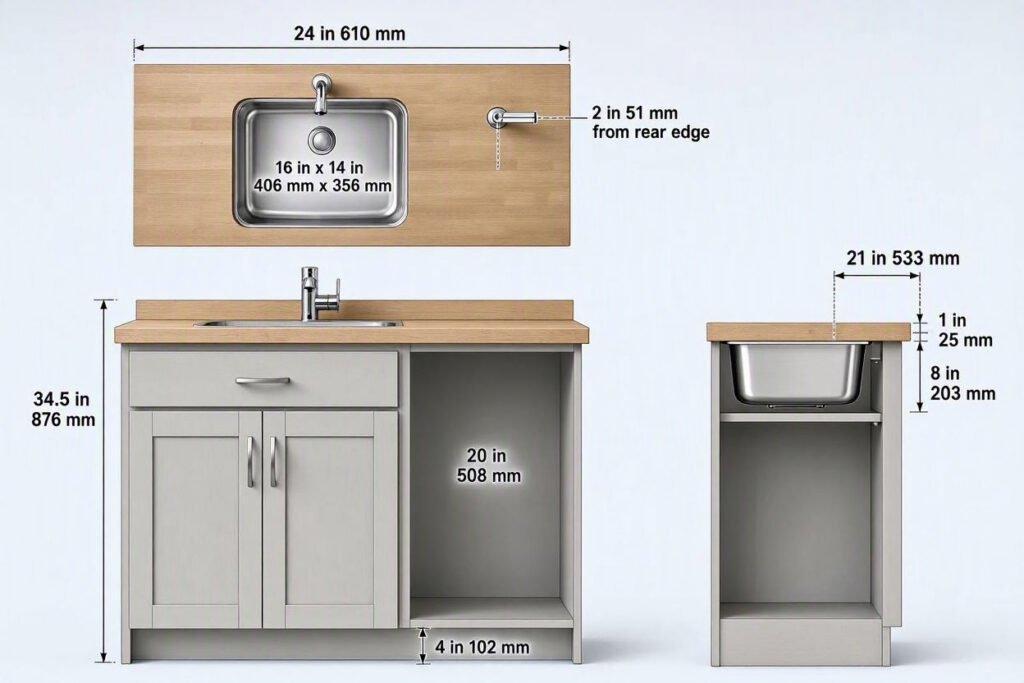
How Deep Should a Compact Single-Bowl Sink Be?
Sink depth affects both the way you use the basin and the amount of space available underneath it.
A deeper bowl can provide more vertical basin space, which may be useful when washing larger items. However, the sink’s depth can also affect the space available below the countertop for plumbing and storage.
A shallower sink may leave more room underneath, but it provides less vertical basin space.
There is therefore no single bowl depth that is ideal for every compact kitchen.
When comparing sinks, consider:
- What you normally wash
- The size of your cookware
- Available cabinet space
- Plumbing clearance
- How comfortable the sink will be to use
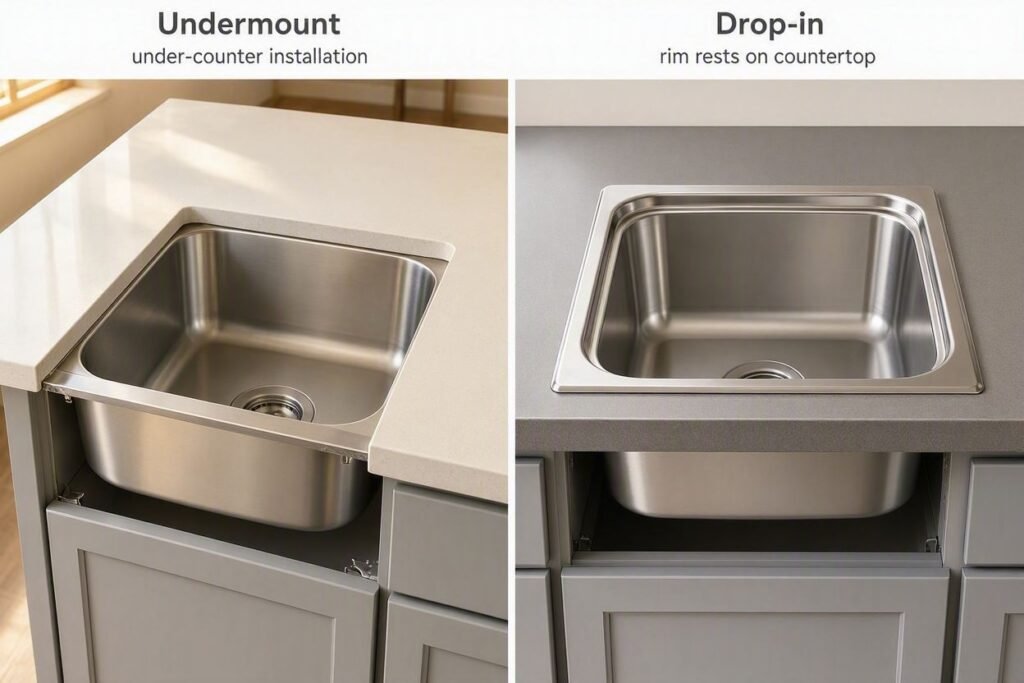
Undermount vs. Drop-In: Which Installation Fits?
Compact single-bowl sinks are available with different installation methods. Two common options are undermount and drop-in/top-mount.
Undermount Single-Bowl Sinks
An undermount sink is installed beneath the countertop.
When considering one, check:
- Countertop compatibility
- Sink dimensions
- Required cutout
- Cabinet clearance
- Manufacturer installation requirements
The countertop must be prepared for the specific sink and installation method.
Drop-In or Top-Mount Single-Bowl Sinks
A drop-in or top-mount sink sits on top of the countertop with its rim supported by the counter.
Before installation, check:
- Overall sink dimensions
- Required countertop opening
- Rim dimensions
- Cabinet clearance
- Manufacturer’s installation instructions
The installation type does not automatically determine whether a sink is compact. Both undermount and top-mount sinks are available in different sizes.
Compact Single-Bowl Sinks to Consider
If you are ready to compare actual products, these examples show why overall dimensions, installation type, and cabinet compatibility matter.
These are not universal recommendations for every kitchen. Always compare the current product listing with your own measurements before purchasing.
Affiliate disclosure: As an Amazon Associate, I earn from qualifying purchases.
1. VCCUCINE 13 × 15-Inch Drop-In Bar Sink
Best suited to: Very compact countertop layouts where a small drop-in sink footprint is a priority.
The VCCUCINE model listed as 13 × 15 inches is a drop-in/top-mount stainless steel sink. The available product information lists dimensions of 15 inches long × 13 inches wide × 9 inches high, with an interior dimension of 11 × 11 × 9 inches. The listing also identifies SUS304 stainless steel and an 18-gauge sink body.
The compact footprint makes this an example of why you should compare both the outside dimensions and interior bowl dimensions. A small exterior footprint does not necessarily mean a large usable basin.
Check before buying:
- Countertop opening
- Cabinet clearance
- Faucet arrangement
- Drain configuration
- Current Amazon listing specifications
2. 20 × 16-Inch 3D Micro-Pebble Embossed Drop-In Sink
Best suited to: A compact kitchen that has more available countertop space and needs a larger single-bowl footprint.
The product information supplied for this sink identifies it as a 20 × 16-inch, 9-inch-deep, top-mount single-bowl stainless steel sink with a 3D micro-pebble embossed surface.
However, verify the exact Amazon listing and current specifications before publication. I could not confidently match the supplied product to a single authoritative current Amazon listing during verification.
That means this product should remain a pending-verification product rather than being presented as fully verified.
🛒 Shop Now on Amazon3. TORVA 13 × 15 × 9-Inch RV/Bar Sink
Best suited to: Compact kitchens where an undermount sink and additional workspace are part of the installation plan.
The TORVA listing identifies a 13 × 15 × 9-inch single-bowl stainless steel sink with undermount installation and a dark-gray finish. Current third-party Amazon-linked product information also identifies this model and size.
The supplied product information also describes a cutting board and faucet included with this particular package. Because configurations can vary by listing, verify the exact package before purchase.
For a compact kitchen, the important point is not simply that the sink is small. An undermount installation requires the countertop and cutout to be compatible with the specific sink.
Check before buying:
- Countertop material compatibility
- Required cutout
- Cabinet clearance
- Drain and plumbing position
- Exact package contents
4. Kingston Brass GKTS2520 25-Inch Single-Bowl Drop-In Sink
Best suited to: A compact kitchen with enough cabinet and countertop space for a larger single-bowl sink.
The Kingston Brass GKTS2520 is a 25-inch self-rimming/drop-in single-bowl stainless steel sink. Kingston Brass currently lists the sink with an overall size of approximately 25 × 21-15/16 × 6-3/16 inches, a 21-1/16 × 15-3/4 × 6-inch bowl, and a 28-inch minimum cabinet size. The manufacturer also identifies 304 stainless steel and a center drain.
This is a useful example of why the phrase compact sink should not be interpreted as “smallest possible sink.” A 25-inch sink may be practical in some compact kitchens but would be unsuitable where cabinet space is more restricted.
Check before buying:
- Minimum 28-inch cabinet requirement
- Overall countertop footprint
- Existing cutout
- Faucet-hole arrangement
- Drain position
How to Measure for a Single-Bowl Compact Sink
If you’re replacing an existing sink, measure the available space before choosing the replacement.
1. Measure the Cabinet
Start with the cabinet underneath the sink.
Record the available cabinet width and front-to-back space.
2. Measure the Existing Sink
If you’re replacing a sink, record its overall length, width, and depth.
Do not assume that the replacement must have exactly the same outside dimensions. The new sink also needs to work with the existing countertop opening and cabinet.
3. Check the Countertop
Measure the available countertop space around the sink.
Make sure the new sink’s footprint works with the countertop layout.
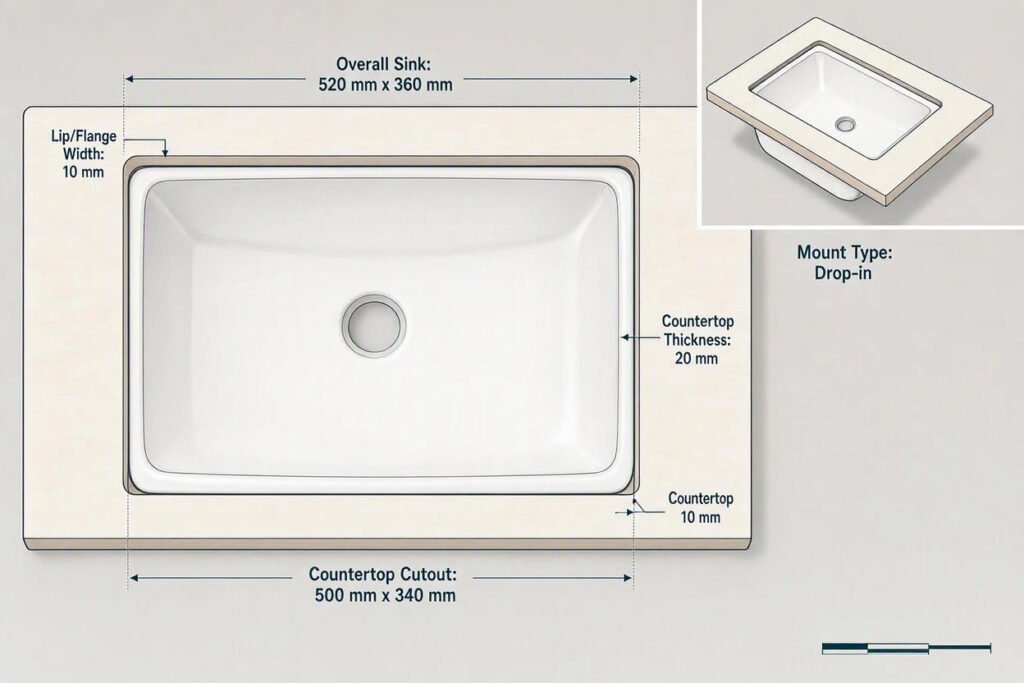
4. Check the Countertop Cutout
The required cutout depends on the specific sink and installation method.
For a replacement project, compare the existing opening with the manufacturer’s required cutout dimensions.
For new installation, follow the manufacturer’s template or cutout specifications.
You can also use the Sink Cutout Size Calculator as a planning aid.
5. Check Bowl Depth
Compare the new sink’s bowl depth with the available space underneath.
A deeper bowl can affect the space available for plumbing and storage.
6. Check Plumbing
Look at the drain position and existing plumbing configuration.
The sink’s bowl depth and drain configuration can affect the available space beneath the countertop, so check plumbing clearance before installation.
7. Confirm Manufacturer Requirements
Before purchasing, compare all of your measurements with the manufacturer’s specifications.
This final check should include:
Cabinet → Countertop → Cutout → Sink → Bowl → Depth → Plumbing → Installation
How to Choose the Right Compact Sink Size
Choosing the right sink size is a balancing exercise between available space and usable basin area.
1. Start With the Cabinet
Determine the cabinet space available for the sink.
2. Check the Sink Footprint
Compare the sink’s overall length and width with your countertop space.
3. Consider the Bowl Dimensions
A sink can have a compact exterior but still offer useful basin space depending on its bowl proportions.
4. Consider Bowl Depth
Think about what you normally wash and how much space you need underneath.
5. Check the Cutout
Never assume the countertop cutout based only on the sink’s advertised dimensions.
Use the manufacturer’s specifications.
6. Check Plumbing
Make sure the drain and plumbing arrangement can work with the sink.
7. Confirm Installation Type
Make sure your countertop and installation plan are compatible with the sink.
What Should You Look for When Buying a Compact Single-Bowl Sink?
Once you understand the dimensions, you can compare potential sinks using the following checklist:
- Overall length
- Overall width
- Bowl length and width
- Bowl depth
- Minimum cabinet requirement
- Countertop cutout
- Installation type
- Drain location
- Plumbing clearance
- Countertop compatibility
- Material
- Manufacturer installation requirements
Don’t choose a sink based only on its advertised overall size.
Two sinks with similar footprints can provide different amounts of usable bowl space.
Single-Bowl vs. Double-Bowl for a Small Kitchen
A single-bowl sink provides one uninterrupted basin, while a double-bowl sink divides the available basin space into two compartments.
| Single-Bowl Sink | Double-Bowl Sink |
|---|---|
| One uninterrupted basin | Two separate basins |
| Can accommodate larger items across the basin | Separates the basin into compartments |
| Simple single-basin layout | Can provide separate washing/rinsing areas |
| Available in many compact configurations | Requires space for the divider and two bowls |
For users who regularly wash larger cookware, the uninterrupted space of a single bowl can be useful.
If you prefer separate washing and rinsing areas, a double-bowl configuration may be worth considering.
For more information about double-bowl sizing, see our guide to small double bowl sink sizes.
Common Mistakes When Choosing a Compact Sink
Choosing by Overall Width Alone
A sink’s overall width does not tell you everything about its usable bowl space.
Ignoring the Minimum Cabinet Requirement
The sink may appear small enough for your kitchen but still require a larger cabinet.
Forgetting Bowl Depth
Depth affects both basin space and the area underneath the sink.
Assuming the Cutout Matches the Sink Dimensions
The countertop opening depends on the specific sink and installation method.
Measuring Only the Countertop
The cabinet underneath the countertop is equally important.
Ignoring Plumbing Clearance
The new sink needs to work with the existing or planned plumbing configuration.
Assuming Every Installation Type Works the Same Way
Undermount and top-mount sinks have different installation requirements.
Choosing Only by Appearance
A sink can look compact while having dimensions that don’t work with your cabinet or countertop.
Key Takeaways
- There is no single standard size for a compact single-bowl sink.
- Compare overall sink dimensions with the available countertop space.
- Check the sink’s bowl dimensions to understand usable basin space.
- Use the manufacturer’s minimum cabinet requirement as the final cabinet-fit check.
- Bowl depth affects both basin space and the area underneath the sink.
- Countertop cutout requirements vary by sink and installation type.
- Check plumbing clearance before installation.
- Measure the cabinet, countertop, existing cutout, sink, and plumbing before purchasing.
- Choose based on how you actually use the sink, not just its outside dimensions.
Conclusion
Choosing a compact single-bowl sink starts with measurements rather than appearance.
Check your cabinet width, countertop space, sink footprint, bowl dimensions, depth, cutout, plumbing, and installation type before making a decision. Most importantly, use the manufacturer’s minimum cabinet and installation requirements as your final fit check.
When those measurements work together, you can choose a single-bowl sink that fits your compact kitchen without relying on a one-size-fits-all rule.
Frequently Asked Questions
What are single-bowl compact sink dimensions?
Single-bowl compact sink dimensions vary by manufacturer and model. The main measurements to compare are overall length and width, bowl dimensions, bowl depth, minimum cabinet requirement, and countertop cutout. There is no single universal dimension that defines every compact single-bowl sink.
What size cabinet do I need for a single-bowl compact sink?
The required cabinet size depends on the specific sink. Check the manufacturer’s stated minimum cabinet requirement and compare it with your actual cabinet dimensions before purchasing.
How deep is a compact single-bowl kitchen sink?
Compact single-bowl sinks are available at different depths. The appropriate depth depends on your available cabinet space, what you normally wash, and the amount of plumbing clearance underneath the sink.
Are undermount sinks available in compact single-bowl sizes?
Yes. Compact single-bowl sinks can be designed for undermount installation as well as other installation methods. The important considerations are the sink’s dimensions, countertop compatibility, cutout requirements, and manufacturer’s installation instructions.
Is a single-bowl sink good for a small kitchen?
A single-bowl sink can work well in a small kitchen when its dimensions and cabinet requirements match the available space. Its uninterrupted basin can also be useful for washing larger cookware.
How do I measure for a replacement single-bowl sink?
Measure the cabinet, existing sink, countertop opening, available countertop space, and plumbing area. Then compare those measurements with the replacement sink’s manufacturer specifications, including its required cutout and minimum cabinet size.
Does sink depth affect cabinet space?
Yes. A deeper bowl can extend farther into the space below the countertop. Check the bowl depth along with plumbing and storage clearance before installation.
What is more important: sink size or bowl size?
Both matter. Overall dimensions determine whether the sink fits the countertop and cabinet area, while bowl dimensions determine how much usable basin space you have.
Khadija is the writer and founder of Tiny Sink Solution. She creates practical guides about small kitchen sinks, faucets, and compact kitchen maintenance, helping homeowners and renters choose solutions for limited spaces. Some articles contain affiliate links, and as an Amazon Associate, she earns from qualifying purchases at no extra cost to readers
![Top [count] Gardening Blogs - OnToplist.com](https://www.ontoplist.com/images/ontoplist32.png?id=6aa4d0c493161)