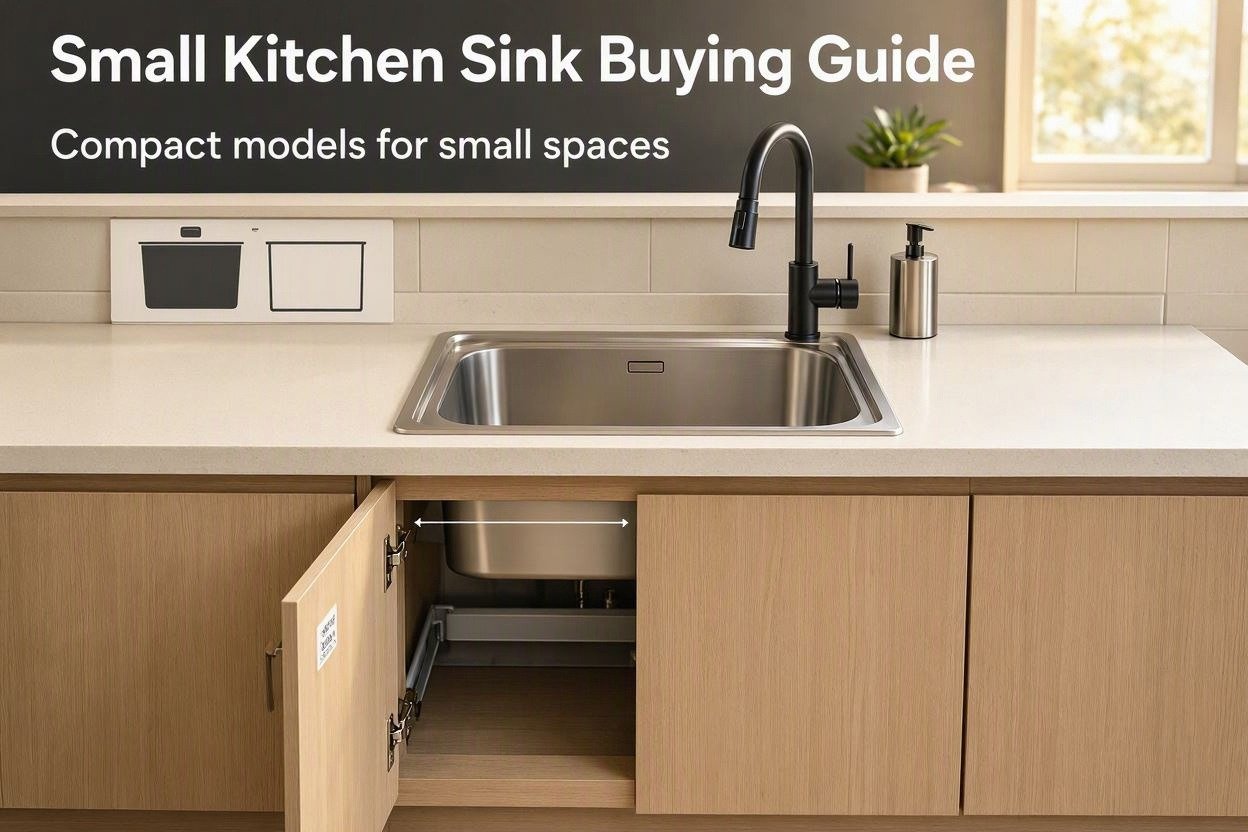
Choosing a small kitchen sink is not simply about finding the smallest sink available. The right sink needs to fit the cabinet, countertop, cutout, plumbing, faucet setup, and the way you actually use your kitchen.
A sink that looks compact enough in a product listing can still be unsuitable if its cabinet requirement, cutout, depth, or installation method does not match your kitchen.
This small kitchen sink buying guide walks through the important factors in the order they should be checked, from cabinet fit and sink dimensions to material, mounting type, bowl configuration, depth, faucet, drain, and maintenance.
Quick Answer: How Do You Choose a Small Kitchen Sink?
Start with the cabinet and available countertop space, not the sink itself. Measure the cabinet opening, countertop area, existing cutout if replacing a sink, and available clearance below the counter. Then compare sink dimensions, installation type, bowl configuration, depth, faucet placement, drain position, material, and maintenance requirements.
The most important rule is simple:
A sink only works if the cabinet, countertop, cutout, sink, and plumbing are compatible.
If you are replacing an existing sink, measure the current installation before shopping. Do not assume that a sink with similar advertised dimensions will use the same cutout.
1. Start With Your Cabinet Size
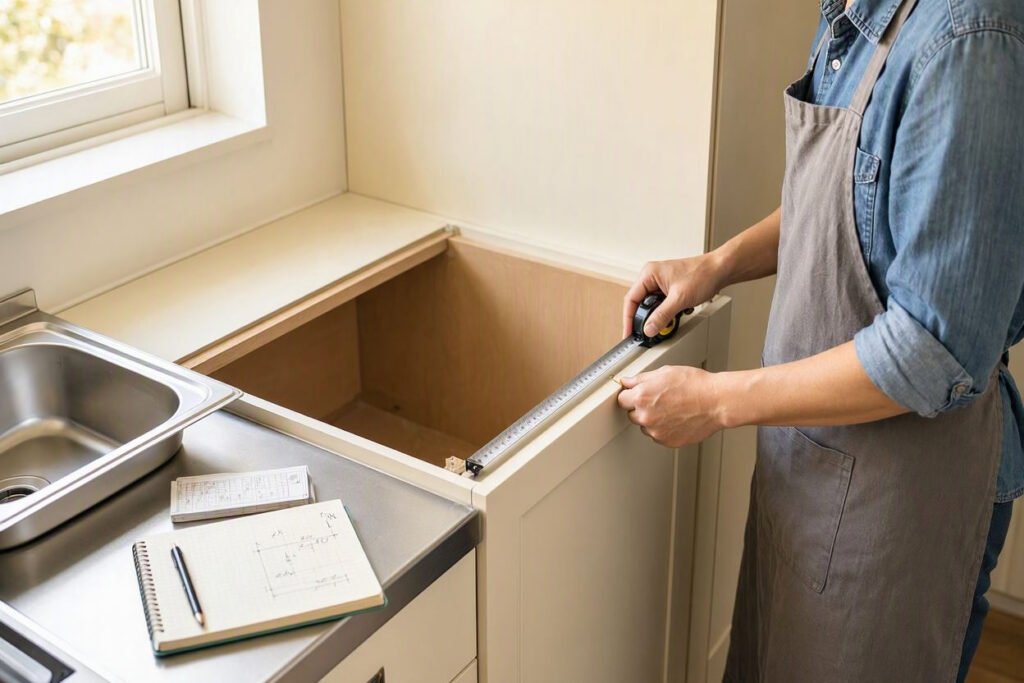
The cabinet underneath the countertop is one of the first things to check because it limits how large a sink can realistically be installed.
Measure:
- Cabinet width
- Cabinet depth
- Available space around the plumbing
- Existing sink opening, if replacing a sink
- Clearance below the countertop
- Space needed for the drain and other plumbing components
A sink may have an attractive overall size but still require a larger cabinet than you have available.
For a more detailed fit check, use our cabinet size checker before choosing a model.
Why Cabinet Fit Comes Before Sink Shopping
The cabinet determines the practical space available beneath the sink. This becomes especially important with deeper bowls, larger sink bodies, and some heavier sink materials.
Do not use the sink’s outside dimensions alone to determine whether it will fit.
Always check the manufacturer’s stated minimum cabinet requirement when one is provided.
2. Compare Sink Dimensions With Your Available Countertop Space
Once the cabinet has been checked, compare the sink’s overall dimensions with the countertop area.
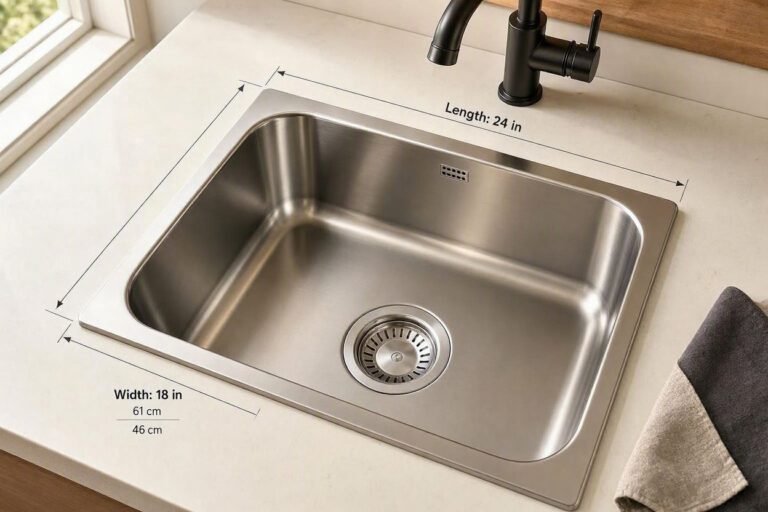
The three basic dimensions are:
- Length: side to side
- Width: front to back
- Depth: how far the bowl extends downward
Remember that manufacturers may present dimensions in different orders, so read the product listing carefully.
For a broader explanation of sink measurements and common size considerations, see our guide to small kitchen sink dimensions.
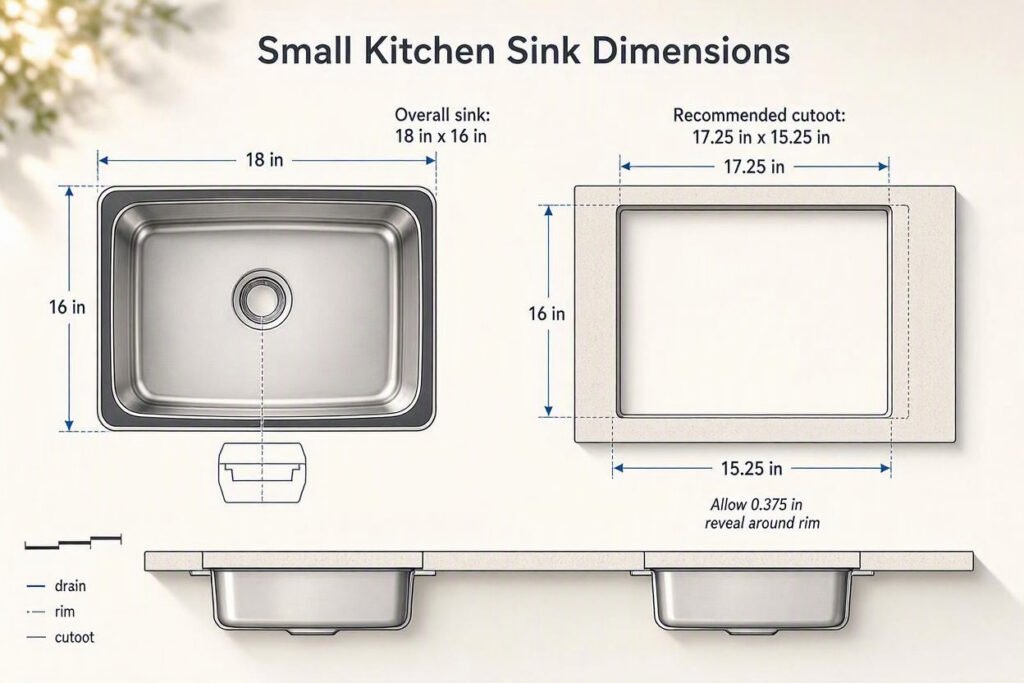
Overall Sink Dimensions Are Not the Same as Cutout Dimensions
This is one of the most important distinctions when replacing a sink.
A sink’s overall dimensions describe the physical size of the sink.
The cutout dimensions describe the opening required in the countertop for a particular installation.
Those measurements are not necessarily identical.
A drop-in sink, for example, may have an overall rim that is larger than the countertop opening. An undermount sink can have different cutout requirements depending on the manufacturer and installation specifications.
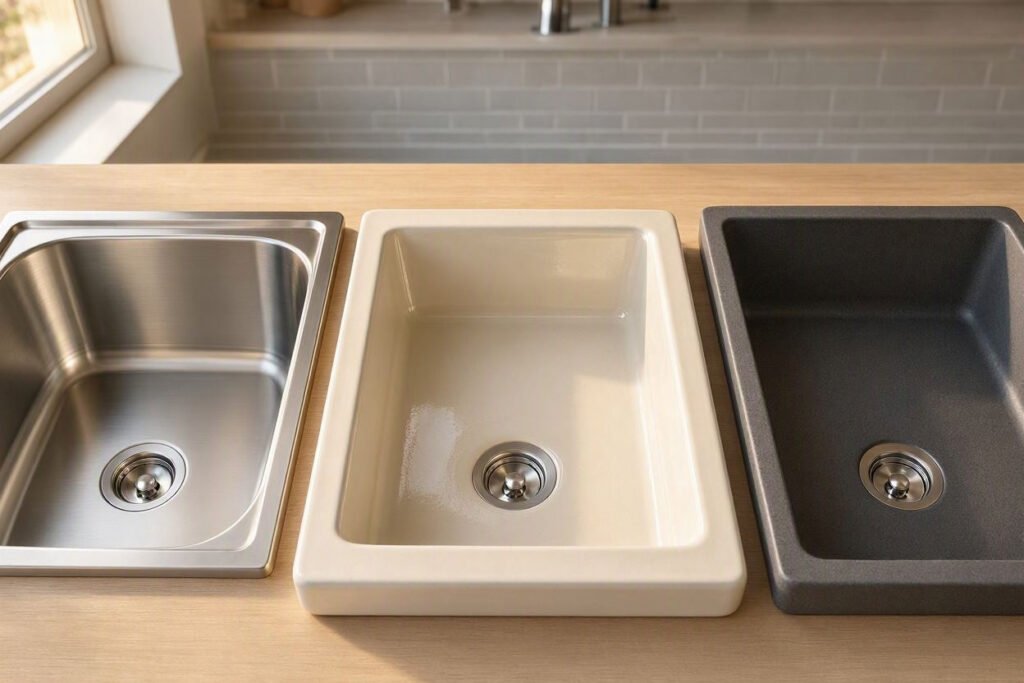
3. Choose the Right Sink Material
The material affects appearance, weight, maintenance, durability characteristics, and sometimes installation requirements.
Common materials for small kitchen sinks include:
Stainless Steel
Stainless steel is widely used for kitchen sinks and is available in many compact configurations.
When comparing stainless steel models, look at the actual product specifications rather than relying only on the gauge number. Construction, finish, sound-dampening features, and design can vary between models.
Fireclay
Fireclay sinks have a solid, ceramic-based construction and are available in traditional white finishes as well as other styles.
Because fireclay sinks can be substantially heavier than some stainless steel models, cabinet and countertop support deserve particular attention.
Composite
Composite sinks are made from engineered materials and can provide a different appearance from stainless steel.
Check the manufacturer’s care instructions and installation requirements before choosing one.
Which Material Should You Choose?
There is no single material that is right for every small kitchen.
Consider:
- How much maintenance you want
- Your preferred appearance
- Available cabinet support
- Installation method
- Countertop material
- How heavily the sink will be used
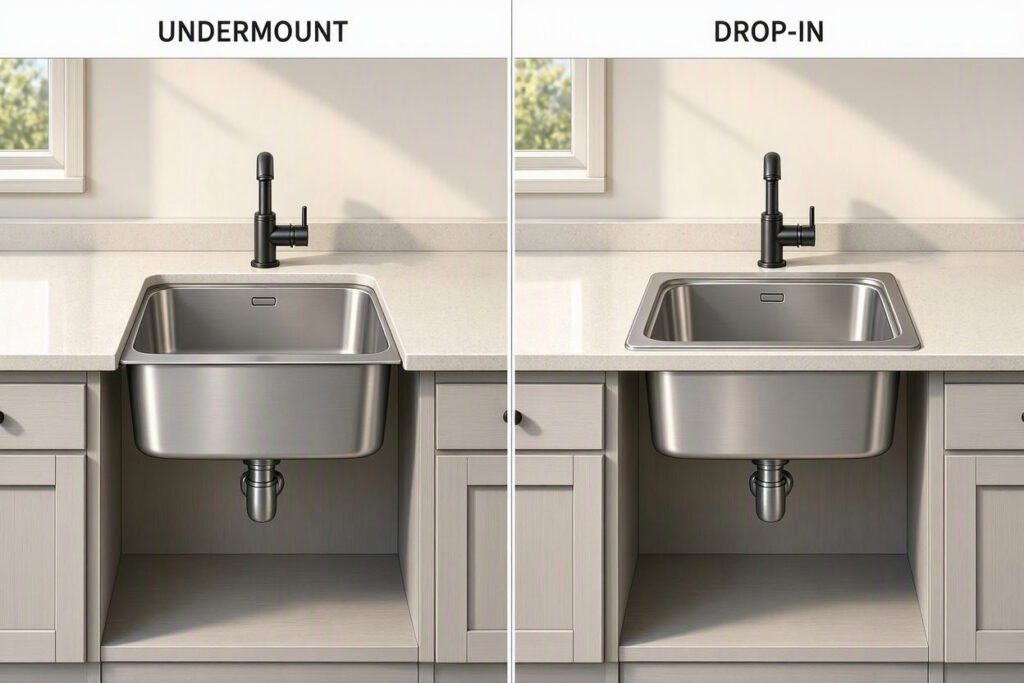
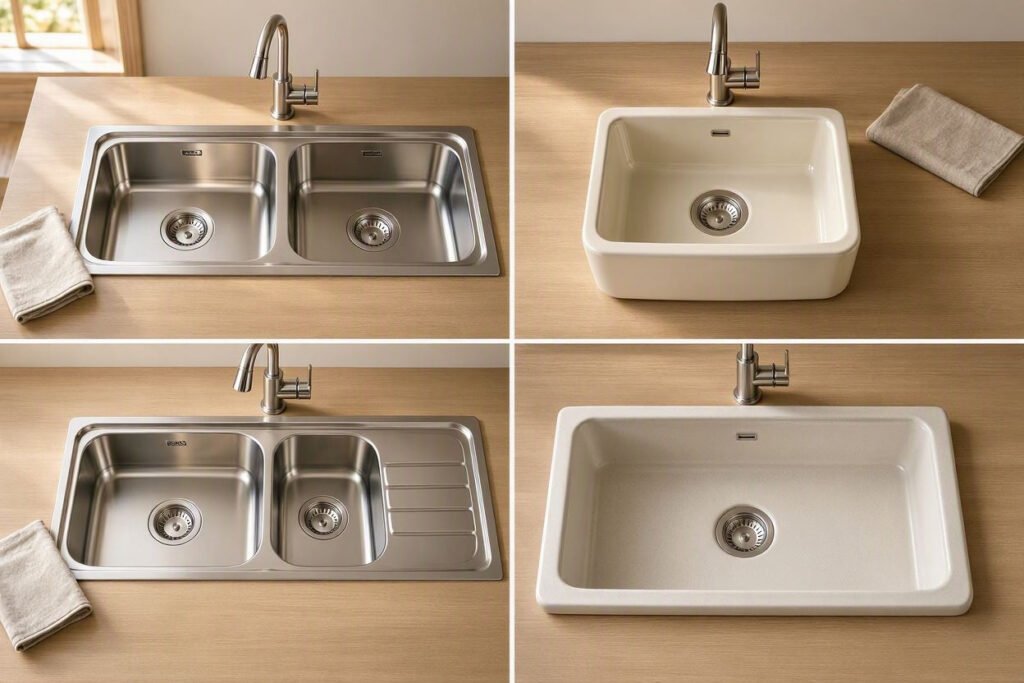
4. Decide Between Undermount and Drop-In Installation
The mounting style affects both appearance and installation requirements.
Undermount Sinks
An undermount sink is installed beneath the countertop.
This creates a countertop edge around the sink opening and can provide a clean transition between the counter and basin.
However, undermount installation depends heavily on countertop compatibility, proper cutout dimensions, support, and installation instructions.
If you are considering this style specifically, see our guide to Best Undermount Small Kitchen Sinks for Compact Kitchens.
Drop-In Sinks
A drop-in or top-mount sink sits within the countertop opening, with its rim resting on top of the counter.
This style can be practical when replacing an existing top-mount sink, but the replacement still needs to match the required opening and available counter space.
Which Mounting Type Is Better?
Neither mounting style is automatically better for every kitchen.
Your decision should depend on:
- Existing countertop
- Existing cutout
- Replacement requirements
- Cabinet clearance
- Desired appearance
- Installation requirements
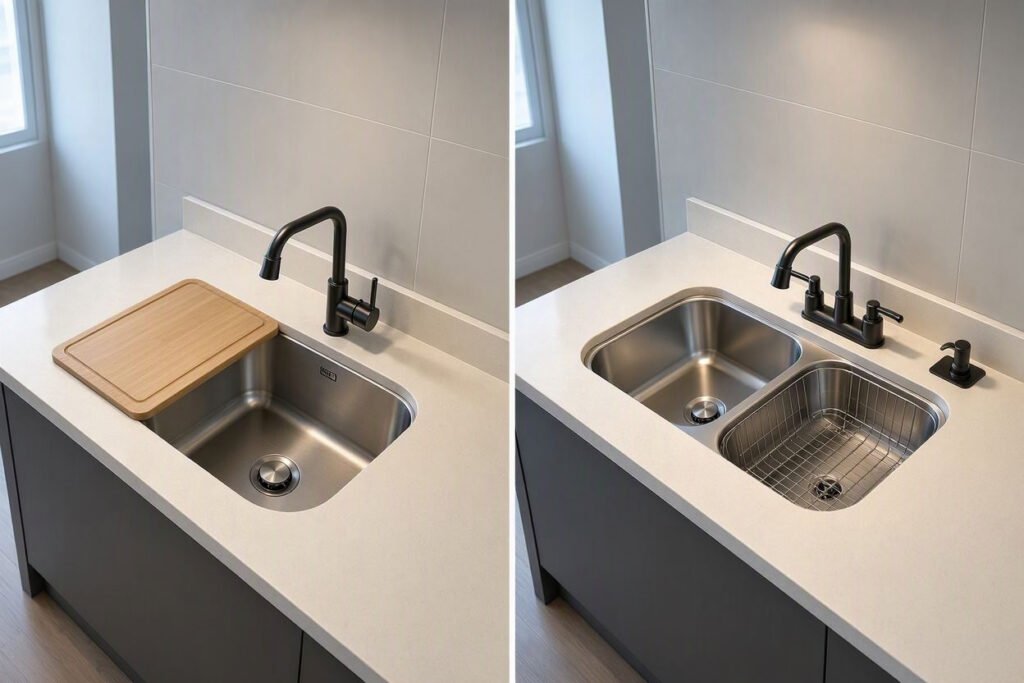
5. Choose Single Bowl or Double Bowl
Bowl configuration affects how much usable washing and preparation space you have.
Single-Bowl Sinks
A single bowl provides one continuous basin.
This can be useful when you prefer an uninterrupted washing area or need to make the most of a limited footprint.
Double-Bowl Sinks
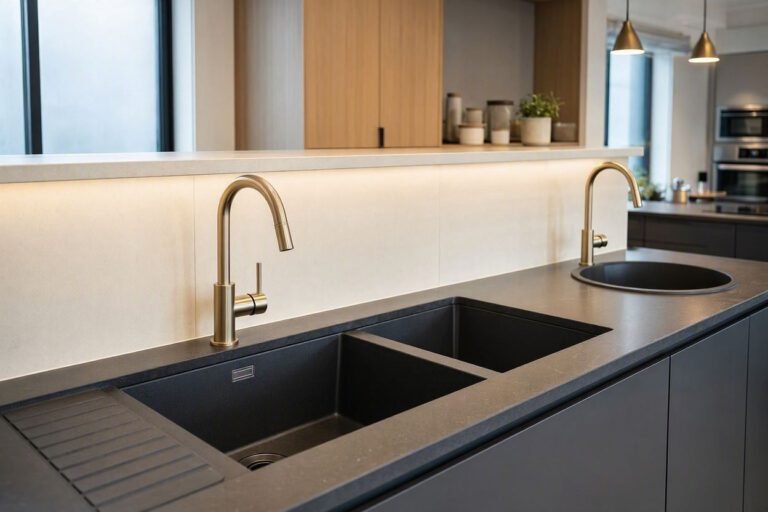
A double-bowl sink separates the basin into two sections.
This can allow different tasks to be performed in separate areas, but the divider also takes up space within the sink’s overall footprint.
If you’re comparing smaller double-bowl configurations, see our guide to small double bowl sink sizes.
Which Bowl Configuration Should You Choose?
Think about how you use the sink rather than choosing based only on appearance.
Ask:
- Do you wash large cookware?
- Do you prefer one uninterrupted basin?
- Do you separate washing and rinsing?
- How much countertop space can you give the sink?
- Does the cabinet accommodate the selected model?
6. Consider Sink Depth
Sink depth is another important factor, especially in a compact cabinet.
A deeper bowl can provide more vertical washing space, but it also extends farther into the cabinet below the countertop.
Before choosing a deep sink, check:
- Cabinet clearance
- Drain position
- Plumbing connections
- Garbage disposal clearance, if applicable
- Space around stored items beneath the sink
Do not assume that a deeper sink will automatically be more practical.
The best depth depends on your cabinet and how you use the sink.
7. Check Faucet Compatibility
The sink and faucet need to work together.
Check whether the sink:
- Has pre-drilled faucet holes
- Requires the faucet to be mounted separately
- Has one or multiple holes
- Has the correct hole spacing for your faucet
- Leaves enough space behind the basin
Some compact sinks have limited space around the faucet area, so check the actual sink design rather than assuming your existing faucet will transfer directly.
If you are replacing an existing sink, measure the faucet setup before ordering the new sink.
8. Check the Drain Position
Drain placement can affect both plumbing compatibility and usable cabinet space.
Look at:
- Drain location
- Drain opening size
- Existing drain pipe position
- Cabinet plumbing
- Garbage disposal requirements, if applicable
A sink with a different drain position may require plumbing changes even if the sink physically fits the countertop.
For a replacement project, compare the existing drain location with the new sink’s specifications before ordering.
9. Think About Maintenance Before You Buy
A sink should fit your cleaning routine as well as your kitchen.
Consider:
- How easy the basin is to wipe clean
- Corner shape
- Surface finish
- Material-specific care requirements
- Whether the manufacturer recommends specific cleaners
- Whether accessories such as grids need separate cleaning
A visually attractive sink can become inconvenient if its maintenance requirements do not fit your routine.
Always follow the manufacturer’s care instructions for the specific material and finish.
Small Kitchen Sinks to Consider
Once you have checked cabinet size, countertop space, installation method, bowl configuration, depth, faucet, and drain requirements, you can begin comparing specific sink models.
The examples below are not ranked as the best sinks. They are different product types that can help illustrate what to compare when shopping.
As an Amazon Associate, Tiny Sink Solutions earns from qualifying purchases.
1. VOKIM 20 × 19 Inch Drop-In Stainless Steel Bar Sink
The VOKIM model is a compact single-bowl, drop-in sink designed for countertop installation.
The supplied product listing describes a 20 × 19 × 9-inch exterior size and a stainless steel construction. It also lists two pre-drilled holes and a standard 3-1/2-inch drain opening.
This type of configuration may be worth comparing if you want a compact top-mount sink with a single basin.
Before purchasing: Verify the current Amazon listing for the exact dimensions, material specification, mounting details, drain opening, and included accessories.
🔗 Buy on Amazon2. 15 × 20 Inch Drop-In Stainless-Steel Sink
This compact single-bowl sink is listed with exterior dimensions of 15 × 20 × 9 inches and interior dimensions of 13 × 16 × 9 inches.
The supplied listing describes stainless steel construction and includes accessories such as a sink grid and drain components.
The product information supplied for this model contains a gauge inconsistency, so the gauge should not be stated here unless the current Amazon listing confirms it.
For shoppers considering a compact top-mount sink, the overall dimensions and bowl configuration are the more important starting points for fit.
🛒 Shop on Amazon3. ARTLINE 19.7 × 17.7 Inch Black Stainless-Steel Sink
The ARTLINE RXZE031 is listed as a compact black stainless steel sink with dimensions of approximately 19.7 × 17.7 inches.
The supplied product information describes a single-bowl configuration, a black finish, and a sloped basin design intended to direct water toward the drain.
If you are considering a dark or specialty-finish sink, compare the manufacturer’s cleaning and care instructions with your normal kitchen routine.
✅ View on Amazon4. Miuara 24 × 19 Inch Fireclay Sink
The Miuara model provides a different option for shoppers considering fireclay rather than stainless steel.
The supplied listing describes a 24-inch-wide, approximately 18.5-inch front-to-back exterior size and an approximately 10-inch internal bowl depth. It also specifies a minimum 27-inch base cabinet width.
The sink is described as supporting both undermount and top-mount installation.
Because fireclay is a heavier sink material, cabinet support and the manufacturer’s installation requirements should be checked carefully before purchase.
🔥 Check on AmazonImportant: Product specifications, configurations, included accessories, and availability can change. Confirm the current Amazon listing and manufacturer information before purchasing. Never rely on the product’s overall dimensions alone to determine whether it will fit your kitchen.
The 8-Point Small Sink Fit Check
Before ordering any small kitchen sink, work through this checklist.
1. Cabinet width
Confirm that your cabinet meets the sink manufacturer’s minimum requirement.
2. Overall sink dimensions
Compare the sink’s length and front-to-back dimensions with your available countertop space.
3. Countertop depth
Make sure the sink and faucet area can fit without interfering with the front or rear countertop edges.
4. Installation type
Confirm whether the sink is:
- Undermount
- Drop-in
- Another specified mounting style
5. Countertop cutout
Check the manufacturer’s required cutout dimensions.
If you’re planning a new opening, our sink cutout size calculator can help with preliminary planning, but manufacturer installation specifications should take priority.
6. Bowl depth and cabinet clearance
Make sure the bowl will not interfere with plumbing, disposal equipment, shelves, or other items below the counter.
7. Faucet and drain configuration
Check faucet holes, faucet placement, drain position, drain opening, and existing plumbing.
8. Material and support
Consider the sink material and whether your cabinet/countertop setup provides the required support.
Common Small Kitchen Sink Buying Mistakes
Choosing by overall dimensions alone
A sink’s advertised length and width do not tell you everything about installation compatibility.
You also need to consider the cutout, cabinet, depth, faucet, and plumbing.
Ignoring the manufacturer’s cabinet requirement
A sink can appear small enough for your countertop but still require more cabinet space underneath.
Assuming every sink uses the same cutout
Different sink designs and mounting methods can require different openings.
Always check the installation instructions.
Choosing a deeper sink without checking the cabinet
Depth affects the space below the countertop.
Measure the vertical clearance before choosing a deep basin.
Buying a material without considering maintenance
Different sink materials and finishes can have different care requirements.
Read the manufacturer’s cleaning guidance before choosing.
Assuming your existing faucet will fit
Faucet holes and spacing vary between sink designs.
Measure your existing setup and compare it with the new sink.
Adding a product before confirming the fit
A product can look suitable online but still be incompatible with your cabinet or countertop.
Fit should come before features.
Key Takeaways
A small kitchen sink should be selected based on fit and function, not just appearance.
Before buying:
- Measure the cabinet.
- Check the available countertop space.
- Understand overall sink dimensions versus cutout dimensions.
- Choose an appropriate mounting style.
- Decide between single and double bowl.
- Check bowl depth and under-counter clearance.
- Verify faucet and drain compatibility.
- Compare material and maintenance requirements.
- Check the manufacturer’s installation specifications.
- Confirm product details before purchasing.
The best approach is to work through the installation from the cabinet → countertop → cutout → sink → plumbing → material → product rather than choosing a sink first and trying to make it fit afterward.
Conclusion
Choosing a small kitchen sink becomes much easier when you treat it as a fit-and-compatibility decision rather than simply a product-shopping decision.
Start with the cabinet and countertop. Then check the cutout, mounting style, bowl configuration, depth, faucet, drain, and plumbing. After those requirements are clear, compare materials, finishes, maintenance, and available products.
If you’re replacing an existing sink, measure first and verify the manufacturer’s specifications before ordering. A few extra measurements can help prevent an expensive or inconvenient installation problem.
Frequently Asked Questions
What size sink is considered small for a kitchen?
There is no single universal dimension that defines a small kitchen sink. A sink is considered small relative to the available countertop, cabinet, and kitchen layout. Compact models can vary considerably in length, front-to-back size, and bowl depth.
How do I know what size sink fits my cabinet?
Measure the cabinet width and depth, then compare those measurements with the manufacturer’s minimum cabinet requirement for the sink. Also check the countertop cutout and clearance below the counter.
Is a single-bowl sink better for a small kitchen?
A single-bowl sink can make efficient use of a limited footprint because the entire basin is one continuous space. However, whether it is better depends on how you wash, rinse, and prepare food.
Are undermount sinks good for small kitchens?
An undermount sink can work well in a small kitchen when the countertop, cabinet, cutout, and sink are compatible. The installation requirements should be checked before choosing one.
How deep should a small kitchen sink be?
There is no single ideal depth. The appropriate depth depends on your cabinet clearance, plumbing arrangement, countertop, and how you use the sink. A deeper bowl requires more space below the countertop.
Can I replace a small kitchen sink without changing the countertop?
Sometimes. If the replacement sink uses a compatible existing cutout and mounting configuration, countertop modification may not be necessary. Always compare the old and new sink’s required cutout dimensions before ordering.
What should I measure before replacing a kitchen sink?
Measure the cabinet width and depth, countertop space, existing cutout, sink overall dimensions, bowl depth, faucet configuration, and drain position. These measurements help determine whether a replacement is physically and functionally compatible.
What is the most important thing to check before buying a small sink?
Fit is the first priority. Confirm the cabinet, countertop, cutout, sink dimensions, installation method, plumbing, faucet, and drain compatibility before comparing appearance or extra features.
Khadija is the writer and founder of Tiny Sink Solution. She creates practical guides about small kitchen sinks, faucets, and compact kitchen maintenance, helping homeowners and renters choose solutions for limited spaces. Some articles contain affiliate links, and as an Amazon Associate, she earns from qualifying purchases at no extra cost to readers
![Top [count] Gardening Blogs - OnToplist.com](https://www.ontoplist.com/images/ontoplist32.png?id=6aa4d0c493161)