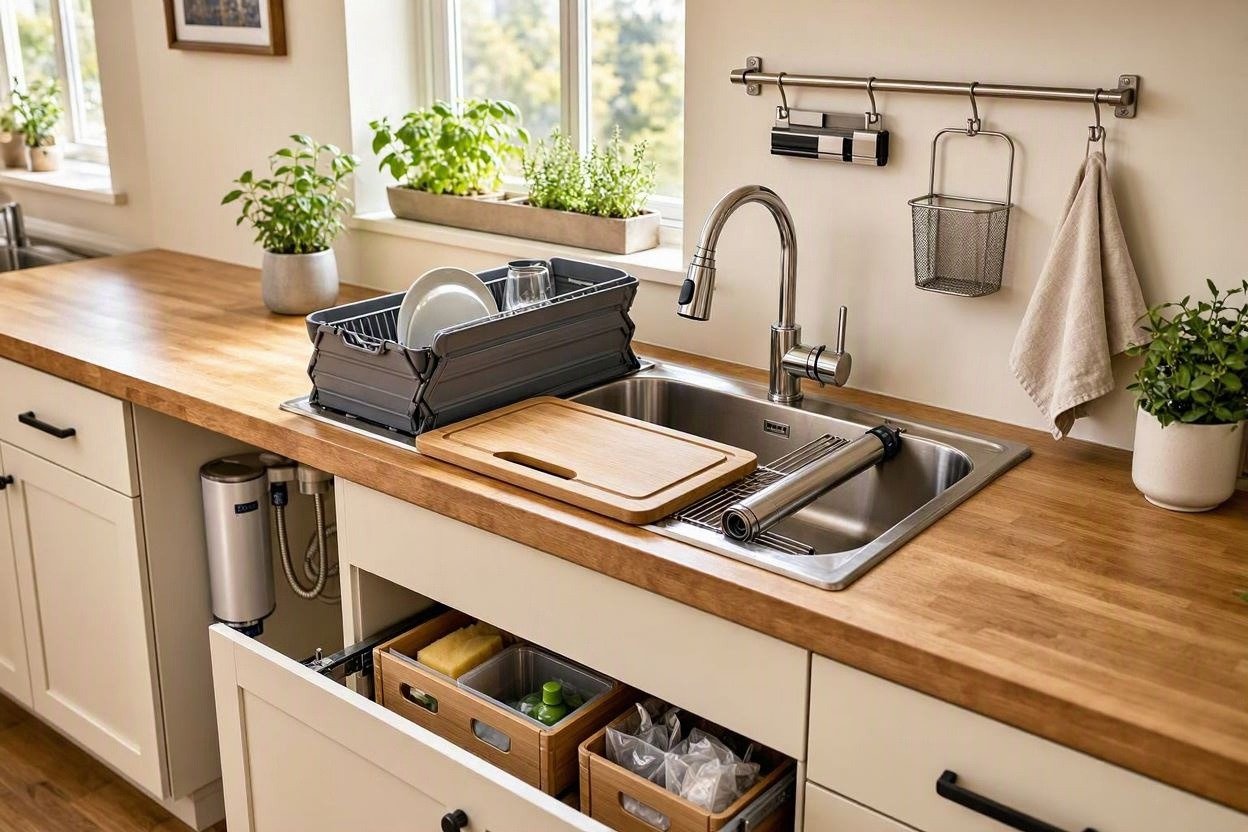
Small kitchens often lose valuable workspace around the sink. The good news is that small sink space optimization does not always require replacing the sink or remodeling the kitchen.
Simple changes to sink placement, counter organization, storage, faucet selection, and accessories can make the existing area more functional. The goal is to create enough room for washing, preparing food, drying dishes, and storing everyday items without overcrowding the countertop.
In this guide, you’ll find nine practical ways to make a compact sink area work more efficiently, including temporary workspace solutions, under-sink organization, drainboard alternatives, and space-conscious sink planning.
Quick Answer: How Do I Maximize Space Around a Small Sink?
To maximize space around a small sink, keep the surrounding countertop clear, create a dedicated prep area, use vertical or under-sink storage, and choose accessories that serve multiple purposes.
A roll-up drying rack, for example, can provide temporary drying or workspace over a compatible sink. Faucet size and placement also matter because the faucet should work with the sink without unnecessarily interfering with nearby counter space.
The key is to make the sink area serve your actual kitchen workflow rather than simply choosing the smallest possible sink.
1. Protect the Counter Space Around Your Sink
Counter space is often the most valuable resource in a compact kitchen. Even a small sink can make the surrounding area feel crowded when soap bottles, sponges, drying racks, utensils, and appliances occupy the countertop.
Start by identifying the counter space you actually use for food preparation.
Instead of permanently storing everything around the sink, keep only frequently used items within easy reach. Less frequently used tools can move to a cabinet, drawer, or other storage area.
A useful approach is to divide the countertop into simple zones:
- Washing zone: the sink and immediately surrounding area
- Prep zone: the clearest available counter space
- Drying zone: a drainboard or temporary drying rack
- Storage zone: items that can be moved off the countertop
The objective is not simply to make the sink smaller. It is to make the available countertop easier to use.
Quick Tip
Before buying another organizer, remove items that rarely get used. Reducing countertop clutter can create more usable workspace without changing the sink at all.
2. Choose Sink Placement That Supports Your Workflow
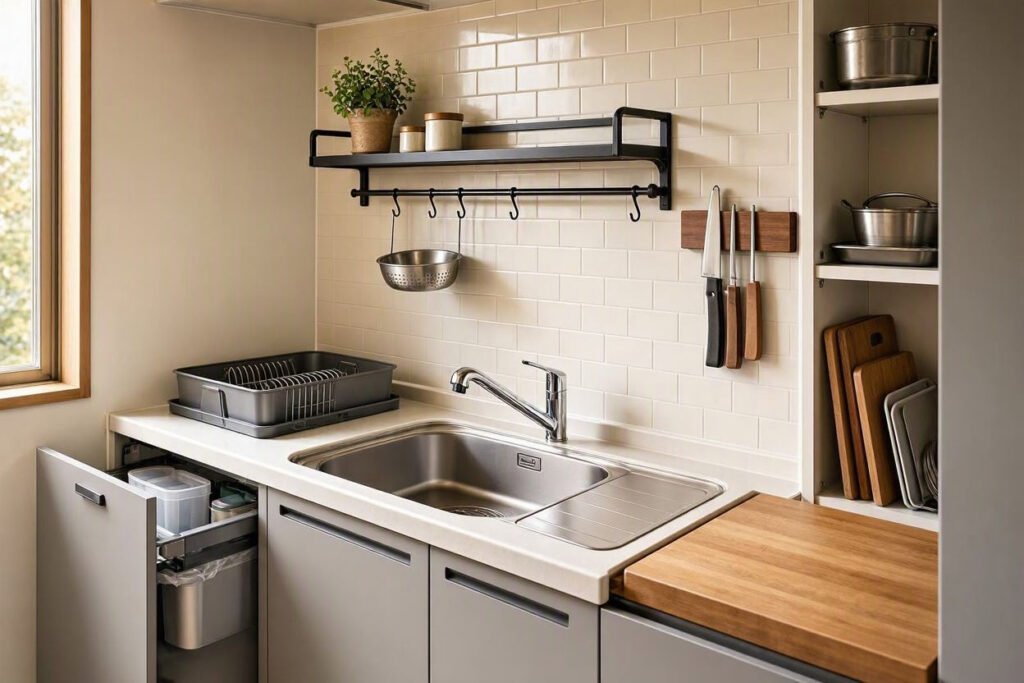
Sink placement can have a major effect on how efficiently a small kitchen works.
A sink placed beside your main preparation area can make washing produce and cleaning cookware easier without forcing you to move repeatedly between different parts of the kitchen.
When evaluating sink placement, consider:
- available counter space on each side
- proximity to the refrigerator
- proximity to the cooking area
- dishwasher location
- cabinet configuration
- plumbing location
- windows or walls that may affect faucet installation
- the direction in which cabinet and appliance doors open
There is no single sink location that works for every compact kitchen. The best arrangement depends on the room’s layout and how you use the kitchen.
For more detailed layout planning, see our small kitchen sink layout ideas.
Where Should a Sink Be Placed in a Small Kitchen?
A sink should be positioned where it provides convenient access to washing and food preparation while preserving useful counter space.
When planning the location, consider nearby appliances, cabinet space, plumbing, faucet clearance, and the amount of counter space available for preparation.
3. Turn the Sink Area Into Temporary Workspace
One of the easiest ways to improve a compact kitchen is to make the sink area serve more than one purpose.
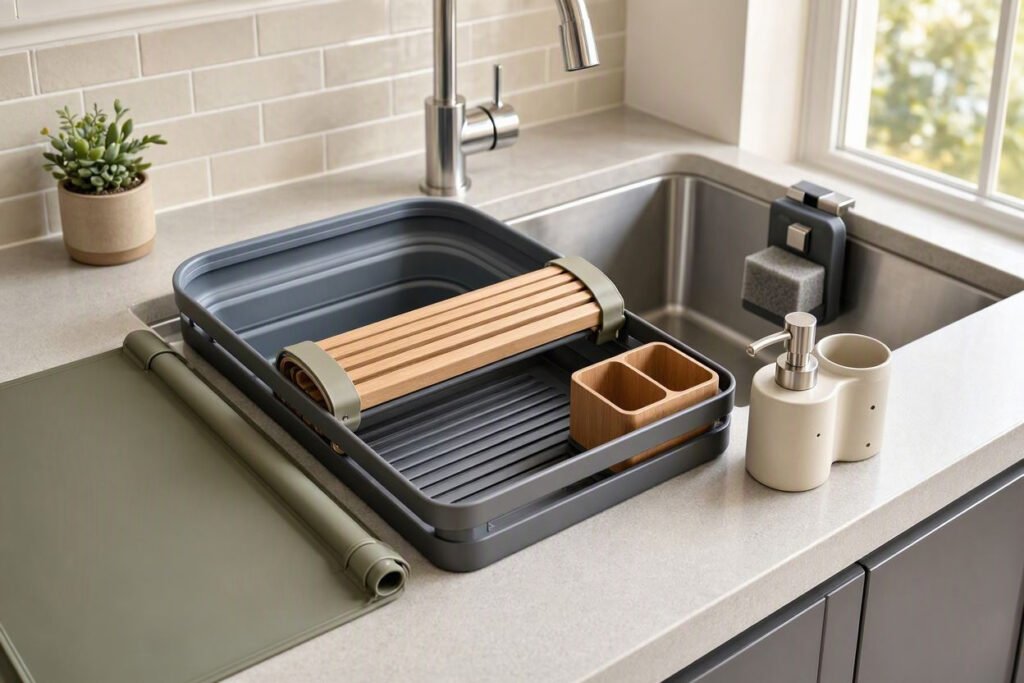
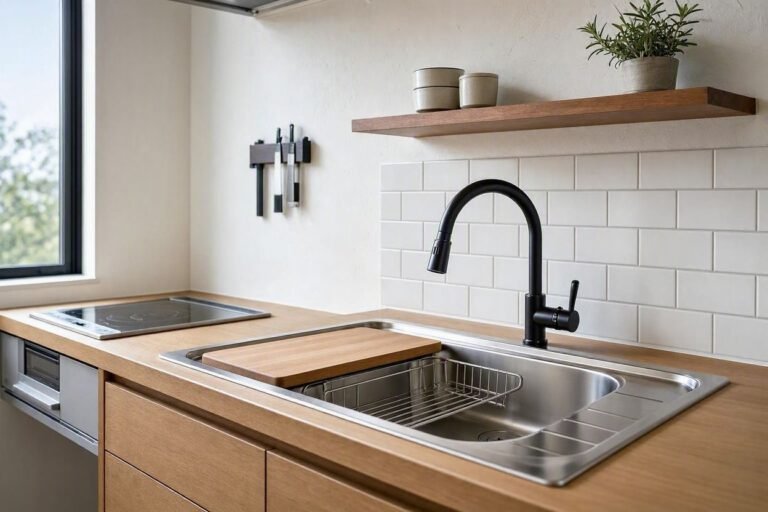
A compatible sink can sometimes support accessories that sit across the basin when needed. Depending on the accessory and sink design, these can include:
- roll-up drying racks
- sink-cover boards
- over-sink cutting boards
- removable colanders
- drying platforms
For example, a roll-up rack can provide a temporary place to dry dishes or rinse produce. When you need the sink for washing, it can be moved or rolled away.
This approach does not permanently increase your countertop area. Instead, it allows one part of the kitchen to perform multiple functions at different times.
Before Using an Over-Sink Accessory
Check:
- The accessory’s dimensions
- Your sink’s inside width and overall dimensions
- Whether the accessory is designed for your sink type
- Whether it sits securely during use
- Whether it leaves enough room for the task you’re performing
4. Choose Compact Sink Accessories That Earn Their Space
Accessories can either solve a space problem or create another one.
In a compact kitchen, an accessory should ideally perform more than one useful function or replace a larger item.
Useful categories include:
Roll-Up Drying Rack
A roll-up rack can provide temporary drying space over a compatible sink and can be stored when you need the area for another task.
Sink Caddy
A small caddy can keep sponges and cleaning tools contained rather than spreading them across the countertop.
Compact Colander
A removable colander can make use of the sink basin without requiring a separate countertop appliance or large bowl for certain tasks.
Over-Sink Cutting Board
A properly sized cutting board can create temporary prep space over the sink, provided it is designed to sit securely and does not interfere with the faucet.
Sink Grid
A sink grid can help separate dishes or cookware from the basin bottom, depending on the sink design.
The important principle is simple:
In a small kitchen, every accessory should have a clear job.
If an item does not save space, improve workflow, or replace another tool, it may not deserve permanent space around the sink.
For a deeper look at useful products and tools, see our sink accessories for small kitchens.
5. Improve Under-Sink Cabinet Organization
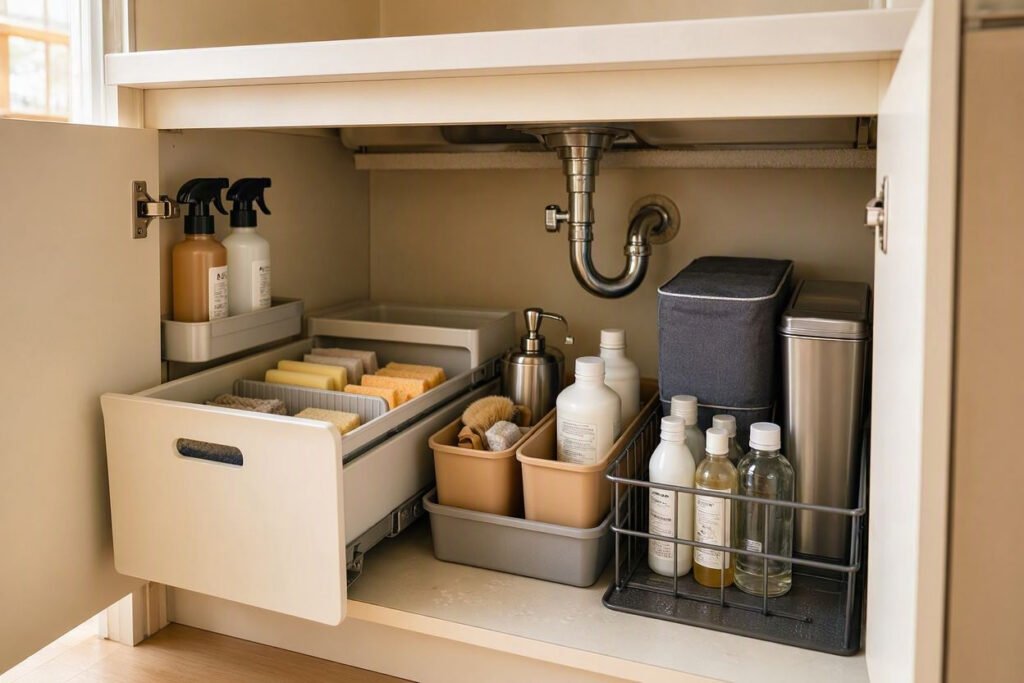
The cabinet underneath a sink can become difficult to organize because plumbing occupies part of the available space.
Instead of filling the cabinet randomly, organize the remaining space around the plumbing.
Useful approaches include:
- using vertical storage where the cabinet allows it
- grouping cleaning products together
- using slim organizers
- keeping frequently used items toward the front
- storing rarely used supplies farther back
- leaving access to shutoff valves and plumbing components
- avoiding containers that interfere with pipes
Before adding an organizer, measure the available cabinet space. The pipes, drain assembly, and other components determine how much storage area is actually usable.
How Do I Organize a Small Sink Cabinet?
Organize a small sink cabinet around the existing plumbing. Use vertical or slim storage where possible, group similar cleaning supplies together, and maintain enough clearance to access pipes, shutoff valves, and other plumbing components
6. Choose a Faucet That Preserves Usable Space
The faucet is another part of the sink area that can affect how the countertop feels and functions.
When choosing a faucet for a compact sink, consider:
- faucet height
- spout reach
- handle movement
- mounting location
- sink dimensions
- countertop space behind or beside the sink
- nearby wall or window clearance
- faucet-hole configuration
A faucet that is too tall or extends too far can make a compact sink area feel awkward, while a faucet with insufficient reach may make washing difficult.
The goal is not simply to choose the smallest faucet. Instead, choose a faucet that provides the reach and clearance you need without interfering with nearby workspace.
When replacing a sink and faucet together, make sure the faucet-hole configuration and mounting arrangement are compatible with the sink and countertop.
For a broader checklist covering faucet compatibility, cabinet fit, mounting, bowl configuration, and sink depth, see our small kitchen sink buying guide.

7. Use a Drainboard or Drying Area Strategically
A drying area can quickly consume countertop space in a small kitchen.
Traditional drainboards provide a dedicated place for dishes to dry, but they also occupy permanent space.
Another option is a removable or roll-up drying rack.
Permanent Drainboard
Advantages:
- always available
- dedicated drying area
- simple workflow
Considerations:
- occupies counter space
- may reduce available prep area
Removable Drying Rack
Advantages:
- can be stored when not needed
- can create temporary drying space
- may help keep the counter more flexible
Considerations:
- requires storage when not in use
- must be compatible with the sink
- available size varies by product
For a very compact kitchen, flexibility can be more valuable than having every function permanently installed.

8. Reduce Clutter Around the Sink
Sometimes the easiest form of small sink space optimization is simply removing unnecessary items.
Look at everything currently stored around your sink and ask:
Does this item save space, save time, or perform more than one job?
If the answer is no, consider moving it somewhere else.
Try these simple changes:
- Move rarely used appliances away from the sink.
- Store extra cleaning supplies under the sink.
- Use wall or vertical storage where appropriate.
- Keep only everyday soap and cleaning tools within reach.
- Combine tasks with multipurpose accessories.
- Avoid keeping several accessories that perform the same function.
- Create one dedicated location for sponges and brushes.
A clear countertop is easier to use and easier to clean.
The Small Sink Clutter Test
Before leaving an item on the counter, ask:
Is it used frequently enough to justify the space it occupies?
If not, move it to storage.
9. Match the Sink Size to the Space You Actually Have
Accessories and organization can improve a compact kitchen, but the sink itself still needs to fit the available space.
Before replacing your sink, compare:
- overall sink dimensions
- cabinet width
- cabinet depth
- countertop space
- countertop cutout
- bowl configuration
- bowl depth
- mounting type
- faucet configuration
- drain location
- plumbing clearance
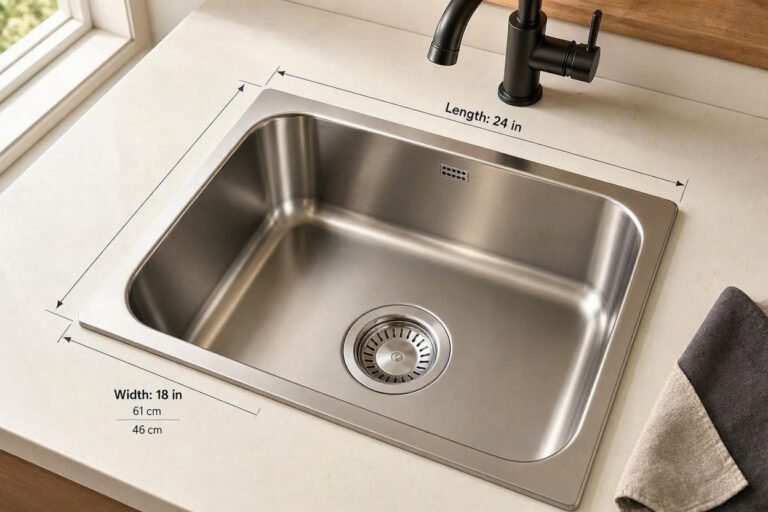
Remember that sink dimensions and countertop cutout dimensions are not necessarily the same. The manufacturer’s installation specifications or template should be used when determining the required opening. KOHLER installation documentation, for example, instructs users to compare the existing cutout with the required cutout and verify cabinet interference before installation. (kohler)
For a deeper explanation of sink measurements, see our small kitchen sink dimensions guide.
You can also use the cabinet size checker to help evaluate cabinet compatibility and our sink cutout size calculator when planning the countertop opening.
Does a Smaller Sink Always Save More Space?
Not necessarily.
A smaller sink can reduce the countertop footprint, but the best choice depends on the cabinet, countertop layout, bowl space, and how you use the kitchen.
A sink that is unnecessarily small may also reduce useful washing space. The goal is to find a size that fits the available area while still supporting your daily tasks.
The 5-Point Small Sink Space Check
Before changing your sink area, check these five things:
1. Counter
Where is your main food-preparation space?
2. Sink
Is the sink using more space than necessary for your daily tasks?
3. Storage
Can frequently used items be stored vertically, in drawers, or under the sink instead?
4. Workflow
Can you wash, prepare, and dry without constantly moving items around?
5. Accessories
Does each accessory save space or provide a useful second function?
This simple check can help you identify the biggest space problem before spending money on new equipment.
Small Sink Space Optimization Checklist
Use this checklist when improving your sink area:
- Keep the main prep area clear
- Review the sink’s placement
- Remove unnecessary countertop items
- Use vertical storage where practical
- Organize the cabinet around plumbing
- Consider a temporary drying solution
- Choose compact multifunctional accessories
- Check faucet reach and clearance
- Consider drainboard space
- Verify sink dimensions before replacement
- Check cabinet compatibility
- Verify countertop cutout requirements
Frequently Asked Questions
How Do I Maximize Counter Space Around a Small Kitchen Sink?
Keep the area around the sink free from unnecessary items and use accessories that create temporary workspace or drying space. Vertical storage, under-sink organization, and a properly sized faucet can also help preserve usable counter space.
What Accessories Save Space Around a Small Sink?
Useful options can include roll-up drying racks, over-sink cutting boards, compact colanders, sink caddies, and other multifunctional accessories. The accessory should be properly sized for the sink and have a clear purpose.
How Can I Organize a Small Sink Cabinet?
Work around the existing plumbing rather than trying to fill every part of the cabinet. Use slim or vertical organizers where appropriate, group similar supplies together, and maintain access to plumbing and shutoff valves.
Does Faucet Size Matter in a Small Kitchen?
Yes. Faucet height, reach, handle movement, and mounting location can affect the amount of usable space around a compact sink. Check faucet and sink compatibility before installation.
Is a Drainboard Useful in a Small Kitchen?
A drainboard can provide a dedicated drying area, but it also occupies counter space. A removable or roll-up drying rack can provide more flexibility when countertop space is limited.
Can I Use a Cutting Board Over My Sink?
A cutting board designed to sit securely over a compatible sink can provide temporary preparation space. Check its dimensions and stability before use, and avoid using an accessory that interferes with the faucet or does not sit securely.
Does a Smaller Sink Always Create More Counter Space?
A smaller sink can reduce the amount of countertop occupied by the basin, but the smallest possible sink is not automatically the best choice. The sink should still provide enough usable bowl space for your normal tasks and fit the cabinet and plumbing requirements.
What Is the Easiest Way to Improve a Small Sink Area?
Start by removing unnecessary countertop clutter and organizing the space you already have. Then consider multifunctional accessories, under-sink storage, faucet clearance, and sink placement before deciding whether a sink replacement is necessary.
Key Takeaways
Small sink space optimization is mainly about making limited space work more efficiently.
The most useful improvements are:
- Protect your main counter space.
- Plan sink placement around your workflow.
- Use the sink for temporary workspace when appropriate.
- Choose accessories that earn their space.
- Organize the cabinet around plumbing.
- Select a faucet with practical reach and clearance.
- Use flexible drying solutions when counter space is limited.
- Remove unnecessary clutter.
- Check sink dimensions and cabinet compatibility before replacing the sink.
You do not necessarily need a major kitchen remodel to improve a compact sink area. Small changes in organization, accessories, and workflow can make the available space more practical.
Conclusion
A compact kitchen does not have to feel cramped around the sink. With thoughtful small sink space optimization, you can protect valuable counter space, improve storage, create temporary workspace, and make everyday washing and food preparation more convenient.
Start with the space you already have, identify the biggest source of clutter or wasted space, and then make changes that support your actual kitchen workflow.
Get Helpful Sink Tips
Subscribe for practical sink planning tips and helpful resources for small kitchens and compact spaces.
Khadija is the writer and founder of Tiny Sink Solution. She creates practical guides about small kitchen sinks, faucets, and compact kitchen maintenance, helping homeowners and renters choose solutions for limited spaces. Some articles contain affiliate links, and as an Amazon Associate, she earns from qualifying purchases at no extra cost to readers



3 Comments