
A stainless steel sink is practical for a compact kitchen, but regular care helps keep the surface clean and reduces water spots, residue, and unnecessary scratches. The good news is that stainless steel small kitchen sink maintenance does not have to be complicated.
The key is to use a simple routine: rinse, clean, rinse again, and dry. You should also pay attention to the sink’s finish and follow the manufacturer’s care instructions before using specialized cleaning products.
Quick Answer: How Do You Maintain a Stainless Steel Kitchen Sink?
To maintain a stainless steel small kitchen sink, rinse away food residue after use, clean the surface with a suitable non-abrasive cleaner, follow the direction of the stainless steel grain when the finish has a directional pattern, rinse thoroughly, and dry the sink to help reduce water spots. Avoid harsh or abrasive products that may damage the finish, and always check the manufacturer’s care instructions for your specific sink.
1. Rinse Your Stainless Steel Sink After Daily Use
One of the easiest ways to maintain a stainless steel sink is to rinse it after using it.
Food particles, soap residue, and other debris can remain around the basin, drain opening, corners, or edges if they are not removed. In a small sink, these areas can become noticeable quickly because the working surface is compact.
After washing dishes or preparing food:
- Remove food debris from the basin.
- Rinse the sink with clean water.
- Pay attention to the area around the drain.
- Wipe away obvious residue when necessary.
- Dry the surface if practical.
This simple routine helps prevent residue from sitting on the stainless steel surface for long periods.
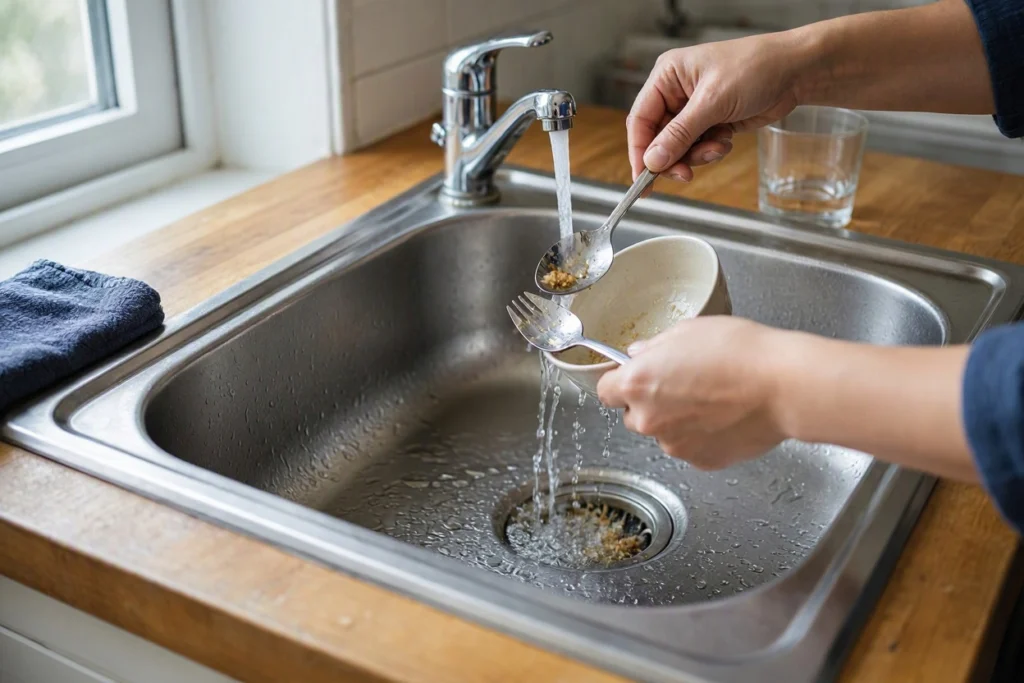
A Simple 4-Step Stainless Steel Sink Care Routine
RINSE → CLEAN → RINSE → DRY
This routine is easy to remember and works well as a basic starting point for everyday sink care.
2. Clean the Sink Regularly With a Suitable Cleaner
Daily rinsing is useful, but it does not replace regular cleaning.
For routine small stainless steel sink cleaning, use a cleaner that is appropriate for stainless steel and compatible with your sink’s finish. A soft sponge or other suitable non-abrasive cleaning tool can help remove normal food residue and buildup without unnecessarily scratching the surface.
Use a cleaner specifically labeled as suitable for stainless steel and compatible with your sink’s finish. A soft sponge or other non-abrasive cleaning tool is usually a better choice than aggressive scrubbing. Always follow the sink manufacturer’s care and cleaning instructions for your specific finish.
Apply the cleaner according to its instructions rather than assuming that a product is safe for every stainless steel finish.
If you are also planning a new compact sink, our small kitchen sink buying guide explains how size, material, mounting type, bowl configuration, and depth can affect your choice.
How Often Should I Clean a Stainless Steel Sink?
Clean your stainless steel sink whenever residue or buildup appears, with a more thorough cleaning as needed based on how frequently the sink is used.
A busy kitchen may require more frequent cleaning than a sink that is used occasionally. The important point is to avoid allowing food residue, soap deposits, or other buildup to remain on the surface unnecessarily.
If your sink manufacturer provides a specific cleaning schedule or product recommendation, follow those instructions.
3. Always Clean in the Direction of the Grain
Some stainless steel sinks, particularly those with brushed or directional finishes, have a visible grain.
When your sink has a directional grain, clean with the grain rather than across it.
This approach can help keep cleaning marks consistent with the existing finish.

Should You Clean Stainless Steel With the Grain?
Yes, when the stainless steel has a directional grain, clean in the same direction as the existing finish.
Look closely at the surface before cleaning so you can identify the direction of the grain. Then move your sponge or cloth along that direction instead of using random circular scrubbing motions.
If your sink has a different type of finish, follow the manufacturer’s cleaning instructions.
4. Dry the Sink to Help Prevent Water Spots
Water left on stainless steel can dry and leave behind visible mineral residue, particularly where the local water contains more dissolved minerals.
That is why drying is an important part of stainless steel sink care.
After rinsing:
- Use a clean microfiber cloth or another suitable soft cloth.
- Wipe away remaining water.
- Pay attention to the bottom and corners of the basin.
- Dry around the drain and edges where water can collect.

How Do I Prevent Water Spots on a Stainless Steel Sink?
The simplest approach is to rinse the sink and dry the surface after cleaning or heavy use. Drying removes remaining water before it evaporates and leaves mineral residue behind.
If water spots continue to appear, clean them using a product specifically intended to be compatible with your sink’s stainless steel finish. Check the manufacturer’s care instructions before using a specialized mineral-deposit cleaner.
5. Protect the Surface From Scratches
Stainless steel is durable, but it is not scratch-proof.
Small scratches can occur through normal use, especially when hard or abrasive objects are dragged across the sink.
To help prevent unnecessary scratches:
- Avoid dragging heavy cookware across the basin.
- Use a suitable sink grid or protective accessory if recommended for your sink.
- Lift cookware instead of sliding it across the surface.
- Use appropriate non-abrasive cleaning tools.
- Avoid aggressive scrubbing.
- Keep abrasive materials away from the sink surface.
A scratch does not necessarily mean the sink is damaged or unusable. Stainless steel surfaces can develop marks through everyday use. The goal is to avoid creating unnecessary scratches while maintaining the finish.
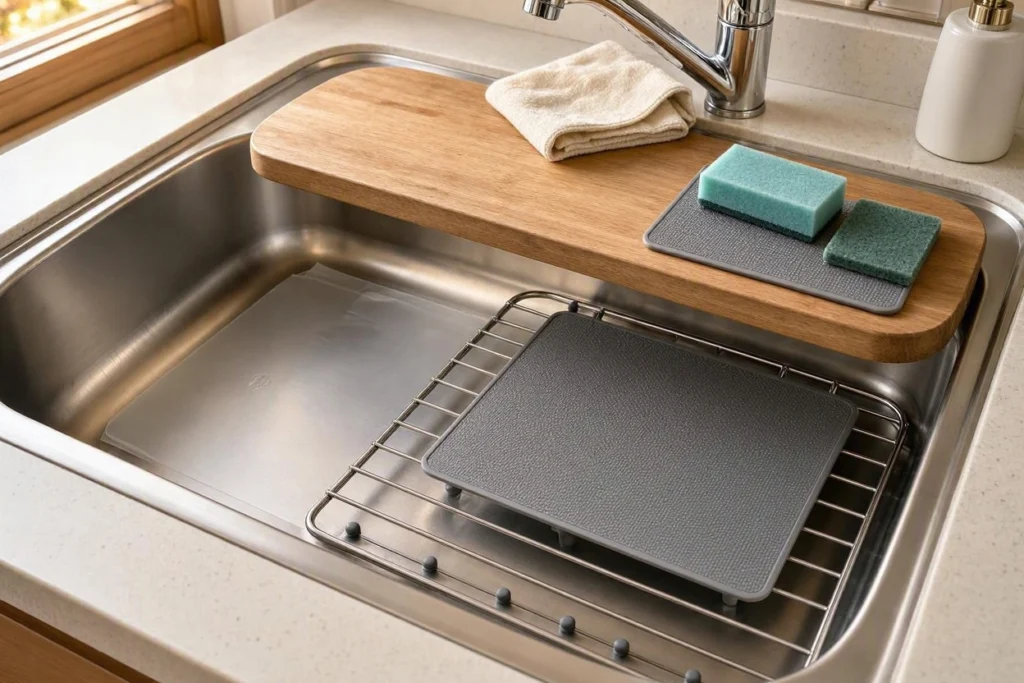
How Do I Prevent Scratches on a Stainless Steel Sink?
Use soft, suitable cleaning tools, avoid abrasive pads and steel wool, and do not drag heavy cookware across the sink.
For brushed or directional finishes, cleaning with the grain can also help keep surface marks consistent with the existing finish.
6. Know What Cleaning Products to Avoid
Choosing the wrong cleaning product can be more damaging than skipping a cleaning session.
For general stainless steel sink maintenance, avoid products or tools that are abrasive or not intended for your particular sink finish.
Be especially careful with:
- Steel wool
- Harsh abrasive pads
- Abrasive powders
- Cleaners that are not intended for stainless steel
- Prolonged exposure to harsh chemicals
- Products specifically prohibited by the sink manufacturer

Can I Use Abrasive Cleaners on Stainless Steel?
Do not assume that an abrasive cleaner is safe simply because the sink is made from stainless steel.
Abrasive products can leave scratches or affect the appearance of some finishes. Instead, choose a suitable cleaner and cleaning tool based on the sink manufacturer’s instructions.
What About Bleach or Chlorine Products?
Do not use bleach or chlorine-based products unless the manufacturer specifically indicates that they are suitable for your sink and finish.
Most importantly, never mix cleaning products together. Different cleaners can react with one another and create dangerous fumes or other hazards.
When in doubt, check the sink manufacturer’s care instructions before applying a chemical cleaner.
7. Deal With Water Spots and Mineral Deposits Carefully
Water spots are usually a surface-cleaning issue rather than a reason to replace the sink.
Start with gentle cleaning and thorough rinsing. Dry the surface afterward to reduce the chance of additional mineral residue.
If mineral deposits have already accumulated, use a product specifically designed for the type of stainless steel surface you have and follow both the product instructions and sink manufacturer’s recommendations.
Avoid aggressive scrubbing simply because a deposit is difficult to remove.
Are Water Spots the Same as Stainless Steel Damage?
Not necessarily.
A visible spot may be leftover mineral residue from water evaporation, while discoloration, scratches, or changes in the finish may have a different cause.
Start with appropriate routine cleaning before assuming the stainless steel itself has been permanently damaged.
8. Keep the Drain and Sink Bottom Clean
The drain area deserves special attention because food particles and residue can collect around it.
When cleaning your small sink, check:
- Around the drain opening
- The bottom of the basin
- Corners
- Basin edges
- Areas underneath a sink strainer or basket
- Areas beneath a removable sink grid
Remove visible food debris before cleaning the surface.
If you use a sink grid or basket strainer, clean those accessories according to their own care instructions as well. Keeping the accessories clean helps prevent residue from being transferred back onto the sink.
For more ideas on making a compact sink area work efficiently, see our small sink space optimization guide.
9. Build a Long-Term Stainless Steel Care Routine
Consistent maintenance is easier than trying to remove heavy buildup later.
A simple routine can look like this:
After Daily Use
Rinse → Remove debris → Wipe residue → Dry when practical
You do not necessarily need a deep cleaning every time you use the sink. The goal is simply to prevent food and other residue from sitting on the surface.
Weekly or As Needed
Give the sink a more thorough cleaning.
Pay attention to:
- The entire basin
- Drain area
- Corners
- Water spots
- Visible residue
- Areas around sink accessories
Occasionally
Inspect the sink’s finish and accessories.
Look for:
- New scratches
- Persistent discoloration
- Mineral buildup
- Worn or damaged accessories
- Areas that require special cleaning
If you notice a cleaning problem that routine care does not resolve, check the manufacturer’s care instructions before trying stronger products.
Stainless Steel Sink Maintenance Checklist
| Task | Why It Matters |
|---|---|
| Rinse after use | Removes loose food and residue |
| Clean regularly | Prevents buildup |
| Clean with the grain | Helps maintain directional finishes |
| Rinse thoroughly | Removes cleaner residue |
| Dry the surface | Helps reduce water spots |
| Use non-abrasive tools | Helps reduce unnecessary scratches |
| Avoid steel wool | Can scratch the surface |
| Check cleaning-product compatibility | Protects the sink’s finish |
| Clean around the drain | Removes trapped food and residue |
| Follow manufacturer instructions | Accounts for sink-specific finishes and care |
If you’re still deciding what size sink is practical for your kitchen, our small kitchen sink dimensions guide covers common measurements, cabinet requirements, sink depth, and other fit considerations.
Common Stainless Steel Sink Maintenance Mistakes
Even a simple cleaning routine can go wrong if the wrong tools or habits are used.
1. Scrubbing Too Aggressively
More pressure does not necessarily mean a cleaner sink. Aggressive scrubbing can create unnecessary surface marks.
2. Ignoring the Grain
If the sink has a directional finish, random scrubbing can make cleaning marks more noticeable.
3. Leaving Water on the Surface
Allowing water to evaporate repeatedly can contribute to visible water spots and mineral residue.
4. Using Steel Wool
Steel wool can scratch stainless steel, so it is not a good general-purpose cleaning choice.
5. Using an Unverified Chemical Cleaner
A product that works on one stainless steel surface may not be appropriate for another finish. Check the manufacturer’s instructions first.
6. Forgetting the Drain Area
The drain and surrounding areas can collect food particles and residue even when the rest of the basin looks clean.
Key Takeaways
Good stainless steel small kitchen sink maintenance comes down to a few consistent habits:
- Rinse away food and residue after use.
- Clean regularly with a suitable stainless steel cleaner.
- Follow the grain when the sink has a directional finish.
- Dry the surface to help reduce water spots.
- Avoid steel wool and harsh abrasive cleaning tools.
- Do not assume every chemical cleaner is safe for every finish.
- Give the drain area and corners regular attention.
- Follow the manufacturer’s specific care instructions.
For a compact kitchen, keeping the sink clean and dry is one of the simplest ways to maintain the appearance of the workspace.
FAQs
How do you maintain a stainless steel kitchen sink?
Rinse the sink after use, clean it regularly with a suitable cleaner, follow the grain on directional finishes, rinse thoroughly, and dry the surface. Avoid abrasive products and follow the manufacturer’s care instructions.
How do I prevent water spots on a stainless steel sink?
Dry the sink after cleaning or heavy use to reduce the amount of water left on the surface. If mineral residue develops, use a compatible cleaning product according to the sink and product manufacturer’s instructions.
Should I clean stainless steel with the grain?
If the sink has a brushed or directional finish, clean in the direction of the grain. This helps keep cleaning marks consistent with the existing surface pattern.
How do I prevent scratches on a stainless steel sink?
Avoid steel wool, abrasive pads, and aggressive scrubbing. Do not drag heavy cookware across the basin, and use suitable non-abrasive cleaning tools.
What should I not use on a stainless steel sink?
Avoid steel wool, harsh abrasive products, and cleaners that are not approved or intended for your sink’s finish. Always check the manufacturer’s care instructions.
Can I use abrasive cleaners on stainless steel?
Do not assume abrasive cleaners are safe for your sink. They can scratch or affect some stainless steel finishes. Choose a cleaner and tool appropriate for the sink’s finish.
How often should I clean a stainless steel sink?
Clean it whenever residue or buildup appears, with a more thorough cleaning as needed depending on how frequently the sink is used.
How do I remove stains from a stainless steel sink?
Start with gentle cleaning using a product appropriate for stainless steel. If the stain remains, check the manufacturer’s care instructions before using a specialized stain or mineral-deposit product.
How do I keep a stainless steel sink looking new?
Regular rinsing, suitable cleaning, drying, scratch prevention, and following the manufacturer’s care instructions can help maintain the sink’s appearance over time.
How do I care for a brushed stainless steel sink?
Clean with the direction of the brushed grain, use suitable non-abrasive products, rinse thoroughly, and dry the surface. Avoid abrasive tools that can create unwanted scratches.
Conclusion
Maintaining a stainless steel small kitchen sink is mostly about consistency rather than complicated cleaning methods.
Rinse, clean, rinse, and dry is a practical routine for everyday care. Add scratch prevention, careful product selection, and regular attention to the drain area, and you can keep your compact stainless steel sink cleaner and better maintained over time.
For sink-specific cleaning questions, always give the manufacturer’s care instructions priority because stainless steel finishes and recommended cleaning methods can vary
Get Helpful Sink Tips
Subscribe for practical sink planning tips and helpful resources for small kitchens and compact spaces.

Khadija is the writer and founder of Tiny Sink Solution. She creates practical guides about small kitchen sinks, faucets, and compact kitchen maintenance, helping homeowners and renters choose solutions for limited spaces. Some articles contain affiliate links, and as an Amazon Associate, she earns from qualifying purchases at no extra cost to readers



2 Comments