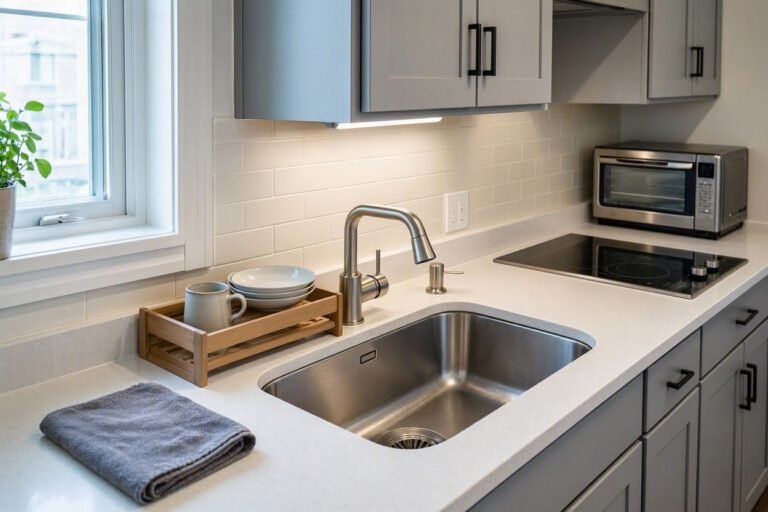
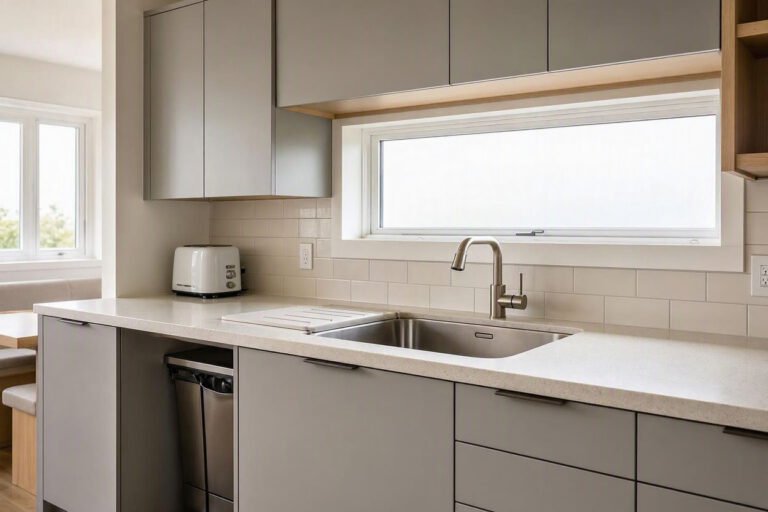
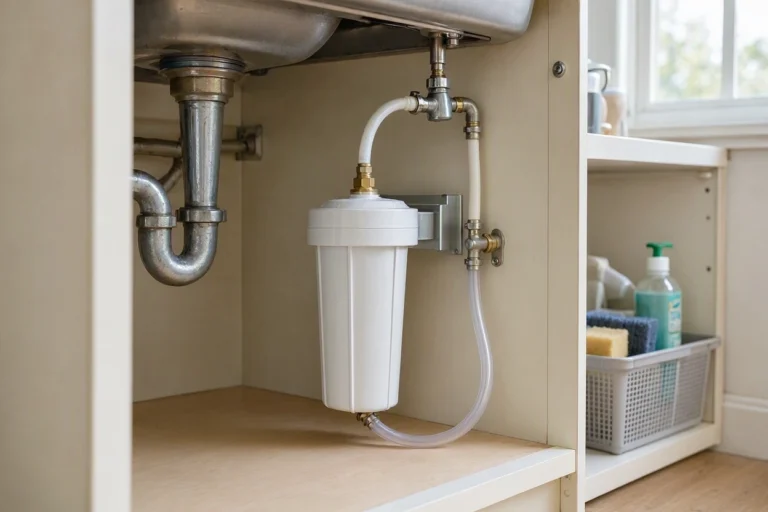
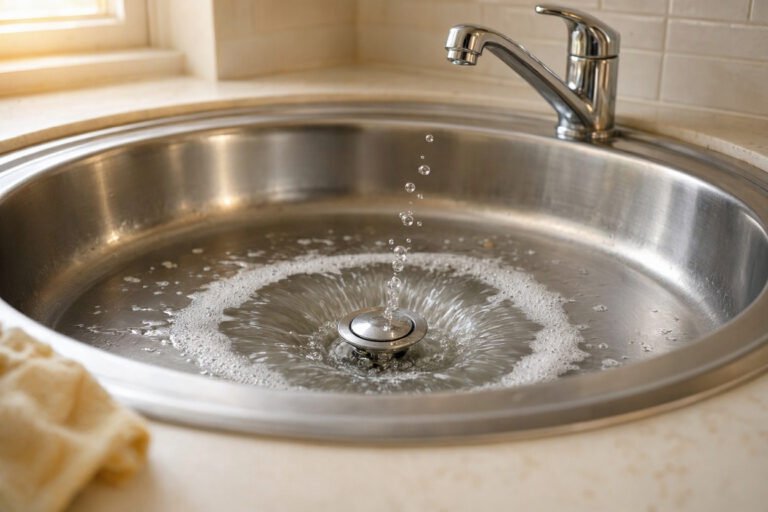
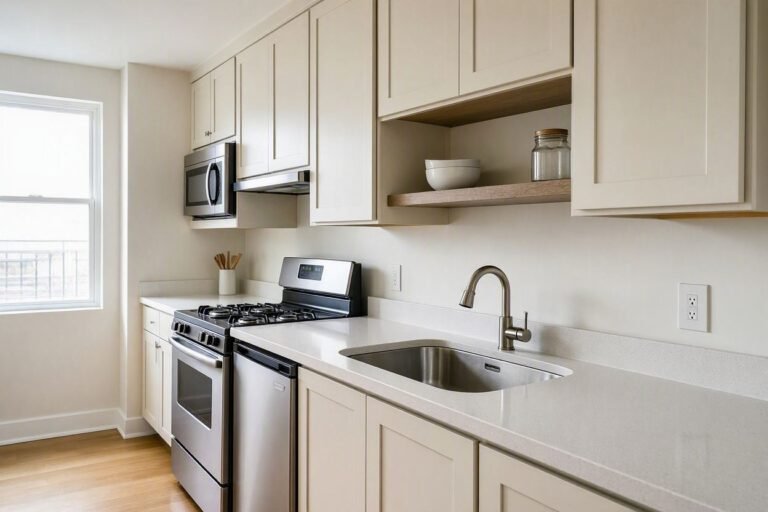
A kitchen sink and garbage disposal need to work together properly for a successful installation. Before buying either one, check the drain opening, mounting assembly, sink thickness, cabinet clearance, and plumbing connections. These details matter even more in compact kitchens, where a deep sink bowl can leave limited room beneath the cabinet.
This guide explains kitchen sink garbage disposal compatibility, what to measure before purchasing, and how to compare disposal models without overlooking important installation requirements. You will also learn what to check when replacing an existing disposal or adding one to a small kitchen sink.
Quick Answer: Can Any Kitchen Sink Work With a Garbage Disposal?
Many standard kitchen sinks can accommodate a garbage disposal, but compatibility depends on the sink opening, mounting system, sink thickness, available cabinet space, and the requirements of the selected model.
A standard 3.5-inch sink opening is common for residential disposals, including many InSinkErator models. However, you should confirm the required opening and mounting hardware in the manufacturer’s documentation before buying. Special flanges or mounting components may be necessary for some installations.
Check these six things first:
- Drain opening: Does the sink opening match the disposal’s requirements?
- Mounting assembly: Will the supplied flange and mounting hardware fit the sink?
- Sink thickness: Can the assembly secure the sink properly?
- Cabinet clearance: Is there enough room for the complete disposal and connected pipes?
- Plumbing: Can the discharge outlet connect correctly to the drain and dishwasher, if applicable?
- Electrical supply: Is the correct power connection available?
The safest approach is to check the sink specifications and the exact disposal installation manual before ordering.
1. How to Check Kitchen Sink Garbage Disposal Compatibility
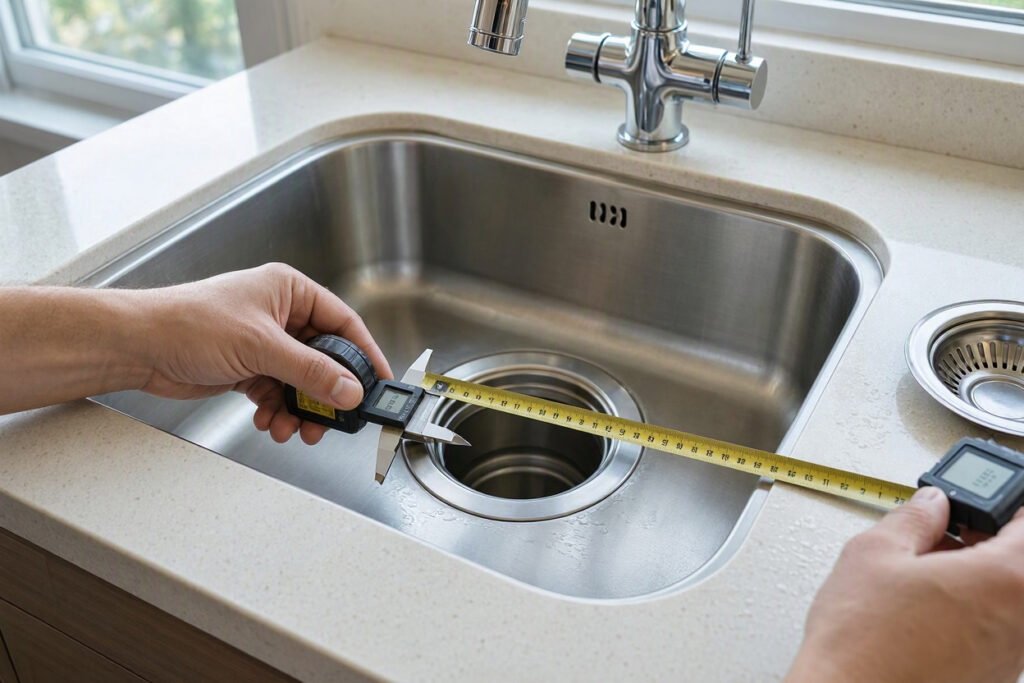
Measure the drain opening
Start by checking the diameter of the sink’s drain opening. Many residential garbage disposals use a flange designed for a standard 3.5-inch opening, but the exact requirement can vary.
If your sink is already installed, look for its product specifications or technical drawing. If the drain assembly must be removed to obtain an accurate measurement, have the work done safely and turn off the relevant water and electrical supplies as appropriate.
Do not measure only the visible rim of the strainer and assume that the result represents the opening required by the disposal.
Compact bar sinks, prep sinks, RV sinks, and imported sinks deserve particular attention because their drain assemblies may differ from common residential designs.
What to do: Record the actual opening size and compare it with the disposal manufacturer’s specifications. Do not assume an adapter will solve every mismatch.
Check the mounting assembly
A garbage disposal typically attaches beneath the sink through a flange and mounting assembly. The parts must be compatible with the disposal and suitable for the sink’s construction.
Two products can use similar-looking drain openings but different mounting systems. This is especially important when replacing an existing disposal.
Before reusing an old mounting assembly, check the manufacturer’s replacement instructions. Reuse it only if the manufacturer confirms compatibility and the hardware is in good condition.
What to do: Confirm which flange, mounting ring, gaskets, screws, and other components are included with the disposal. Check whether additional hardware is needed.
Confirm sink thickness
Sink thickness can affect how securely the mounting assembly attaches to the basin.
Stainless steel sinks are often relatively thin around the drain opening, while some fireclay, cast iron, ceramic, and composite sinks can be thicker. Requirements depend on the particular sink and mounting design, not just the material name.
For example, InSinkErator’s EZ Connect installation instructions specify different screws for sinks thicker than 3/8 inch. That is a model-specific instruction, not a universal rule for every disposal.
What to do: Measure the thickness around the drain opening and check the installation manual for permitted thickness and approved accessories.
2. Do Sink Material and Style Matter?
Yes. Material, thickness, mounting requirements, and the manufacturer’s instructions can all affect installation.
| Sink Type | What to Check |
|---|---|
| Stainless steel | Drain opening, flange fit, sink thickness, and cabinet space |
| Granite composite | Opening dimensions, material thickness, and approved sealing method |
| Fireclay | Thickness around the drain and manufacturer-approved mounting hardware |
| Cast iron or enameled sink | Mounting requirements, weight support, and approved installation method |
| Farmhouse or apron-front sink | Drain-area thickness, basin depth, and cabinet clearance |
| Bar or prep sink | Actual drain opening and availability of a compatible flange |
These are general checks rather than guarantees of compatibility.
For ceramic, fireclay, and other potentially delicate sinks, follow both manufacturers’ recommendations for installation and vibration. Do not assume that every sink material needs the same hardware or sealing method.
3. How Much Cabinet Space Does a Garbage Disposal Need?
A disposal needs more than enough space for its motor housing. You must also account for the discharge elbow, drain trap, dishwasher hose, electrical connection, and access for future maintenance.
This is particularly important in small kitchens. A deep sink bowl can extend farther into the cabinet and reduce the space available beneath it.
Measure the following before choosing a model:
- Vertical clearance: Space from the underside of the sink to the cabinet floor or any obstruction.
- Horizontal clearance: Space between the planned disposal position and the cabinet walls, drawers, or existing pipes.
- Outlet position: The location where the disposal’s discharge pipe meets the drain system.
- Sink bowl depth: How far the basin extends below the countertop.
- Service access: Whether you can reach the mounting assembly, connections, and reset button if the model has one.
Compare these measurements with the manufacturer’s complete dimensional drawing. Include connected plumbing in your planning rather than measuring only the disposal housin
Read our Small Kitchen Sink Dimensions: Complete Size Guide for help understanding sink dimensions before planning a compact installation.

4. Plumbing and Electrical Requirements
Drain and P-trap connections
The disposal’s discharge outlet must connect properly to the kitchen drain system. The outlet position and supplied elbow can affect whether the existing plumbing will fit.
If the drain connection is too high, too low, or poorly aligned, plumbing changes may be necessary. Avoid forcing pipes into position or creating an arrangement that prevents proper drainage.
Dishwasher connection
If your dishwasher drains through the disposal, verify that the selected model has the required dishwasher inlet and follow the manufacturer’s instructions.
Some disposals have a knockout plug in the dishwasher inlet that must be removed before the hose is connected. The installation procedure depends on the model. Applicable plumbing codes may also require an air gap or another approved backflow-prevention arrangement.
Electrical supply
Check the disposal’s voltage, wiring requirements, and whether the selected version includes a power cord. Some models are supplied with a cord, while others may require a compatible cord kit or hardwired connection.
Any new wiring or electrical modifications should comply with local codes and be completed by a qualified electrician when required.
Safety note: Disconnect power before servicing an existing disposal. Never place your hand inside the grinding chamber.
Consult the official InSinkErator garbage disposal installation guide for manufacturer instructions and installation manuals.
5. Can You Install a Garbage Disposal in a Small Kitchen Sink?
Yes, provided the sink and disposal are compatible and the complete installation fits inside the available cabinet space.
In a compact kitchen, choosing the disposal and sink together is often more practical than selecting either product independently.
Use these steps:
- Measure the sink’s drain opening.
- Check the basin thickness and mounting requirements.
- Compare the disposal’s overall dimensions with the available cabinet space.
- Plan the drain-trap and dishwasher connections.
- Verify the electrical requirements.
- Leave enough room to inspect and service the installation.
A compact disposal may help preserve usable cabinet space, but the word compact alone does not establish that a model will fit. Compare actual dimensions and the outlet position.
If you are still choosing a sink, use our Kitchen Sink Problem Troubleshooter to plan the basin dimensions before finalizing the disposal.
6. Garbage Disposal Products to Compare Before Buying
Once you have confirmed your measurements, compare a few disposal models. The examples below are starting points for research, not universal compatibility recommendations.
The InSinkErator Badger 5 is worth comparing if you want a conventional continuous-feed disposal. The manufacturer’s specifications list a 1/2 HP motor and an overall height of 11.5 inches for the referenced model. Verify the exact version, included power cord, mounting requirements, and current dimensions before buying.
The Moen GX50C is another model to compare. Moen lists a 1/2 HP motor, a preinstalled power cord, and a Universal Xpress Mount designed for Moen and most existing three-bolt mounting assemblies. The manufacturer’s published overall height is 13 3/8 inches, so compare it carefully with the space under your sink.
If your sink is unusually thick or has a nonstandard drain opening, research a manufacturer-approved flange or mounting accessory for your exact disposal model. Do not recommend a generic adapter unless its compatibility has been confirmed.
7. What to Check Before Buying a Garbage Disposal
Use this checklist before ordering:
- Measure the sink drain opening.
- Check sink thickness around the opening.
- Confirm mounting-system compatibility.
- Measure the cabinet’s usable height and width.
- Compare the full disposal dimensions with the sink and cabinet.
- Check the discharge outlet and drain-trap alignment.
- Confirm the dishwasher inlet requirements, if applicable.
- Verify electrical requirements and power-cord arrangements.
- Check which mounting parts and accessories are included.
- Review the installation manual and warranty conditions.
- Confirm local plumbing and electrical requirements.
If replacing an existing unit, record its model number and compare the old and new mounting systems, dimensions, outlet position, and electrical setup. Similar-looking disposals are not necessarily interchangeable.
8. Common Garbage Disposal Compatibility Problems
| Problem | Possible Cause | What to Check |
|---|---|---|
| Flange does not fit the opening | Drain opening is nonstandard | Sink specifications and approved flange options |
| Mounting assembly will not secure | Sink thickness or hardware mismatch | Manufacturer-approved mounting components |
| Disposal hits the cabinet floor | Insufficient vertical clearance | Full installed dimensions and sink depth |
| Discharge pipe does not align | Different outlet position | Dimensional drawing and drain layout |
| Dishwasher will not drain through the disposal | Inlet plug or connection issue | Manufacturer’s dishwasher connection instructions |
| Disposal will not run | Electrical supply, switch, overload, or jam issue | Turn off power and follow the model’s troubleshooting guide |
Do not force incompatible components together. Resolve measurement and mounting problems before completing the installation.
Frequently Asked Questions
Does a garbage disposal fit a standard kitchen sink drain?
Many residential disposals are designed for a 3.5-inch drain opening. Check the exact model’s requirements and verify that its mounting flange fits your sink.
Can I add a garbage disposal to an existing kitchen sink?
Often, yes. Check the drain opening, mounting assembly, sink thickness, cabinet clearance, plumbing, and electrical supply before buying the disposal.
Can I install a garbage disposal under a farmhouse sink?
It may be possible if the opening, mounting hardware, and available space are suitable. Thick fireclay or other heavy sink designs may require special consideration and manufacturer-approved components.
Can a garbage disposal work with a small sink?
Yes, if the disposal and its plumbing fit the available cabinet space. Measure the sink depth, disposal height, outlet position, and drain-trap layout.
Are garbage disposal mounting systems universal?
No. Some mounting assemblies work with selected models or brands, but compatibility should be confirmed before reusing existing hardware.
Does a garbage disposal need a special sink?
Not necessarily. Many standard kitchen sinks can accept a compatible disposal flange. Nonstandard openings or unusually thick sink materials may require approved accessories.
Can a dishwasher drain through a garbage disposal?
Many disposals provide a dishwasher inlet. Follow the model’s instructions for the inlet connection, knockout plug, and any required backflow-prevention arrangement.
What should I measure before buying a garbage disposal?
Start with the drain opening and sink thickness. Then measure the available cabinet space and compare the disposal’s full dimensions, plumbing outlet, and electrical requirements.
Final Takeaway
A kitchen sink and garbage disposal can work well together when their openings, mounting components, dimensions, and connections are compatible. Check the sink drain first, then verify mounting hardware, cabinet clearance, plumbing, dishwasher connections, and electrical requirements.
For compact kitchens, measure the complete under-sink space before buying. If a specification is unclear, confirm it with the manufacturer or a qualified installer rather than assuming the parts will fit.
Get Helpful Sink Tips
Subscribe for practical sink planning tips and helpful resources for small kitchens and compact spaces.

Khadija is the writer and founder of Tiny Sink Solution. She creates practical guides about small kitchen sinks, faucets, and compact kitchen maintenance, helping homeowners and renters choose solutions for limited spaces. Some articles contain affiliate links, and as an Amazon Associate, she earns from qualifying purchases at no extra cost to readers