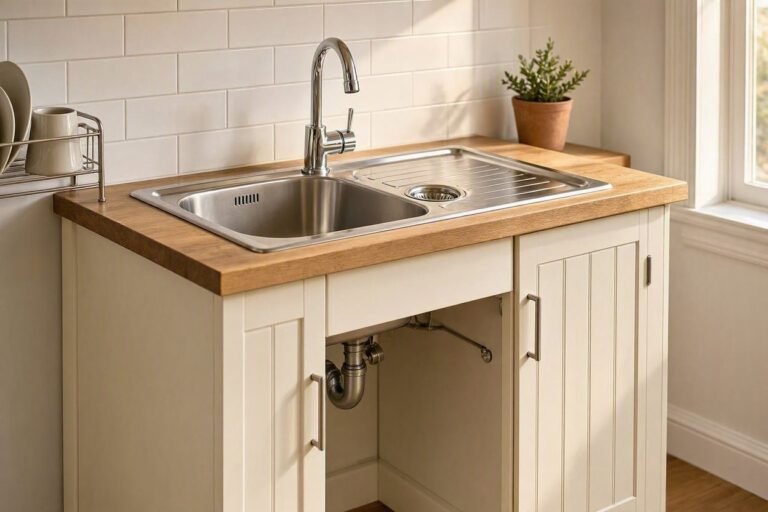
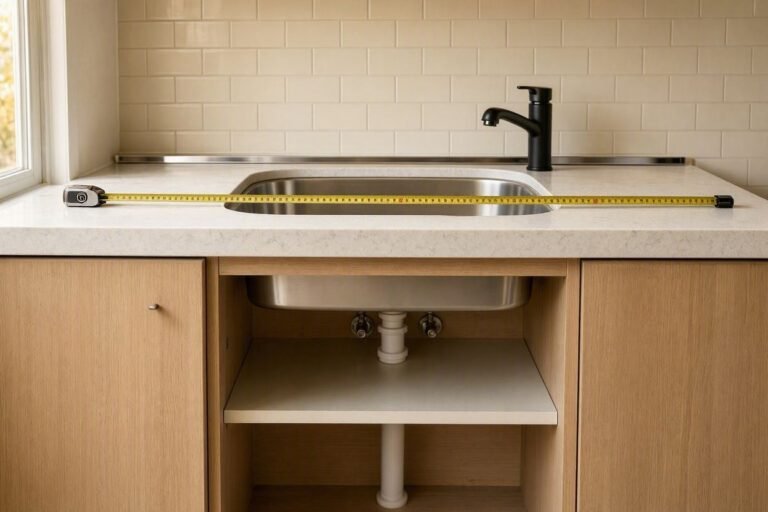
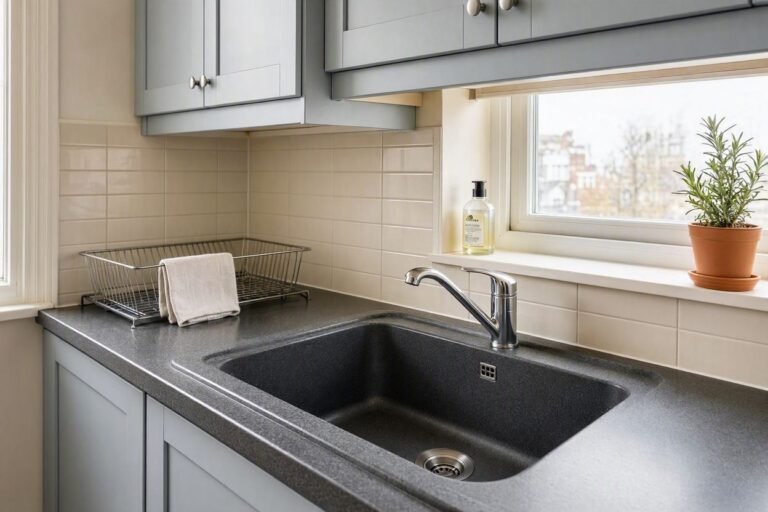
A kitchen sink water filter can improve drinking-water taste or reduce specific contaminants, depending on the system. But choosing the right model involves more than comparing filtration claims. You also need to consider your faucet, cabinet dimensions, plumbing layout, replacement-filter costs, and installation requirements. Some systems connect directly to an existing faucet, while others use a separate drinking-water faucet or a reverse osmosis membrane. This guide compares common kitchen sink water filter types, explains what to check before buying, and helps you find a system that suits your water-quality needs and available kitchen space.
Quick Answer: Which Kitchen Sink Water Filter Should You Choose?
The right kitchen sink water filter depends on your water-quality concerns and installation space. A faucet-mounted filter can suit a simple setup, an under-sink carbon filter can provide hidden filtration, and a reverse osmosis system may reduce additional specified contaminants. Check the exact product’s certification, faucet compatibility, cabinet clearance, maintenance requirements, and replacement-filter costs before buying.
What Are the Main Types of Kitchen Sink Water Filters?
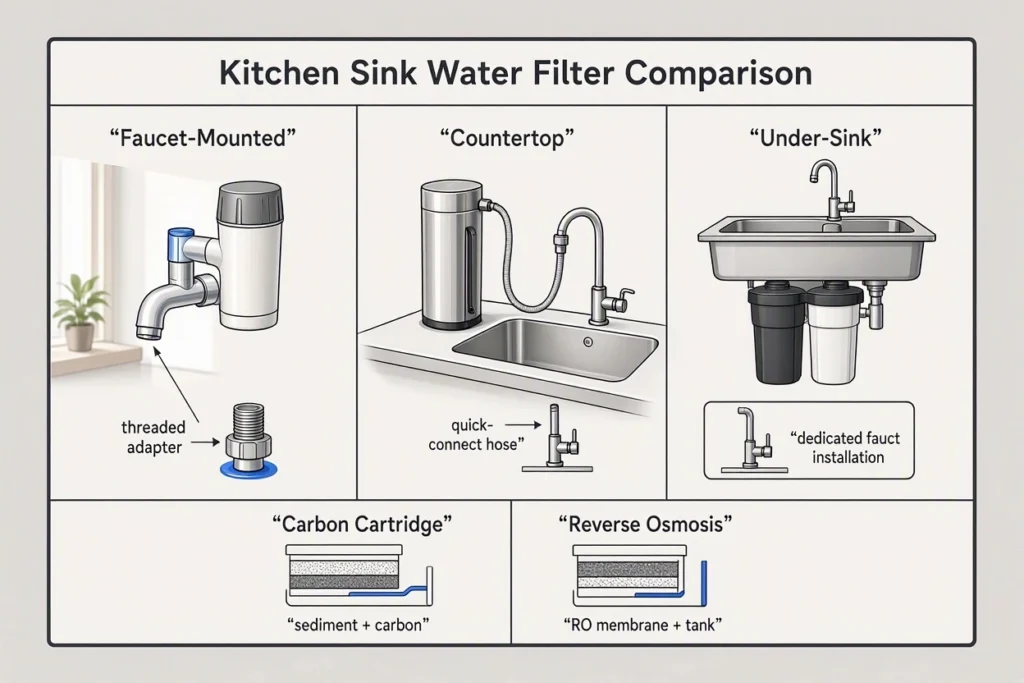
Kitchen sink water filters differ in how they connect to the water supply, where their components sit, and which contaminants they are designed to reduce.
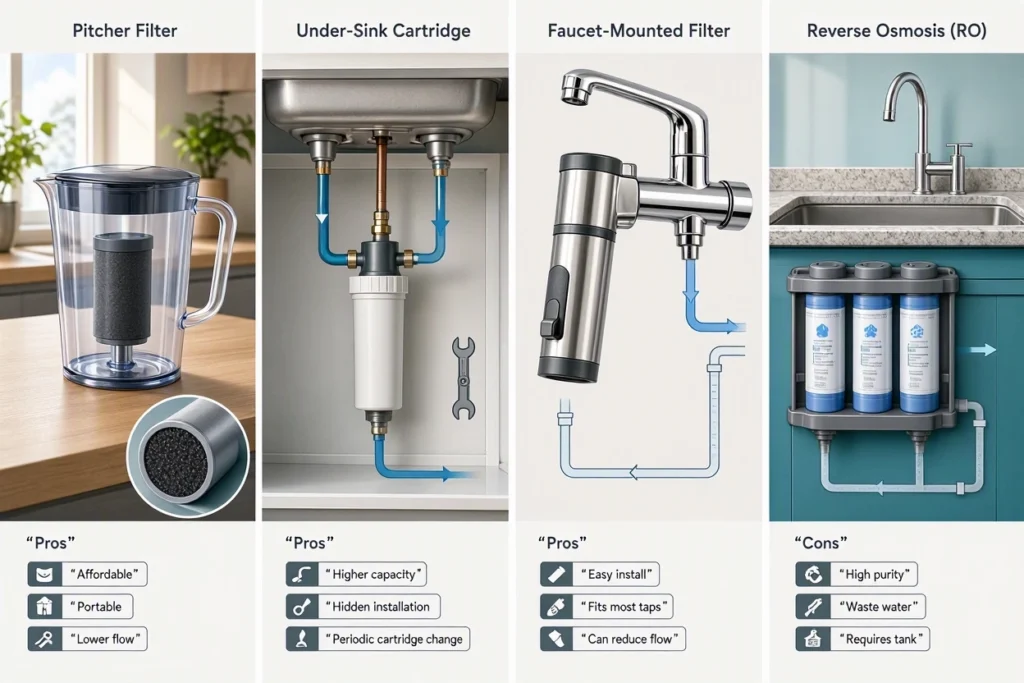
1. Faucet-Mounted Water Filters
A faucet-mounted water filter attaches to a compatible faucet outlet. Depending on the design, a switch may let you select filtered or unfiltered water.
Best for: Kitchens where under-sink cabinet space is limited or a more involved plumbing installation is not desirable.
Advantages
- Usually requires little or no cabinet space.
- Can provide filtered water at the existing faucet.
- May be easier to install than a plumbed-in system.
Limitations
- Compatibility varies by faucet design.
- Some models do not fit pull-down or pull-out faucets.
- The attachment can change the faucet’s appearance or clearance.
- Cartridge replacement is still necessary.
Before purchasing, check the faucet connection and the manufacturer’s compatibility information.
2. Under-Sink Carbon Water Filters
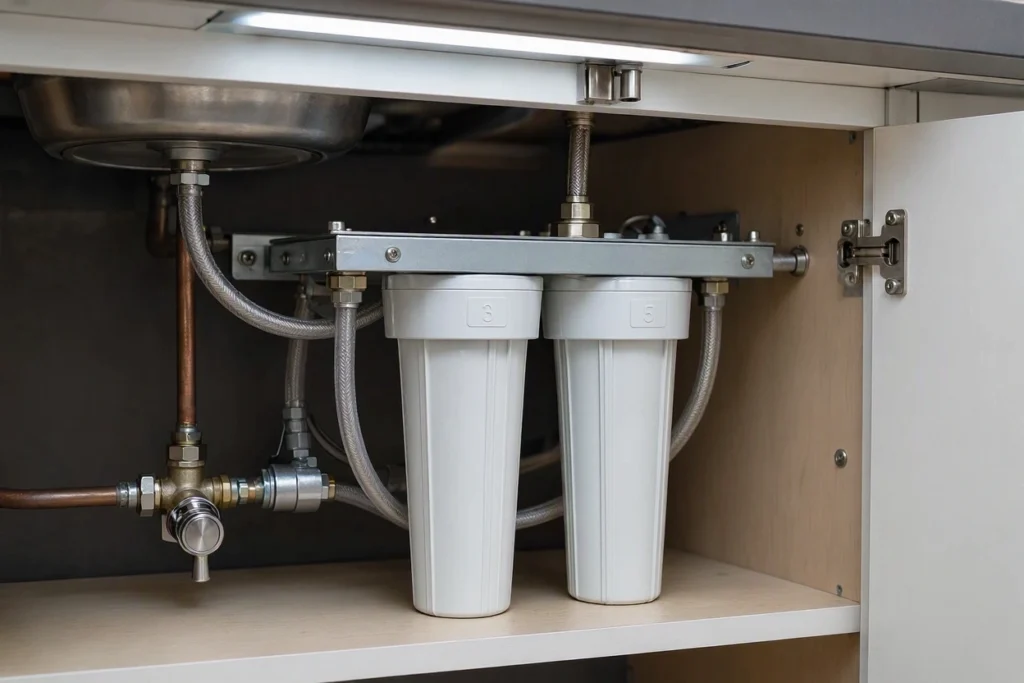
An under-sink carbon filter is installed inside the cabinet and connected to the water supply. Depending on the model, it may supply the existing faucet or a separate drinking-water faucet.
Activated carbon can reduce certain substances, including chlorine that affects taste and odor. Other contaminant-reduction claims depend on the exact system and its verified performance.
Best for: Homeowners who want a concealed filtration system and have enough cabinet space for the housing and replacement cartridges.
Advantages
- Keeps the filtration equipment out of sight.
- Can avoid a large countertop unit.
- May provide filtered water without a reverse osmosis storage tank.
- Some systems connect to an existing faucet.
Limitations
- Uses space beneath the sink.
- May require a dedicated faucet or plumbing modification.
- Filter cartridges need periodic replacement.
- Performance varies between models.
3. Under-Sink Reverse Osmosis Systems
Reverse osmosis (RO) systems force water through a semipermeable membrane. Many also use additional filter stages.
Depending on the specific system, reverse osmosis can reduce various dissolved substances and other specified contaminants. It is important to check the product’s certification and performance data rather than assume every RO system removes every contaminant.
Best for: Households whose identified water-quality concerns match the reduction capabilities of a particular RO system.
Advantages
- Can reduce a range of specified contaminants.
- Keeps most equipment beneath the sink.
- Often supplies filtered water through a separate faucet.
- Some designs use a storage tank, while others are tankless.
Limitations
- May need more installation planning than a basic carbon filter.
- A storage tank can occupy valuable cabinet space.
- Some installations require a drain connection and an additional faucet hole.
- RO systems discharge reject water during operation.
- Replacement filters and membranes add ongoing costs.
4. Faucet-Integrated Filtration Systems
Some kitchen faucets incorporate filtration components into the faucet assembly or use a dedicated filtered-water outlet.
This design may reduce the need for a separate faucet-mounted attachment, but the installation requirements depend on the model.
Best for: Kitchens where appearance and convenient access to filtered water are priorities.
Check before buying
- Faucet and filter compatibility.
- Cartridge replacement access.
- Required supply connections.
- Available replacement cartridges.
- Verified contaminant-reduction claims.
Kitchen Sink Water Filter Comparison
| Filter Type | Cabinet Space | Installation Considerations | Main Consideration |
|---|---|---|---|
| Faucet-Mounted | Usually minimal | Check faucet compatibility | Convenient installation |
| Under-Sink Carbon | Requires housing space | Supply connection; faucet requirements vary | Hidden filtration |
| Under-Sink RO | Housing and possibly tank space | May require a drain connection and separate faucet | More components and maintenance |
| Faucet-Integrated | Depends on faucet design | Faucet-specific installation | Appearance and cartridge access |
No filter type is automatically best for every kitchen. Select a system that matches the water-quality problem and fits the installation.
How Do You Choose the Right Kitchen Sink Water Filter?
Start With Your Water Quality
First, identify what you want the filter to do. Is the main concern chlorine taste, sediment, lead, PFAS, or another substance?
For U.S. municipal water, review the annual Consumer Confidence Report from your water utility. If you use private well water, appropriate laboratory testing can help identify potential contaminants.
The CDC’s home water filter guidance explains why filter selection should be based on the substances present and the system’s specific capabilities.
Do not rely on water’s appearance, taste, or smell alone to determine whether it is safe.
Check Certifications and Reduction Claims
A certification standard is not a universal guarantee that a filter removes every contaminant.
Common standards include:
- NSF/ANSI 42: Certain aesthetic effects, such as chlorine taste and odor.
- NSF/ANSI 53: Specific health-related contaminant reduction claims.
- NSF/ANSI 58: Reverse osmosis drinking-water treatment systems.
- NSF/ANSI 401: Certain specified emerging or incidental compounds.
The exact claims vary by product. Check the model’s performance data sheet and the certifying organization’s product listing.
See NSF’s water treatment standards guide for further information.
Compare Flow Rate and Filter Life
A filter’s flow rate affects how quickly water comes from the faucet. Cartridge capacity and replacement intervals affect maintenance and ongoing cost.
Before purchasing, compare:
- Manufacturer-stated flow rate.
- Filter capacity, if specified.
- Recommended replacement interval.
- Availability and cost of replacement cartridges.
- Any indicator or maintenance requirements.
Do not assume a higher number of filtration stages automatically means better performance. The verified claims and suitability for your water are more important.
Consider the Total Cost of Ownership
The initial purchase price is only one part of the cost.
Consider the cost of replacement cartridges, RO membranes where applicable, any required faucet or fittings, and professional installation if needed.
How Much Space Does a Kitchen Sink Water Filter Need?
There is no single cabinet size that fits every system. The required space depends on the filter housing, cartridge design, plumbing arrangement, mounting position, and whether the unit includes a storage tank.
Measure the Available Cabinet Space
Measure the usable interior width, depth, and height. Check the actual clearance rather than relying only on the cabinet’s outside dimensions.
Account for:
- Sink bowl and drain assembly.
- P-trap and water supply lines.
- Garbage disposal, if installed.
- Cabinet hinges, doors, and shelves.
- Existing organizers or stored items.
- Filter cartridge removal and service access.

A deep sink bowl can reduce the height available beneath it. A garbage disposal can also occupy the area where a filter might otherwise be mounted.
Check Filter Housing and Cartridge Clearance
A filter may fit inside the cabinet but still be difficult to maintain if its cartridge cannot be removed.
Check the manufacturer’s installation diagram for the required mounting orientation and service clearance. Allow enough room to disconnect or replace components according to the instructions.
Consider Tankless and Tank-Based RO Systems
A tank-based RO system requires space for its storage tank as well as the filters, tubing, and connections.
A tankless RO system removes the separate tank requirement, but it still needs space for the filtration unit and maintenance access. Tankless does not automatically mean compact enough for every cabinet.

A Simple Pre-Purchase Measurement Checklist
| What to Measure or Inspect | Why It Matters |
|---|---|
| Usable Cabinet Width | Determines where the filter housing can fit. |
| Usable Cabinet Depth | Helps check front-to-back clearance. |
| Vertical Clearance Below the Bowl | Determines the available mounting height. |
| Drain and Disposal Position | Helps identify potential obstructions. |
| Filter Replacement Clearance | Makes future filter changes and maintenance easier. |
| Faucet-Hole Availability | Helps determine the installation requirements. |
| Supply and Drain Connections | Helps confirm plumbing compatibility. |
If you’re planning a compact sink installation, review the Small Kitchen Sink Dimensions guide for related sink and cabinet measurement considerations.
Does a Kitchen Sink Water Filter Need a Separate Faucet?
Not every system requires a separate faucet. Some connect to the existing faucet, while others supply filtered water through a dedicated drinking-water faucet.
A separate faucet may require an existing unused sink or countertop hole. If a new hole is needed, check the sink or countertop manufacturer’s guidance before drilling, particularly with stone or other specialty surfaces.
Before buying, verify:
- Whether the faucet is included.
- Whether the system connects to the existing faucet.
- Whether a separate faucet is required.
- Whether drilling is necessary.
- Whether the supply and drain connections match your installation.
If avoiding drilling is important, choose a product whose instructions explicitly support your preferred setup.
How Is a Kitchen Sink Water Filter Installed?
Installation varies by model. Follow the supplied instructions rather than relying on a generic installation method.
- Check compatibility. Confirm the water supply, faucet, cabinet dimensions, and required connections.
- Plan the mounting position. Keep the filter clear of the sink bowl, drain, disposal, and cabinet doors.
- Shut off the water. Follow the manufacturer’s directions before disconnecting any supply line.
- Install the system. Use the supplied fittings and approved connection method.
- Check for leaks. Restore the supply as instructed and inspect every connection.
- Flush the system. Follow the manufacturer’s flushing procedure before drinking the filtered water.
- Record maintenance dates. Keep track of the recommended filter replacement schedule.
Some systems are suitable for careful DIY installation. Others require plumbing changes or a drain connection. Contact a qualified plumber if the work is beyond your experience or the shutoff valves and connections are not in good condition.
Common Mistakes When Buying a Kitchen Sink Water Filter
Choosing a Filter Without Identifying the Problem
A filter intended to improve taste may not reduce the contaminant that concerns you. Match the system’s verified performance to your water-quality needs.
Assuming All Certifications Mean the Same Thing
A standard number does not prove that a system removes every contaminant. Check the exact product and the individual reduction claims.
Ignoring Replacement Costs
Replacement cartridges and membranes can add up over time. Check availability and maintenance costs before choosing a system.
Forgetting the Garbage Disposal
The disposal, P-trap, and supply lines may limit where the filter can be mounted. Measure the cabinet before buying.
Buying Based Only on the Initial Price
A lower upfront price may not represent the best long-term value if replacement parts are expensive or the product does not address the actual water-quality concern.
Key Takeaways
- Choose a kitchen sink water filter based on the contaminants you want to reduce.
- Faucet-mounted filters can be useful when under-sink space is limited.
- Under-sink carbon filters and RO systems require careful cabinet and plumbing planning.
- Check product-specific certifications and contaminant-reduction claims.
- Compare cartridge costs, replacement intervals, and maintenance requirements.
- Measure the sink bowl, drain, garbage disposal, and service clearance before buying.
- Follow the manufacturer’s installation and flushing instructions.
Frequently Asked Questions
What is the best kitchen sink water filter?
The best system depends on your water-quality needs, faucet compatibility, cabinet space, and maintenance budget. Compare faucet-mounted filters, under-sink carbon systems, and reverse osmosis options by their verified reduction claims and installation requirements.
Can a water filter fit under a small kitchen sink?
Some systems can fit in compact cabinets, but it depends on the housing dimensions, drain layout, garbage disposal, and cartridge access. Measure the available space and compare it with the complete manufacturer’s installation dimensions before purchasing.
Do kitchen sink water filters remove lead?
Some products are certified to reduce lead, but not all filters do. Check the exact model’s certification and lead-reduction claim. The EPA provides a consumer tool for identifying filters certified to reduce lead.
Is reverse osmosis better than a carbon filter?
Neither is universally better. Reverse osmosis can reduce a different range of specified substances than many carbon systems, but the right choice depends on the water-quality issue, verified product performance, installation needs, and maintenance costs.
How often should water filter cartridges be changed?
Follow the manufacturer’s recommended schedule and any stated capacity limits. Replacement timing varies by product, water quality, and usage. Keeping up with maintenance helps the system continue operating as intended.
Does an under-sink filter need a separate faucet?
Some models connect to an existing faucet, while others require a dedicated drinking-water faucet. Check the installation manual and included components before buying.
Are tankless reverse osmosis systems suitable for small kitchens?
They may help when a separate storage tank would take up too much space, but they still require room for the filtration unit, tubing, and maintenance. Compare the complete dimensions and installation requirements.
Do water filters make unsafe water safe to drink?
Not necessarily. Different systems reduce different contaminants, and many household filters are not designed to remove harmful germs. Test the water when appropriate and choose a treatment system specifically designed and verified for the identified concern.
Conclusion
The right kitchen sink water filter should match your water-quality needs, fit your cabinet, and remain practical to maintain.
Start by identifying the contaminants you want to reduce. Compare verified filtration claims, faucet compatibility, cabinet dimensions, replacement costs, and installation requirements before selecting a product.
For a compact kitchen, pay particular attention to the sink bowl, garbage disposal, drain, and space needed to replace cartridges. A careful measurement and a review of the manufacturer’s specifications can help prevent a filter that does not fit or cannot be serviced easily.
Explore the verified filter options above, compare their requirements, and choose a system that suits your kitchen rather than relying on marketing claims alone.
Get Helpful Sink Tips
Subscribe for practical sink planning tips and helpful resources for small kitchens and compact spaces.

Khadija is the writer and founder of Tiny Sink Solution. She creates practical guides about small kitchen sinks, faucets, and compact kitchen maintenance, helping homeowners and renters choose solutions for limited spaces. Some articles contain affiliate links, and as an Amazon Associate, she earns from qualifying purchases at no extra cost to readers