A kitchen sink strainer helps catch food scraps and other debris before they enter the drain. However, choosing the right kitchen sink strainer involves more than finding one that looks good. Different designs serve different purposes, and the correct choice depends on your drain opening, sink material, cleaning preferences, and whether your sink has a garbage disposal.
Some strainers are complete plumbing assemblies, while others are removable screens that sit over the drain. Understanding the difference can help you choose a practical option without buying an incompatible replacement.
This guide explains the main types of kitchen sink strainers, how they work, what to check before purchasing, and how to maintain them.
Quick Answer: What Is a Kitchen Sink Strainer?
A kitchen sink strainer is a device that catches food particles and other debris while allowing water to drain. Common options include basket-strainer assemblies, removable mesh screens, flat drain screens, and strainer-stopper combinations.
To choose the right one, check the drain opening, sink thickness where relevant, connection type, material, and compatibility with your existing plumbing or garbage disposal. A removable screen may be all you need for everyday debris, while replacing a built-in drain assembly requires a more careful fit check.
What Does a Kitchen Sink Strainer Do?
A kitchen sink strainer helps prevent food scraps and other solid debris from entering the drain. It also makes cleanup easier because collected waste can be removed and discarded instead of being washed into the plumbing.
Depending on its design, a strainer may:
- Catch food particles during dishwashing and rinsing.
- Reduce the amount of solid debris entering the drain.
- Help keep the drain opening accessible for routine cleaning.
- Allow water to pass through while collecting waste.
- Double as a stopper when the design supports that function.
A strainer does not prevent every clog. Grease, soap residue, and fine particles can still travel into the drain. Scrape food waste into an appropriate waste container before rinsing dishes, and clean the strainer regularly.
Types of Kitchen Sink Strainers
Different strainer designs suit different kitchen setups. Here are the main options to consider before buying.
1. Basket Sink Strainers
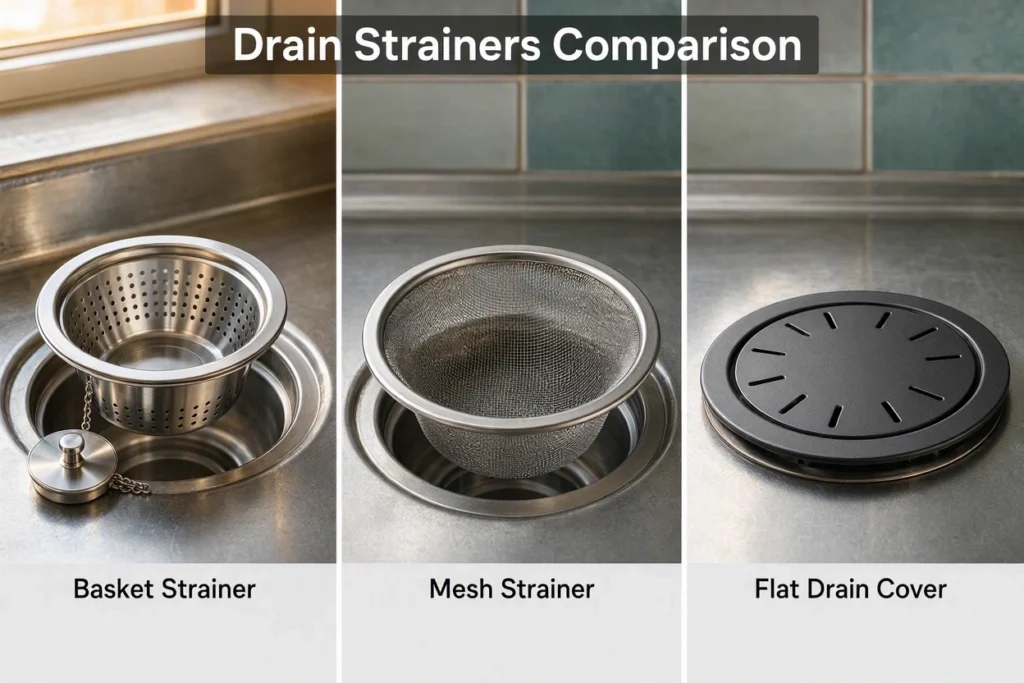
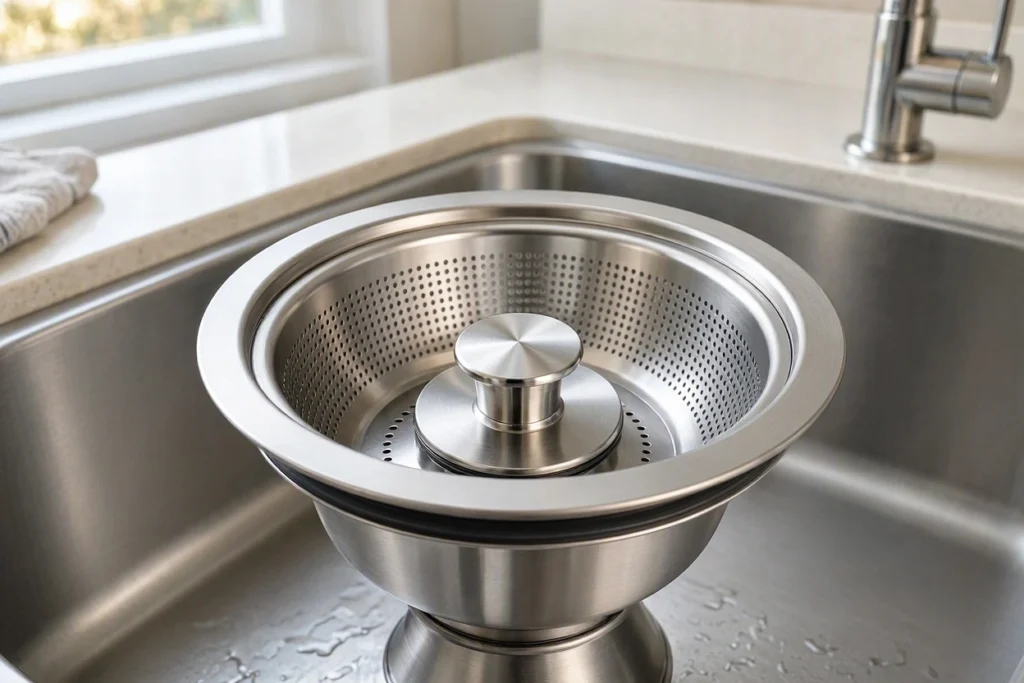
A basket sink strainer is a drain fitting installed in the sink opening. It typically has a metal flange, a strainer body, and a removable perforated basket that catches food scraps.
Some models include a stopper mechanism that allows the basin to hold water when needed.
Best for: Kitchen sinks with a conventional drain and no garbage disposal in that basin.
Advantages:
- Collects food scraps in a removable basket.
- Makes routine drain cleanup straightforward.
- Can provide a stopper function on compatible models.
- Available in different finishes and configurations.
What to check: Confirm the sink opening, sink thickness, outlet connection, and included components. A replacement basket alone is not necessarily compatible with every strainer body.
As an Amazon Associate, I earn from qualifying purchases.
2. Mesh Sink Strainers
A mesh sink strainer is a removable screen or cup with small openings that catch food particles while allowing water to pass through.
Some designs sit inside the drain opening, while others rest over the drain. Their shape and dimensions determine where they fit.
Best for: Everyday rinsing, catching small food scraps, and renters who want a removable accessory rather than a plumbing replacement.
Advantages:
- Easy to remove and empty.
- Often simple to clean.
- Available in stainless steel and other materials.
- Does not usually require plumbing modifications.
Limitations: Fine mesh can clog quickly with food residue and may slow drainage if it is not emptied. Check the diameter and depth before buying, especially if the screen must sit inside the drain opening.
As an Amazon Associate, I earn from qualifying purchases.
3. Flat Drain Strainers
Flat drain strainers sit over the drain opening and use perforations or a mesh surface to catch debris. Some are made from stainless steel, while others use silicone or flexible materials.
Their low-profile design can be convenient when you do not want a deep basket occupying the drain area.
Best for: Readers who prefer a simple screen that can be lifted away for cleaning.
Advantages:
- Low-profile design.
- Easy to remove for cleaning.
- Available in different sizes and materials.
- Useful for catching larger food particles.
Limitations: A flat screen may shift during use or leave gaps around the drain if its dimensions do not match the basin. It is not a replacement for a complete basket-strainer assembly.
As an Amazon Associate, I earn from qualifying purchases.
.
4. Sink Strainer and Stopper Combinations
Some sink strainers combine debris collection with a stopper function. Depending on the mechanism, the basket may lift out, press down, or move between straining and water-holding positions.
These products can be convenient when you regularly fill the basin for washing dishes.
Best for: Households that want both debris collection and the ability to hold water.
Advantages:
- Combines two functions in one fitting.
- Can simplify routine washing and cleanup.
- May replace an older basket-and-stopper arrangement.
Limitations: Not all baskets seal the drain. Confirm the mechanism, replacement-part availability, and compatibility with the existing drain assembly.
As an Amazon Associate, I earn from qualifying purchases.
5. Garbage-Disposal Drain Accessories
A sink with a garbage disposal needs a compatible disposal mounting flange rather than a conventional basket-strainer assembly in that same drain opening. A removable screen or other accessory may also be useful, but it must be used according to the disposal manufacturer’s instructions.
Best for: Kitchens with a garbage disposal installed beneath the sink.
Important distinction: A disposal flange is not the same as a basket strainer. Do not assume that a conventional basket strainer will attach to or operate correctly with a disposal.
Before purchasing an accessory, check the disposal model, drain configuration, and manufacturer’s instructions. Never reach into a disposal to retrieve debris.
Kitchen Sink Strainer Comparison Table
| Strainer Type | Main Purpose | Best Suited For | Main Thing to Check |
|---|---|---|---|
| Basket-Strainer Assembly | Collects food scraps at the drain | Conventional kitchen drains | Opening, sink thickness, outlet |
| Mesh Screen | Catches small food particles | Everyday rinsing | Diameter, depth, mesh cleaning |
| Flat Drain Screen | Provides a low-profile debris barrier | Simple removable protection | Shape, diameter, stability |
| Strainer-Stopper Combination | Strains debris and may hold water | Washing dishes in a filled basin | Stopper mechanism and fit |
| Disposal-Compatible Accessory | Works with a disposal drain setup | Sinks with garbage disposals | Exact disposal compatibility |
Buying tip: Decide whether you need a complete drain assembly or just a removable screen before comparing products. These are different purchases, even when listings use similar names.
How to Choose the Right Kitchen Sink Strainer
1. Check the Drain Opening
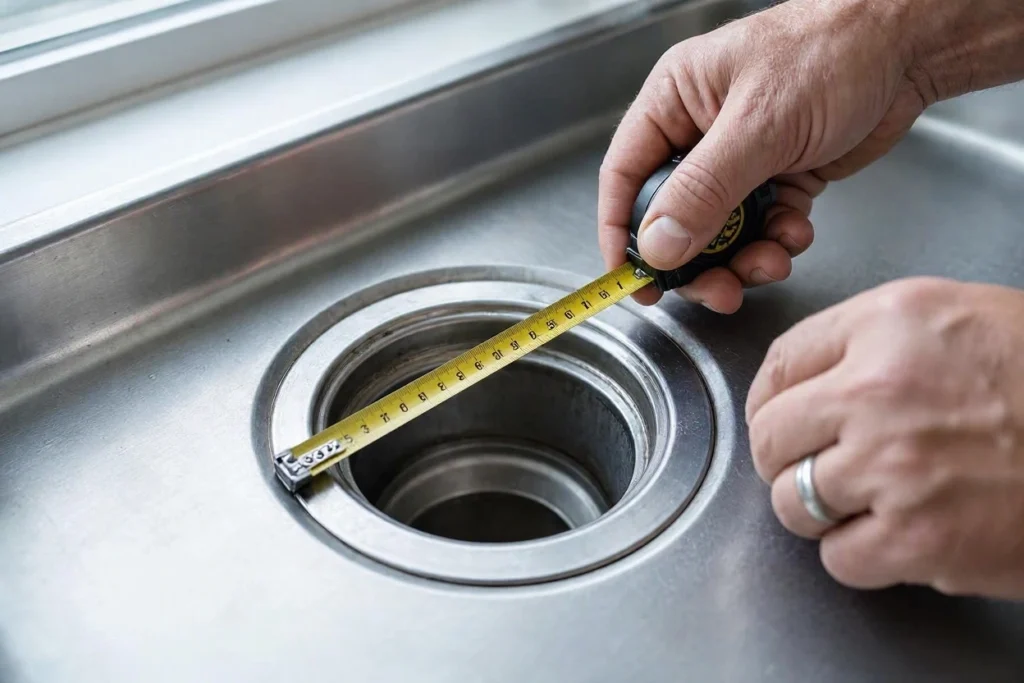
Start by identifying the actual sink drain opening. Do not measure only the outside edge of the visible metal flange, because that rim is wider than the opening beneath it.
For many US residential kitchen sinks, a conventional drain opening is around 3½ inches, but this is not a guarantee of compatibility. Bar sinks, specialty sinks, and some imported products can use different dimensions.
If you are replacing an existing assembly, check its manufacturer and model when possible. Otherwise, compare the bare opening measurement with the replacement product’s specifications.
Small Kitchen Sink Dimensions: Complete Size Guide
2. Confirm Sink Thickness and Drain Connection
Sink thickness can affect whether the strainer body and mounting hardware fit correctly. This is especially important with thick fireclay, cast-iron, or composite sinks.
Also check the outlet connection and the plumbing parts included with the assembly. A strainer that fits the opening may still require a different connection or approved hardware.
If the sink has a garbage disposal, follow the disposal manufacturer’s flange and mounting requirements rather than selecting a conventional basket strainer.
3. Choose the Right Material
Common materials include stainless steel, plastic, silicone, and combinations of metal with rubber or other sealing components.
- Stainless steel: A practical choice for a durable, easy-to-clean metal screen or basket.
- Plastic: Often lightweight and economical, depending on the product design.
- Silicone: Flexible and useful for some removable drain screens.
- Mixed-material assemblies: May combine a metal body with seals or a removable stopper.
Consider the manufacturer’s cleaning instructions and the conditions around your sink. Do not assume that every stainless-steel product has the same grade or corrosion resistance; check the stated specifications.
4. Consider the Size of Debris You Need to Catch
A fine mesh may catch smaller food particles but can accumulate residue and slow water flow sooner. Larger openings are often easier to rinse but may allow smaller scraps through.
For everyday kitchen use, choose a design that balances drainage with the type of debris you commonly encounter. Scrape large food scraps into the trash or compost before rinsing dishes.
5. Check Cleaning and Maintenance Requirements
A removable basket or screen is generally easier to clean than a component that requires tools to remove.
Before buying, check whether the product:
- Can be lifted out easily.
- Has corners or crevices that trap residue.
- Is compatible with your preferred cleaning method.
- Has replaceable seals or baskets, if applicable.
- Includes clear care instructions.
A dishwasher-safe claim should be verified for the specific product. Do not assume that every metal or silicone strainer is dishwasher safe.
6. Match the Strainer to Your Sink Setup
Your sink setup affects the type of product you need.
- Single-bowl sink without a disposal: A compatible basket-strainer assembly is a common option.
- Double-bowl sink: Check each basin independently. One may have a disposal while the other uses a conventional drain.
- Sink with a garbage disposal: Use the approved flange and accessories specified for the disposal.
- Compact or bar sink: Check the actual opening rather than assuming that a full-size kitchen strainer will fit.
- Rental kitchen: A removable screen may be preferable if you do not need to replace the installed drain assembly.
For a compact sink, measuring carefully is more useful than relying on the overall basin width alone.
Common Kitchen Sink Strainer Problems
Even a suitable strainer can cause problems when it is dirty, damaged, or poorly matched to the drain.
Water Drains Slowly
Food residue may be blocking the mesh or basket. Remove the strainer, empty it, and clean the openings. If drainage remains slow after the screen is clean, the obstruction may be farther down the drain.
Food Scraps Slip Through
The openings may be too large for the debris you want to catch, or the strainer may not sit securely. Consider a finer screen or a better-fitting design.
The Strainer Moves Around
A removable screen that is too small or poorly shaped may shift during rinsing. Measure the drain and compare the product dimensions before replacing it.
Water Leaks Beneath the Sink
A leak around a complete basket-strainer assembly may come from the seal, locknut, outlet connection, or another plumbing joint. Dry the area and check where fresh moisture appears. Follow the manufacturer’s repair instructions, or contact a plumber if the source is unclear.
A removable screen sitting over the drain does not create the same watertight connection as a complete basket-strainer assembly.
Kitchen Sink Troubleshooting Tool Use the tool to help identify the likely cause of a sink problem and decide what to check next.
How to Clean and Maintain a Kitchen Sink Strainer
Regular cleaning helps keep a strainer working properly and reduces the buildup of food residue.

- Remove collected debris. Empty the basket or lift away the screen and discard food waste appropriately.
- Rinse thoroughly. Use warm water to remove loose residue.
- Wash with dish soap. Use a soft brush or sponge to clean the basket and openings.
- Check for buildup. Inspect small holes, mesh, and crevices where residue can collect.
- Rinse and dry as appropriate. Follow the product’s care instructions, particularly for coated or mixed-material components.
- Inspect for damage. Look for corrosion, cracks, warped parts, worn seals, or a damaged stopper mechanism.
Avoid harsh abrasives or aggressive cleaners unless the manufacturer confirms they are suitable for the product.
If the drain remains slow after cleaning the strainer, investigate the drain itself rather than repeatedly scrubbing the screen.
When Should You Replace a Kitchen Sink Strainer?
Consider replacing a strainer when:
- The mesh or basket is cracked, bent, or badly corroded.
- The stopper no longer seals when it should.
- The screen no longer sits securely over the drain.
- The assembly leaks despite appropriate maintenance.
- Replacement parts are unavailable or the assembly is incompatible with a new sink.
If only the removable basket is damaged, you may not need a complete replacement. Check whether the manufacturer supplies a compatible basket and whether it matches the existing body and stopper mechanism.
When replacing a complete assembly, confirm the opening, sink thickness, connection, and required seals before ordering.
Frequently Asked Questions
1. What is the most common kitchen sink strainer type?
A basket-strainer assembly is a common choice for a conventional kitchen sink without a garbage disposal. Removable mesh screens and flat drain strainers are also widely used as accessories.
2. Are kitchen sink strainers a standard size?
Many US kitchen sinks use a drain opening around 3½ inches, but not every sink or strainer uses the same dimensions. Check the sink and product specifications before buying.
3. Can I replace just the strainer basket?
Sometimes. The replacement basket must match the existing strainer body and stopper mechanism. Check the model number or compare the relevant dimensions rather than assuming that baskets are interchangeable.
4. Can I use a sink strainer with a garbage disposal?
A conventional basket-strainer assembly generally occupies the same drain opening used by a disposal flange, so it is not installed there alongside the disposal. Use the approved disposal flange and follow the manufacturer’s instructions for any removable accessories.
5. Is stainless steel better than silicone for a sink strainer?
It depends on the design and intended use. Stainless steel can provide a rigid, durable basket or screen, while silicone can be flexible and easy to remove. Compare dimensions, cleaning instructions, and material specifications.
6. How often should I clean my kitchen sink strainer?
Empty it whenever debris accumulates and wash it regularly, particularly after preparing food or washing dishes. A fine mesh may need more frequent cleaning because it can collect residue quickly.
7. Why does water drain slowly through my sink strainer?
The mesh or basket may be clogged with food particles or grease residue. Remove and clean the strainer first. If the drain remains slow, the obstruction may be in the drainpipe or another part of the plumbing.
8. Can a sink strainer stop all drain clogs?
No. A strainer catches only the debris that cannot pass through its openings. Grease, soap residue, and smaller particles can still enter the drain, so proper food-waste disposal and routine maintenance remain important.
9. Should I buy a complete strainer assembly or a removable screen?
Buy a complete assembly when you need to replace the installed drain fitting. Choose a removable screen when you only want to catch debris at an otherwise suitable drain opening.
10. How do I know whether a replacement strainer will fit?
Check the drain opening, sink thickness where relevant, outlet connection, and any stopper or disposal requirements. Compare these details with the manufacturer’s specifications before ordering.
Final Buying Tips
The best kitchen sink strainer is one that fits your sink, catches the debris you want to remove, and is easy to clean.
For a conventional drain, start by checking whether you need a complete basket-strainer assembly or only a removable screen. Compare materials and cleaning requirements, and verify the dimensions rather than relying on a product title alone. If your sink has a garbage disposal, use its approved mounting flange and compatible accessories.
A little measuring before buying can prevent an unnecessary return and help you choose a strainer that works with your kitchen’s existing setup.
Get Helpful Sink Tips
Subscribe for practical sink planning tips and helpful resources for small kitchens and compact spaces.

Khadija is the writer and founder of Tiny Sink Solution. She creates practical guides about small kitchen sinks, faucets, and compact kitchen maintenance, helping homeowners and renters choose solutions for limited spaces. Some articles contain affiliate links, and as an Amazon Associate, she earns from qualifying purchases at no extra cost to readers