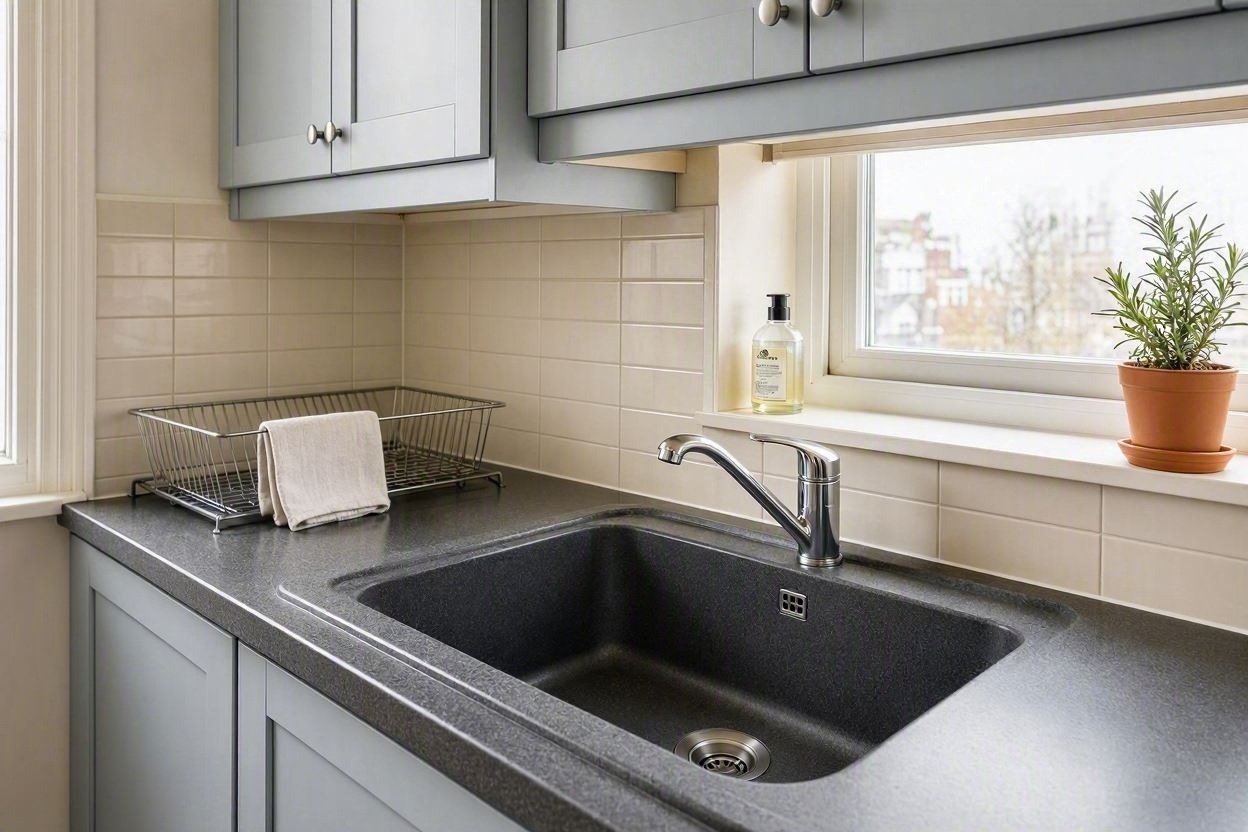
A granite composite sink can be an appealing option for a small kitchen if you want a stone-like appearance, a solid surface, and a sink designed for everyday use. Composite formulations vary by manufacturer, so the exact material, care requirements, and performance can differ from one model to another.
For a compact kitchen, material is only one part of the decision. You also need to consider the sink’s overall dimensions, minimum cabinet size, bowl depth, mounting style, countertop cutout, and available workspace.
Quick Answer
Can a granite composite sink work in a small kitchen? Yes. A granite composite sink can work well in a compact kitchen when its dimensions and installation requirements fit the available cabinet and countertop space. The main things to check are sink size, cabinet compatibility, mounting type, bowl configuration, and manufacturer care instructions.
What Is a Granite Composite Sink?
A granite composite sink is made by combining mineral material with a binding material such as resin. The exact composition varies between manufacturers and product lines.
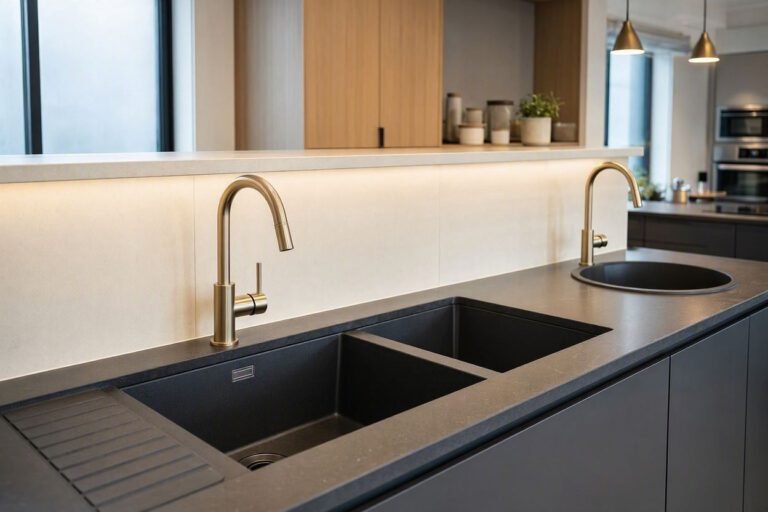
The result is a sink with a stone-like appearance rather than the metallic look associated with stainless steel. Granite composite sinks are available in different colors, bowl configurations, shapes, and mounting styles depending on the model.
That variety makes composite sinks useful to consider for kitchen remodeling, but it also means you should check the specifications of the exact sink you are considering.
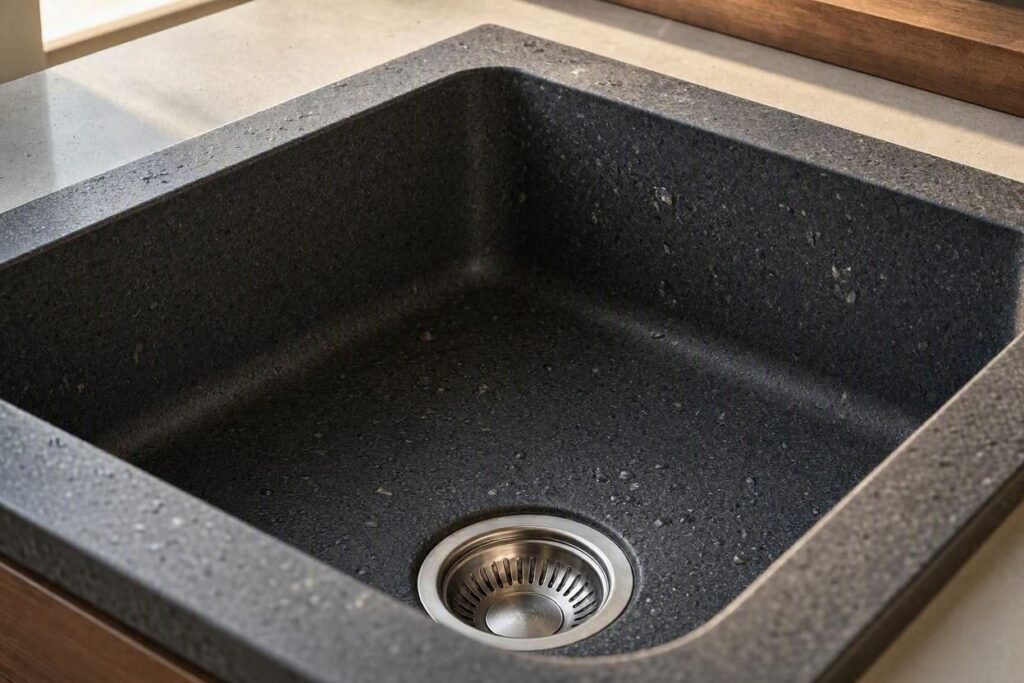
Are Granite Composite Sinks Suitable for Small Kitchens?
They can be, but the sink’s dimensions matter more than the material name.
A compact kitchen may have limited:
- Countertop space
- Cabinet width
- Front-to-back depth
- Plumbing clearance
- Space around the faucet
- Room for large cookware
A granite composite sink that is physically too large can create installation problems even if the material itself is suitable.
Before ordering, measure the available cabinet and countertop space and compare those measurements with the manufacturer’s specifications.
Granite Composite Sink Pros
Durable, Solid Surface
Granite composite sinks are designed for everyday kitchen use, and manufacturers commonly emphasize resistance to normal wear such as impacts, scratches, and staining. Exact performance depends on the particular composite formulation.
For example, the KRAUS KGU-413B is described as a quartz composite sink made from natural quartz and acrylic resin, with a hard, non-porous surface.
Stone-Like Appearance
If you want something different from stainless steel, granite composite provides a more substantial, stone-inspired appearance.
Black, white, gray, and other neutral colors can work with a variety of countertop and cabinet styles.
Multiple Installation Options
Installation options depend on the specific sink.
Some models are designed specifically for undermount installation, while others support more than one mounting method.
For example, the MONSINTA 27-inch model supplied for this article is described as supporting both undermount and topmount installation.
Always check the individual product’s installation instructions before assuming that a particular mounting method will work with your countertop.
Straightforward Routine Cleaning
Many granite composite sinks can be cleaned with mild soap, water, and a soft cloth or sponge.
However, cleaning recommendations vary by manufacturer. Some manufacturers specifically advise against abrasive cleaners, steel wool, harsh chemicals, or undiluted bleach.
The care guide for your exact sink should always take priority.
Granite Composite Sink Cons
They Can Be Heavy
Granite composite sinks can weigh more than some stainless steel alternatives.
This matters when installing a sink in an existing cabinet or countertop. The cabinet and countertop need to accommodate the specific sink and its installation method.
Size Options Can Vary
Not every granite composite sink is designed for a compact kitchen.
Some models are quite large. A 31-inch or 33-inch sink, for example, may require a substantially wider cabinet than someone with a very small kitchen can provide.
That is why the phrase “granite composite sink” alone isn’t enough when shopping for a small kitchen.
Cleaning Requirements Still Matter
Granite composite does not mean maintenance-free.
Dark surfaces may make mineral deposits or water spots more noticeable, while different manufacturers may recommend different cleaning products.
Use the manufacturer’s care instructions instead of assuming that a cleaner safe for one composite sink is suitable for another.
Heat Handling Varies by Product
Some granite composite sinks are marketed with heat-resistant properties, but you should not assume that every composite sink has identical heat performance.
Check the manufacturer’s instructions for hot cookware and other high-temperature items.
How to Choose a Granite Composite Sink for a Small Kitchen
Before looking at appearance, work through the physical requirements.
1. Measure the Cabinet
Start with the cabinet underneath the sink.
Check:
- Cabinet width
- Available depth
- Plumbing clearance
- Drawer clearance
- Door clearance
- Minimum cabinet requirement
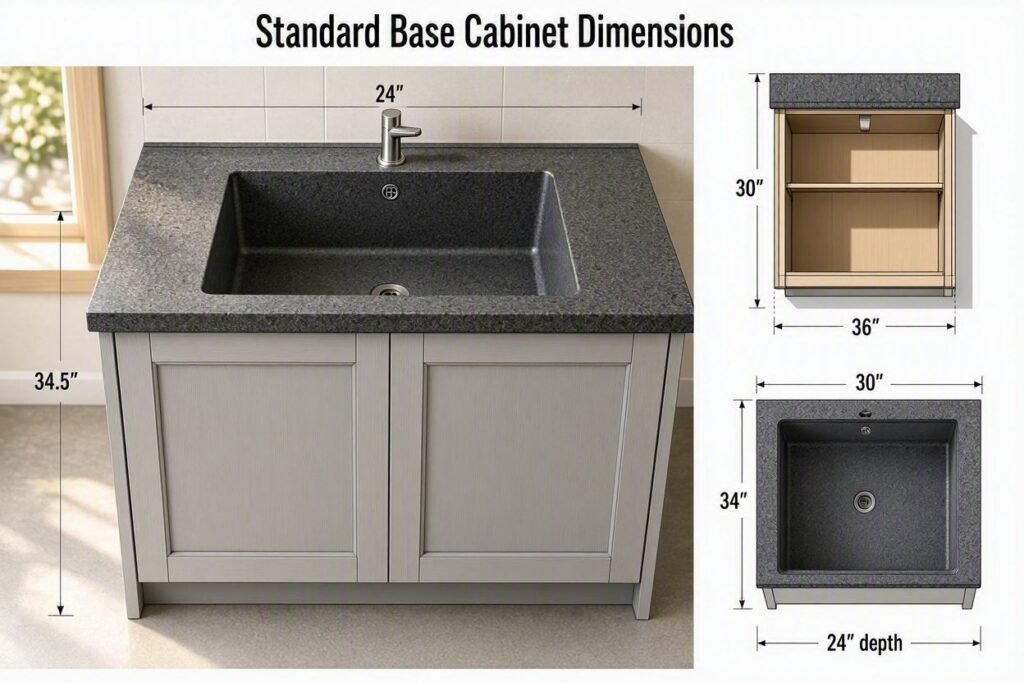
The minimum cabinet size listed by the manufacturer is particularly important.
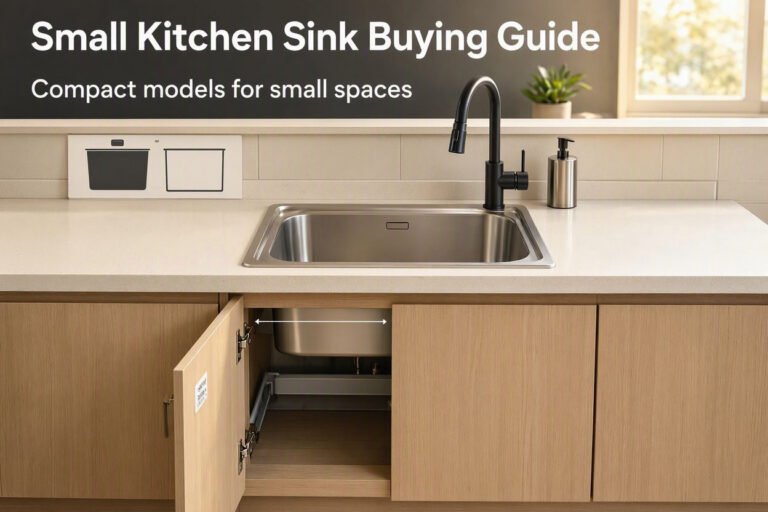
2. Check the Overall Sink Dimensions
Look at the complete external dimensions rather than only the advertised size.
A sink described as “27 inches” may have an actual exterior dimension that is slightly different.
Also compare:
- Overall length
- Overall width
- Overall depth
- Bowl length
- Bowl width
- Bowl depth
Before choosing a granite composite sink, measure the available cabinet and counter space carefully. Our guide to small kitchen sink dimensions can help you understand common sink sizes and how they relate to your available space.
3. Think About Bowl Size
A deeper or larger bowl can be useful for washing cookware, but it also takes up physical space.
For a compact kitchen, consider how you actually use the sink. If you mainly rinse dishes and prepare food, you may not need the same basin size as someone who regularly washes large pots and pans.
4. Check the Mounting Type
Undermount: The sink is installed beneath the countertop and creates a clean transition between the counter and sink.
If you prefer a cleaner countertop appearance, an undermount design may be worth considering. See our guide to undermount small kitchen sinks for more information about this installation style.
Topmount/drop-in: The sink sits within the countertop opening with the rim visible above the counter.
For easier replacement or a more straightforward installation approach, you can also compare the benefits and limitations of drop-in compact kitchen sinks.
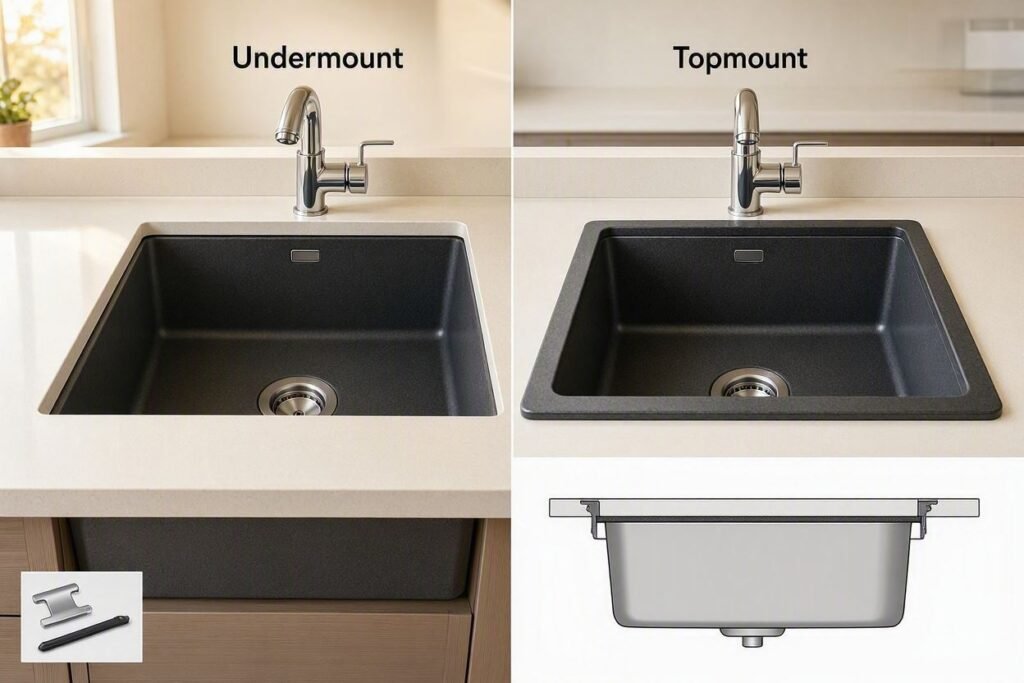
Some models support more than one installation method, while others are designed for a specific installation type.
5. Verify the Cutout
Never assume that the sink’s external dimensions are the same as the countertop cutout.
If you are installing a new sink or modifying an existing countertop, use the manufacturer’s installation template and required cutout dimensions.
Granite Composite Sinks to Consider
If you’re shopping for a granite composite sink, the following models illustrate how much sizes and installation requirements can vary.
Amazon Associates disclosure: As an Amazon Associate, Tiny Sink Solutions earns from qualifying purchases.
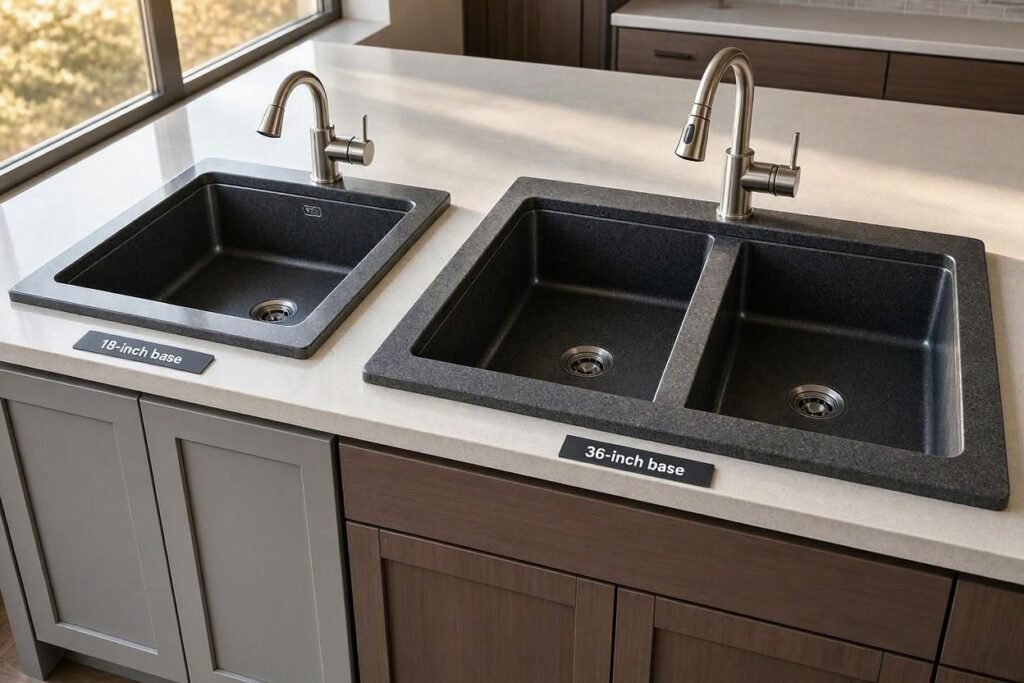
KRAUS KGU-413B Black Onyx Granite Composite Sink
The KRAUS KGU-413B is a 31-inch-class undermount sink with a single bowl and black finish.
According to the product information supplied for this article, its external dimensions are 30 1/2 inches long × 17 inches wide × 9 1/4 inches deep, with a listed minimum cabinet size of 33 inches.
It uses a quartz composite construction made from natural quartz and acrylic resin and has a non-porous surface. The package includes a stainless steel drain assembly with a removable basket strainer and a kitchen towel.
Because of its size and 33-inch minimum cabinet requirement, this model is better suited to a small kitchen with a reasonably wide sink cabinet rather than an extremely compact cabinet.
Key specifications:
- Brand: KRAUS
- Model: KGU-413B
- Color: Black Onyx
- Installation: Undermount
- Bowl: Single
- External dimensions: 30 1/2″ × 17″ × 9 1/4″
- Minimum cabinet size: 33″
- Material: Quartz composite
MONSINTA 27-Inch Granite Composite Single-Bowl Sink
The MONSINTA 27-inch granite composite sink provides a somewhat smaller overall footprint than the 31-inch KRAUS model.
The supplied product information lists exterior dimensions of approximately 26 3/4 × 18 3/4 × 9 7/16 inches, with an interior bowl measuring approximately 24 1/2 × 16 1/2 × 9 1/16 inches.
One notable feature is its dual-mount design. It can be installed as either an undermount or topmount sink, depending on the countertop and installation requirements.
The package also includes a stainless steel bottom grid, drain assembly, and expandable dish-drying rack.
For a small kitchen, remember that the listed dimensions still need to be compared with your cabinet and countertop space before purchase.
Key specifications:
- Brand: MONSINTA
- Color: Black
- Installation: Undermount or topmount
- Bowl: Single
- Listed size: 27″ × 18″ × 9″
- Exterior dimensions: approximately 26 3/4″ × 18 3/4″ × 9 7/16″
- Material: Granite composite
The manufacturer/seller also describes this model as heat resistant and corrosion resistant. These are product-specific claims, so follow the supplied care and installation instructions.
🌈 Shop NowDcolora 21-Inch Granite Composite Bar Prep Sink
For a genuinely space-conscious kitchen, the Dcolora 21-inch granite composite bar prep sink takes a different approach.
Instead of trying to provide a large main kitchen basin, this model is designed as a smaller single-bowl sink for uses such as wet bars, prep areas, RVs, and small kitchens.
The supplied specifications list an exterior size of approximately 21 × 18 × 9 inches, an interior bowl of approximately 19 × 16 × 8 inches, and a recommended cutout size of 20.2 × 17.2 inches.
The listed minimum base cabinet size is 24 inches.
It is designed for undermount installation and is described as being compatible with select drop-in applications depending on the countertop setup.
The sink also includes a bottom grid and drain assembly.
Because its minimum cabinet requirement is considerably smaller than the KRAUS and Couoko models listed below, this type of compact prep sink may be relevant when cabinet space is the primary limitation.
Key specifications:
- Brand: Dcolora
- Color: White
- Installation: Undermount; select drop-in applications
- Bowl: Single
- Exterior dimensions: approximately 21″ × 18″ × 9″
- Interior dimensions: approximately 19″ × 16″ × 8″
- Recommended cutout: approximately 20.2″ × 17.2″
- Minimum base cabinet: 24″
- Material: Granite composite quartz
Couoko 33-Inch White Quartz Composite Sink
The Couoko 33-inch granite composite kitchen sink is at the larger end of the products in this comparison.
The supplied product information lists overall dimensions of 33 × 19 × 9.65 inches, with a minimum cabinet size of 36 inches.
It is an undermount, single-bowl sink with a matte white quartz-composite finish. The listed interior bowl depth is approximately 8.9 inches.
The sink includes a roll-up rack, protective bottom grid, and drain assembly.
The product information also describes a rear-offset drain and sloped bottom designed to help direct water toward the drain.
For a small kitchen, the important point is its 36-inch minimum cabinet requirement. This is a significantly larger installation requirement than the 24-inch minimum listed for the Dcolora model.
So although it is a granite composite option, it may not be appropriate for a very compact sink cabinet.
Key specifications:
- Brand: Couoko
- Color: Matte White
- Installation: Undermount
- Bowl: Single
- Overall dimensions: 33″ × 19″ × 9.65″
- Minimum cabinet size: 36″
- Interior bowl depth: approximately 8.9″
- Material: Quartz composite
- Accessories: Roll-up rack, bottom grid, drain assembly
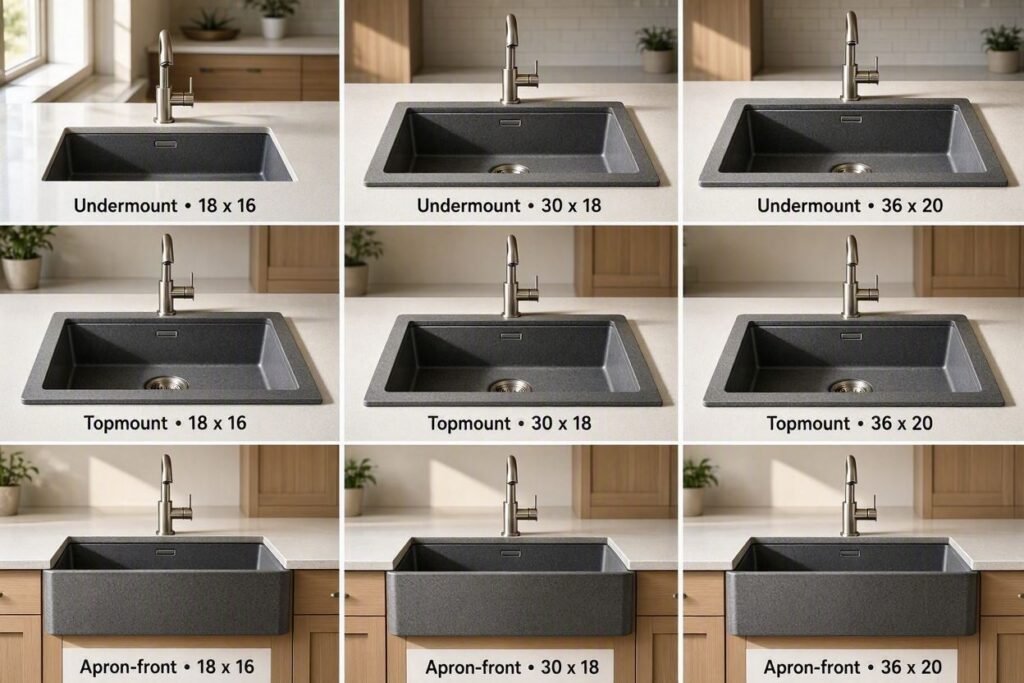
Comparing the Four Granite Composite Sink Options
| Product | Overall Size | Installation | Bowl | Listed Minimum Cabinet | Color |
|---|---|---|---|---|---|
| KRAUS KGU-413B | 30 1/2″ × 17″ × 9 1/4″ | Undermount | Single | 33″ | Black |
| MONSINTA | Approx. 26 3/4″ × 18 3/4″ × 9 7/16″ | Undermount / Topmount | Single | Check listing | Black |
| Dcolora | Approx. 21″ × 18″ × 9″ | Undermount / select drop-in | Single | 24″ | White |
| Couoko | 33″ × 19″ × 9.65″ | Undermount | Single | 36″ | Matte White |
The measurements above come from the product information supplied for this article. Always confirm the current Amazon listing and manufacturer’s installation information before purchasing or cutting a countertop.
Which Size Makes Sense for a Small Kitchen?
There isn’t one universal “small kitchen sink” size.
The four examples above show why.
The Dcolora model lists a 24-inch minimum cabinet, while the KRAUS lists 33 inches and the Couoko lists 36 inches. Those differences can completely change whether a particular sink is realistic for your kitchen.
If cabinet space is tight, start with the cabinet measurement and work backward to the sink.
If you have more cabinet space available, you can consider larger basins without automatically ruling them out because the kitchen is generally described as “small.”
Granite Composite vs. Stainless Steel for a Small Kitchen
| Feature | Granite Composite | Stainless Steel |
|---|---|---|
| Appearance | Stone-like appearance with multiple color options | Metallic appearance with different finishes |
| Weight | Can be relatively heavy | Often lighter, depending on construction |
| Color options | Commonly available in several colors | Primarily metallic finishes |
| Cleaning | Routine soap-and-water cleaning; follow manufacturer instructions | Usually straightforward routine cleaning |
| Installation | Depends on model | Depends on model |
| Small-kitchen suitability | Depends on dimensions and cabinet requirements | Depends on dimensions and cabinet requirements |
The material comparison is only a starting point. A compact stainless steel sink may fit a cabinet that cannot accommodate a particular granite composite model, while a different composite model may fit comfortably.
How to Maintain a Granite Composite Sink
A simple cleaning routine can help keep a composite sink looking its best.
- Rinse the sink after use.
- Clean with mild dish soap and a soft cloth or sponge.
- Rinse away cleaning residue.
- Dry the surface to reduce visible water spots and mineral buildup.
- Follow the manufacturer’s instructions for stains and deeper cleaning.
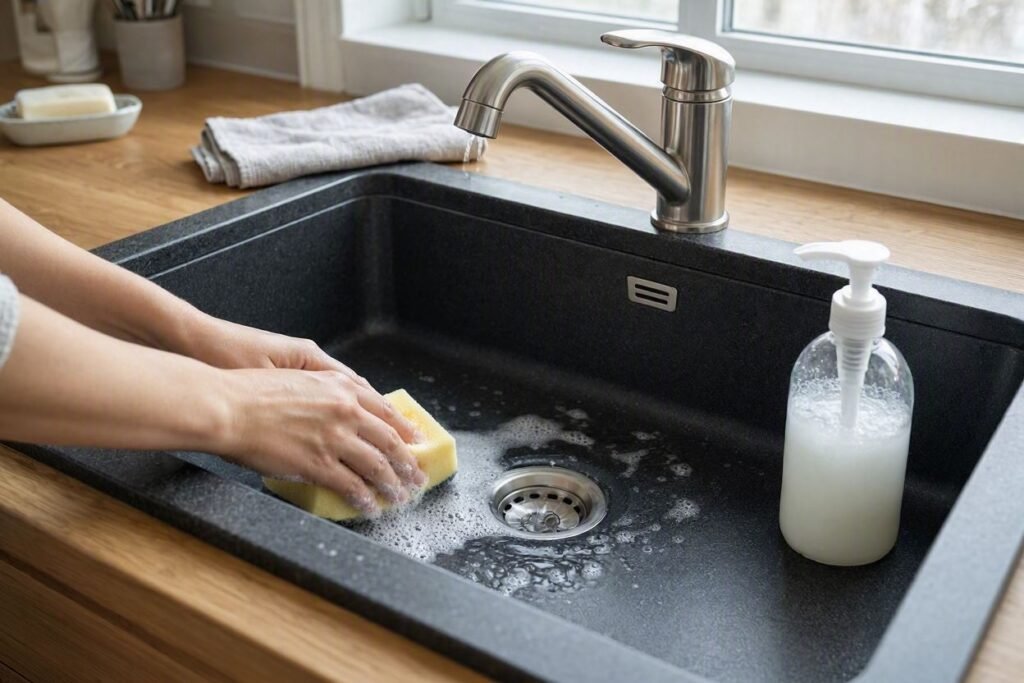
Avoid assuming that abrasive cleaners, bleach, steel wool, or harsh chemicals are suitable for every composite sink.
The care instructions for the exact model should always take priority.
What to Check Before Buying
Use this checklist before ordering:
- Cabinet width
- Available cabinet depth
- Overall sink dimensions
- Minimum cabinet size
- Bowl dimensions
- Bowl depth
- Single- or double-bowl configuration
- Undermount or topmount installation
- Countertop compatibility
- Cutout dimensions
- Drain location
- Faucet-hole configuration
- Sink weight
- Manufacturer’s installation instructions
- Manufacturer’s cleaning instructions
The most important step is to compare the actual product dimensions with your existing space before ordering.
Are Granite Composite Sinks Worth Considering for Small Kitchens?
A granite composite sink can be a practical option when you want a stone-like appearance and a solid composite surface.
But the right model depends heavily on the available cabinet and countertop space.
The four examples above demonstrate this clearly: a compact 21-inch-class sink with a listed 24-inch minimum cabinet requirement is a very different proposition from a 33-inch sink requiring a 36-inch cabinet.
Measure first, then compare the products that actually fit.
Frequently Asked Questions
Are granite composite sinks good for small kitchens?
Yes. They can work in small kitchens when the sink’s dimensions, cabinet requirements, and installation method fit the available space.
What size granite composite sink fits a small kitchen?
There is no universal size. Cabinet width, countertop depth, plumbing clearance, installation method, and the manufacturer’s minimum cabinet requirement all affect the appropriate sink size.
Are granite composite sinks durable?
Granite composite products are generally designed for everyday kitchen use, but durability varies by material formulation and manufacturer. Check the specifications and care instructions for the exact model.
Are granite composite sinks heavy?
They can be heavier than some stainless steel sinks. Check the product specifications and installation requirements before replacing an existing sink.
Can granite composite sinks be undermounted?
Many models are designed for undermount installation. Some also support topmount or other installation methods. Always check the individual product.
Is a 21-inch granite composite sink suitable for a small kitchen?
A 21-inch-class model can be an option when cabinet space is limited. For example, the Dcolora model listed above specifies a 24-inch minimum base cabinet. The actual countertop and cutout requirements still need to be checked before installation.
Are granite composite sinks easy to clean?
Routine cleaning is generally straightforward, but cleaning products and procedures vary by manufacturer. Mild soap, water, and a soft cloth or sponge are commonly used for routine cleaning.
Do granite composite sinks scratch?
Composite sinks are designed for everyday use, but no sink surface should be treated as completely scratch-proof. Use the manufacturer’s recommended cleaning methods and avoid abrasive materials unless specifically approved.
Can you put hot pans in a granite composite sink?
Heat performance varies between products. Some manufacturers specify heat-resistant properties, but you should follow the exact sink manufacturer’s instructions for hot cookware.
Conclusion
A granite composite sink can give a small kitchen a different look from traditional stainless steel while offering a solid, stone-inspired surface.
The key is to choose based on fit first and appearance second.
Measure your cabinet, check the sink’s actual dimensions and minimum cabinet requirement, confirm the installation method, and review the manufacturer’s care instructions.
If you’re comparing compact options, pay particular attention to cabinet requirements. A sink that looks compact in a product photo may still need a wider cabinet than your kitchen has available.

Khadija is the writer and founder of Tiny Sink Solution. She creates practical guides about small kitchen sinks, faucets, and compact kitchen maintenance, helping homeowners and renters choose solutions for limited spaces. Some articles contain affiliate links, and as an Amazon Associate, she earns from qualifying purchases at no extra cost to readers
![Top [count] Gardening Blogs - OnToplist.com](https://www.ontoplist.com/images/ontoplist32.png?id=6aa4d0c493161)