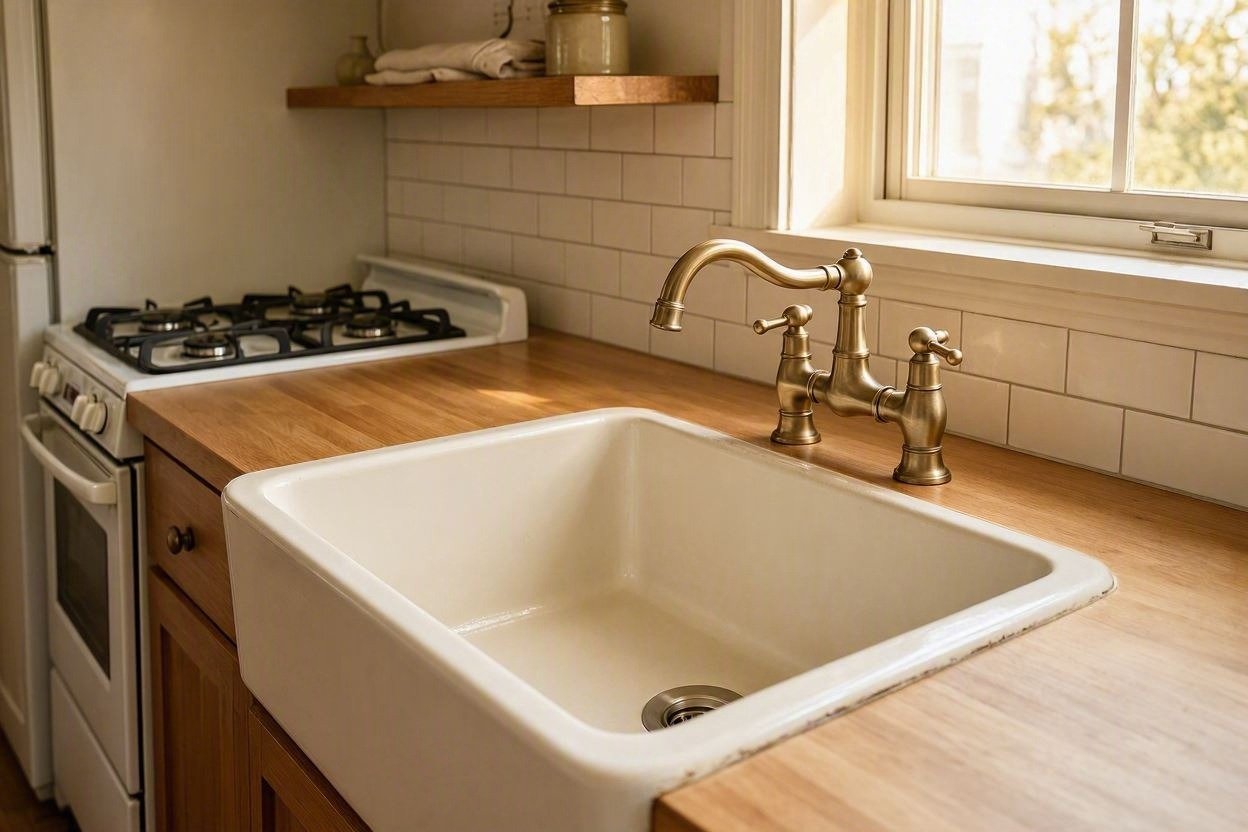
Fireclay kitchen sinks can bring a classic farmhouse look to a compact kitchen while offering a smooth, glazed surface that is relatively easy to maintain. However, fireclay sinks are also heavier than many other sink materials, so cabinet support, installation, and accurate measurements are especially important.
For a small kitchen, choosing the right fireclay sink is about more than finding a sink that fits the countertop. You also need to consider cabinet width, sink depth, installation type, weight, countertop compatibility, and plumbing clearance.
Quick Answer: Fireclay kitchen sinks can work well in small kitchens when the cabinet and countertop can properly accommodate the sink. They offer a smooth glazed surface and a traditional appearance, but their weight can make installation more demanding. Always check the exact sink dimensions, minimum cabinet requirements, support requirements, and installation instructions before buying.
What Is a Fireclay Kitchen Sink?
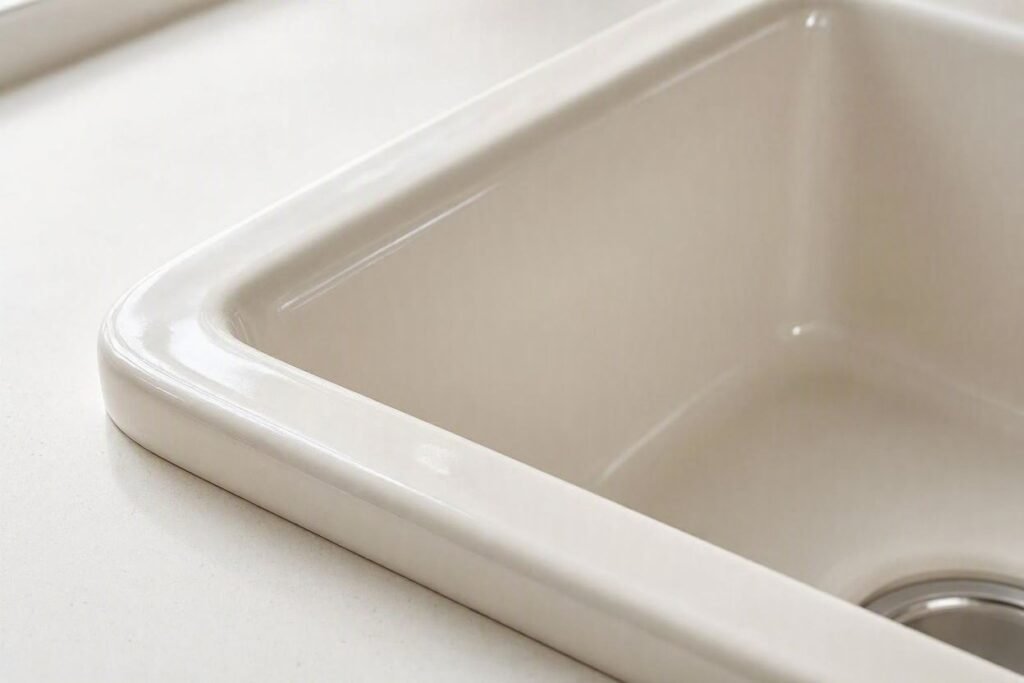
Fireclay is a ceramic-based sink material made from clay that is formed and fired at high temperatures before receiving a glazed finish.
The result is a solid sink with a smooth, glossy surface. White is one of the most common finishes, which is why fireclay sinks are particularly popular in farmhouse, traditional, cottage, and transitional kitchens.
Unlike stainless steel sinks, fireclay sinks are not made from thin sheets of metal. Their solid construction gives them a substantial feel, but that construction also means they can be significantly heavier.
Fireclay sinks are available in different configurations, including farmhouse/apron-front and some undermount or dual-mount designs.
Why Is Fireclay Popular?
Homeowners often choose fireclay because of its:
- Classic appearance
- Smooth glazed surface
- White finish options
- Solid construction
- Traditional farmhouse styling
- Easy routine cleaning
For a small kitchen, the appearance can be especially useful if you want the sink to become a visual feature rather than simply a functional fixture.
Are Fireclay Sinks Good for Small Kitchens?
Yes, a fireclay sink can work in a small kitchen, but cabinet compatibility is more important than the sink’s advertised width alone.
A sink that is 30 or 32 inches wide may look compact compared with larger farmhouse sinks, but it can still require a relatively large base cabinet and substantial structural support.
Before buying, check:
- Overall sink width
- Overall sink depth
- Sink height
- Minimum cabinet size
- Installation type
- Cabinet support requirements
- Countertop compatibility
- Drain position
- Plumbing clearance
- Garbage-disposal requirements, if applicable
A smaller kitchen does not automatically mean that every smaller fireclay sink will fit.
Compact Kitchen Tip
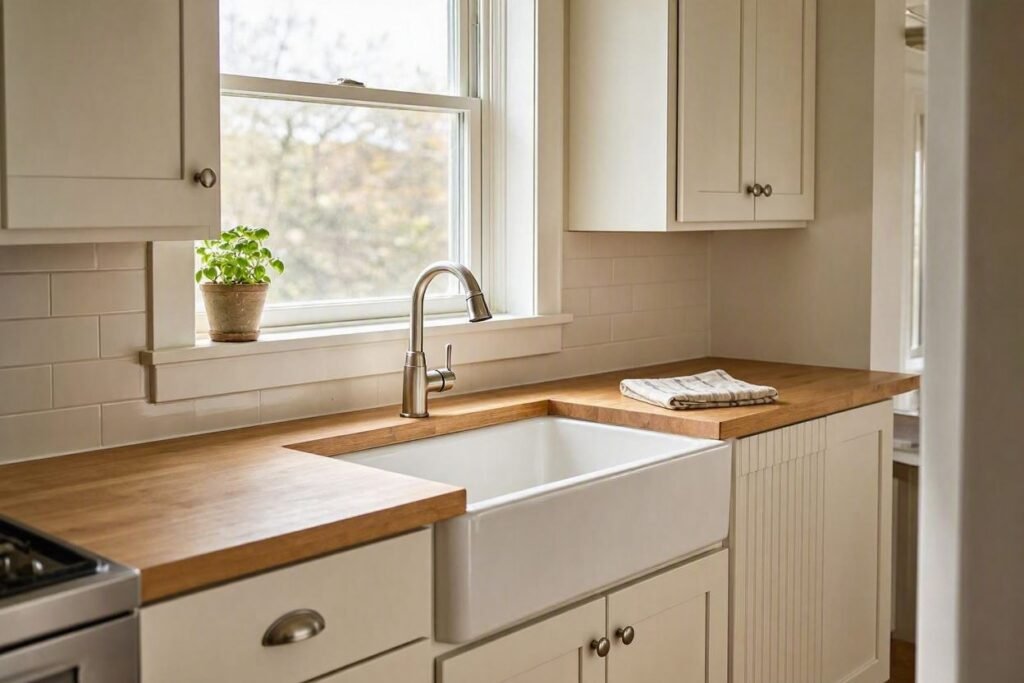
If you’re replacing an existing sink, don’t remove the old sink or order the new one based only on the old sink’s width.
Measure the cabinet, countertop opening, available depth, and plumbing area first.
Fireclay Sink Pros
1. Classic Appearance
One of the biggest reasons people choose fireclay is its appearance.
A glossy white fireclay sink can work particularly well with:
- White cabinets
- Wood cabinets
- Shaker-style cabinets
- Farmhouse kitchens
- Cottage kitchens
- Traditional kitchens
- Transitional kitchens
A fireclay sink can also become a focal point in a small kitchen without requiring a complicated design.
2. Smooth Glazed Surface
Fireclay sinks typically have a smooth glazed surface that gives them their characteristic glossy appearance.
This can make everyday cleaning relatively straightforward because food residue is less likely to cling to a smooth surface than to a rough or heavily textured one.
However, cleaning instructions vary by manufacturer, so always follow the care instructions supplied with your sink.
3. Solid Construction
Fireclay sinks have a substantial, solid construction.
The products covered later in this guide are marketed as heavy-duty fireclay sinks and are designed for regular kitchen use.
That solid construction can be appealing if you prefer the feel of a traditional ceramic-style sink.
4. Good Fit for Farmhouse Styles
Fireclay is particularly associated with farmhouse and apron-front sinks.
If you want a traditional farmhouse appearance in a smaller kitchen, a compact apron-front fireclay sink may provide the style you’re looking for without using the width of a very large double-bowl sink.
5. Single-Bowl Designs Can Be Practical
Many fireclay sinks are available with a single large bowl.
For a small kitchen, a single bowl can make it easier to wash larger cookware because the available basin space isn’t divided by a center divider.
This can be useful when you regularly wash:
- Pots
- Baking trays
- Frying pans
- Large dishes
- Mixing bowls
Fireclay Sink Cons
1. Fireclay Sinks Can Be Heavy
Weight is one of the most important considerations when choosing a fireclay sink.
The exact weight varies by model, size, and construction, but fireclay sinks are generally much more substantial than lightweight stainless steel models.
This means the cabinet needs to provide adequate support.
For a small kitchen, this is especially important because compact cabinetry may not have been designed for a heavy farmhouse-style sink.
Never assume that an existing cabinet can support a fireclay sink simply because the sink fits inside it.
2. Installation Can Be More Complicated
Fireclay installation can require more planning than installing a lightweight sink.
Depending on the model, you may need:
- Cabinet modifications
- Additional support
- A custom support frame
- Accurate countertop cutout measurements
- Special installation hardware
- Additional help when positioning the sink
Always follow the installation instructions for the exact model.
3. Cabinet Size Matters
A sink’s advertised dimensions don’t tell you the entire story.
For example, one of the products in this guide is 33 inches wide but specifically lists a 36-inch minimum required cabinet size.
That means someone with a 33- or 34-inch cabinet should not assume the sink will fit simply because the sink itself is 33 inches wide.
4. Deep Bowls Can Affect Plumbing Space
Many fireclay sinks have deep bowls.
A deeper sink can be useful for washing large cookware, but it can also reduce the space available below the sink for:
- Drain plumbing
- P-trap
- Garbage disposal
- Other plumbing components
Check the sink depth and the available cabinet space before purchasing.
5. Abrasive Cleaners Should Be Avoided Unless Approved
A glazed fireclay surface should be treated according to the manufacturer’s care instructions.
Avoid assuming that a cleaner suitable for stainless steel or another sink material is automatically suitable for fireclay.
Use the manufacturer’s recommended cleaning products and methods.
Fireclay vs. Stainless Steel for a Small Kitchen
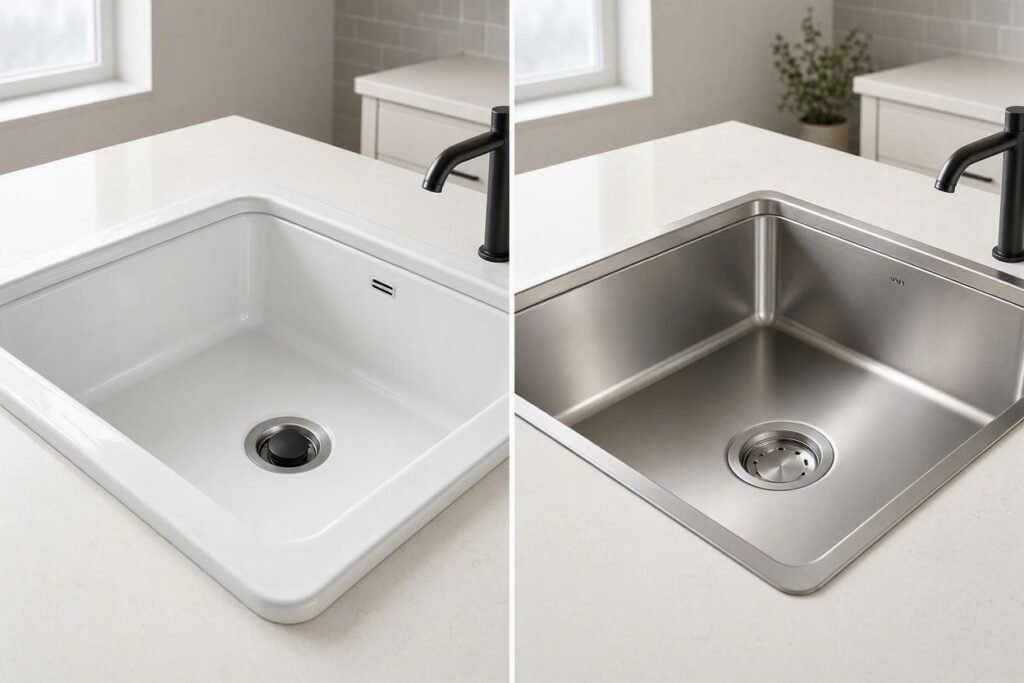
Both materials can work in compact kitchens, but they have different characteristics.
| Feature | Fireclay | Stainless Steel |
|---|---|---|
| Appearance | Traditional and ceramic-like | Modern and versatile |
| Surface | Glazed | Metal |
| Weight | Generally heavier | Generally lighter |
| Farmhouse styling | Excellent fit | Less traditional |
| Installation | May require additional support | Often simpler depending on model |
| Maintenance | Generally straightforward | Generally straightforward |
| Small-kitchen use | Good when cabinet support is adequate | Often flexible |
| Main consideration | Weight and installation | Finish, gauge, noise, and care |
What Size Fireclay Sink Works in a Small Kitchen?
There isn’t one universal size that defines a small fireclay sink.
Instead, start with your cabinet width.
A fireclay sink that looks relatively compact can still require a larger base cabinet because the cabinet needs to accommodate the sink and provide sufficient structural support.
30-Inch Fireclay Sinks
A 30-inch fireclay sink can be an option for a kitchen where cabinet space is limited but enough room remains for a larger single-bowl sink.
For example, the GETPRO model discussed below measures 30 × 18 inches.
However, always verify the manufacturer’s cabinet requirements before purchasing.
32-Inch Fireclay Sinks
A 32-inch sink can provide a larger washing area while still being smaller than many oversized farmhouse sinks.
The Miuara model discussed below is listed at approximately 31.88 × 19 × 10 inches.
Because of its size and weight, adequate cabinet support is important.
33-Inch Fireclay Sinks
A 33-inch fireclay sink provides a generous basin but requires more cabinet space.
The Logmey model below specifically states a 36-inch minimum cabinet size.
For a compact kitchen, that requirement should be checked before considering the sink.
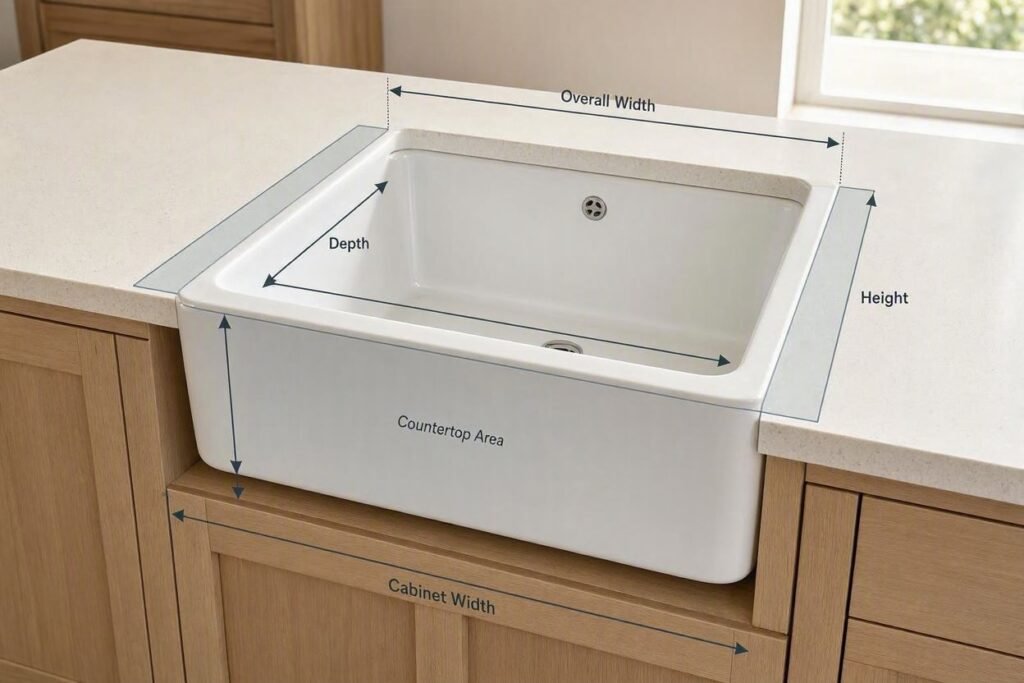
What to Measure Before Buying a Fireclay Sink
Before ordering a fireclay sink, measure more than the existing sink.
1. Cabinet Width
Start with the base cabinet.
Check both the available cabinet dimensions and the sink manufacturer’s minimum cabinet requirement.
2. Countertop Depth
Measure the available countertop depth from the front edge to the backsplash.
A sink that is too deep may not leave enough usable countertop space.
3. Sink Height
Check the overall height of the sink.
This is especially important for farmhouse and apron-front installations.
4. Existing Cutout
If you’re replacing an existing sink, measure the countertop opening.
Do not assume that the new sink will use exactly the same cutout.
If you’re unsure about the required opening, use our Sink Cutout Size Calculator as a planning tool.
5. Plumbing Clearance
Measure the space underneath the sink.
Pay particular attention to:
- Drain location
- P-trap
- Water lines
- Garbage disposal
- Cabinet shelves
- Other plumbing components
6. Minimum Cabinet Requirement
This may be one of the most important measurements.
Always compare your cabinet width with the manufacturer’s stated minimum cabinet size.
For example, the Logmey 33-inch model below specifies a 36-inch minimum cabinet size.
If you’re unsure what sink size your cabinet can accommodate, our Cabinet Size Checker can help with preliminary planning.
Fireclay Small Kitchen Sinks to Consider
Once you’ve checked your cabinet and countertop measurements, you can start comparing actual fireclay sink options.
The following products represent three different approaches: a dual-mount sink, a 30-inch farmhouse sink, and a reversible 33-inch farmhouse sink.
Affiliate disclosure: As an Amazon Associate, Tiny Sink Solutions may earn from qualifying purchases.
1. Miuara 32-Inch Fireclay Kitchen Sink
The Miuara 32 × 19-inch fireclay kitchen sink is a dual-mount design that can be used for either undermount or top-mount installation.
Its glossy white finish and single-bowl design give it a traditional appearance, while the dual-mount configuration provides more installation flexibility.
The product listing gives the overall dimensions as approximately 31.88 inches wide × 19 inches deep × 10 inches high.
It is described as having a smooth glazed surface, a gently sloped bottom toward the center drain, and compatibility with a 3.5-inch garbage disposal opening.
The listing also states that the sink requires sufficient support because of its substantial fireclay construction.
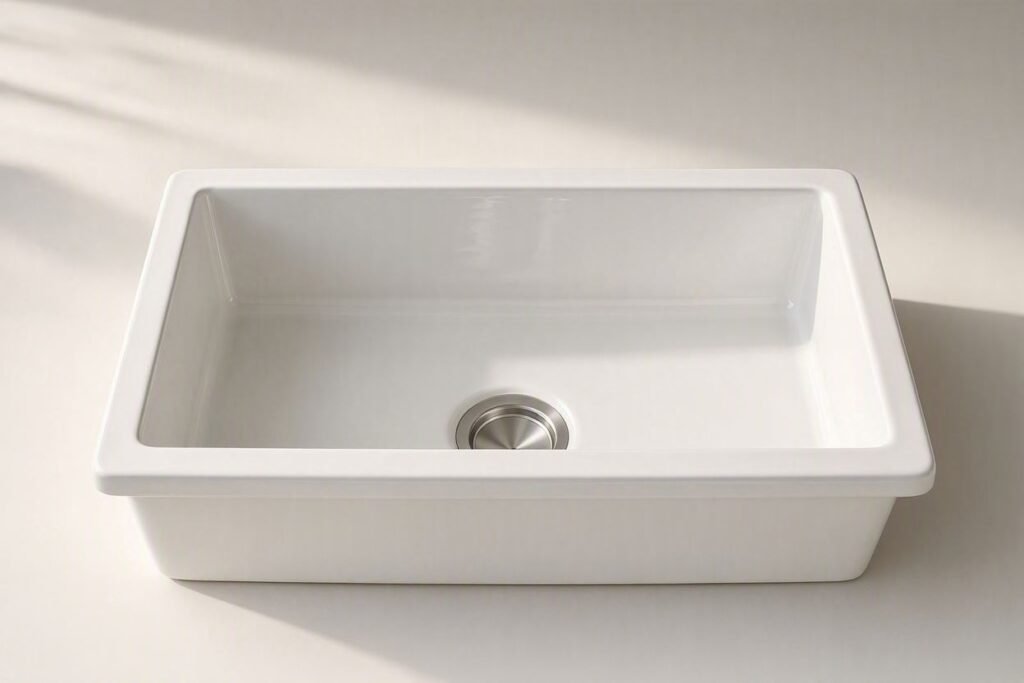
Miuara Key Details
- Brand: Miuara
- Material: Fireclay
- Color: Glossy white
- Overall size: 32 × 19 × 10 inches
- Installation: Undermount or top-mount
- Bowl: Single bowl
- Style: Traditional white fireclay
- Main advantage: Dual-mount flexibility
- Important consideration: Verify cabinet support and plumbing clearance
2. GETPRO 30-Inch Fireclay Farmhouse Sink
The GETPRO 30 × 18-inch fireclay farmhouse sink is a smaller apron-front option designed around a traditional farmhouse appearance.
The listing describes it as a single-bowl fireclay sink with a 10-inch-deep basin and glossy white finish.
The product is marketed as resistant to staining, scratching, heat, and discoloration. Its single-bowl design provides room for larger cookware while maintaining a 30-inch overall width.
For a small kitchen, the 30-inch width may make it worth considering, but cabinet dimensions and support should still be verified before purchase.
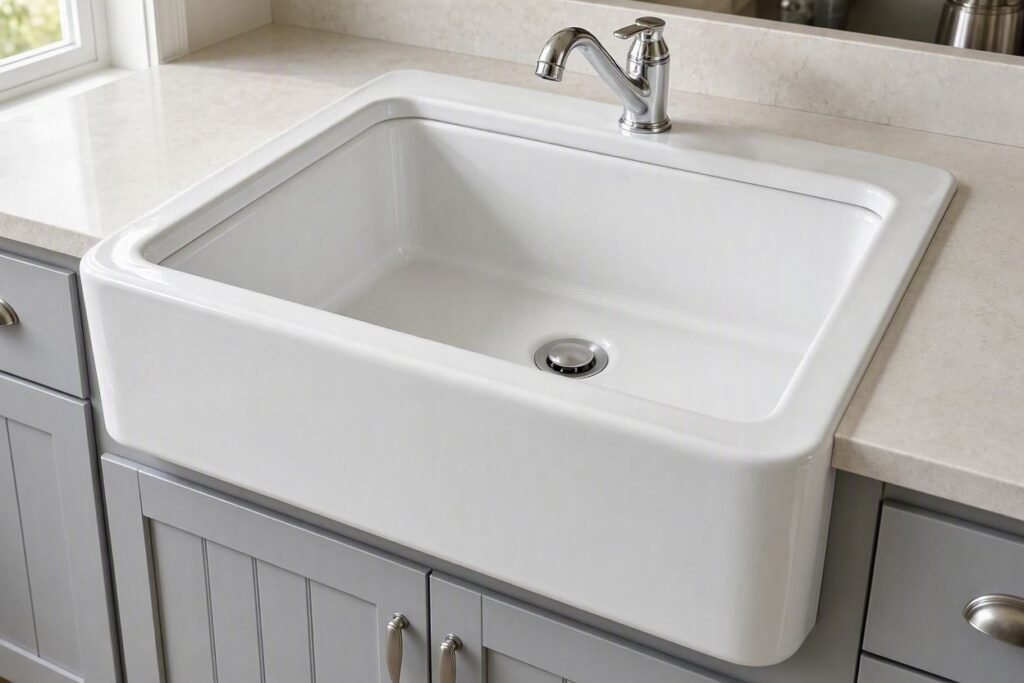
GETPRO Key Details
- Brand: GETPRO
- Material: Fireclay
- Color: Glossy white
- Size: 30 × 18 inches
- Bowl depth: 10 inches
- Installation: Listed as undermount
- Bowl: Single bowl
- Style: Farmhouse/apron-front
- Main advantage: Smaller farmhouse format
- Important consideration: Verify cabinet dimensions and installation requirements
3. Logmey 33-Inch Reversible Fireclay Farmhouse Sink
The Logmey 33 × 18-inch reversible fireclay farmhouse sink is the largest of the three options.
Its reversible apron gives you the choice of placing either the flat or fluted side toward the front, which can make it easier to coordinate the sink with different kitchen styles.
The product listing specifies overall dimensions of 33 × 18 × 10 inches and states a 36-inch minimum required cabinet size.
That cabinet requirement is particularly important for anyone planning this sink for a smaller kitchen.
The listing also states that the package includes a bottom rinse grid and stainless steel drain assembly.
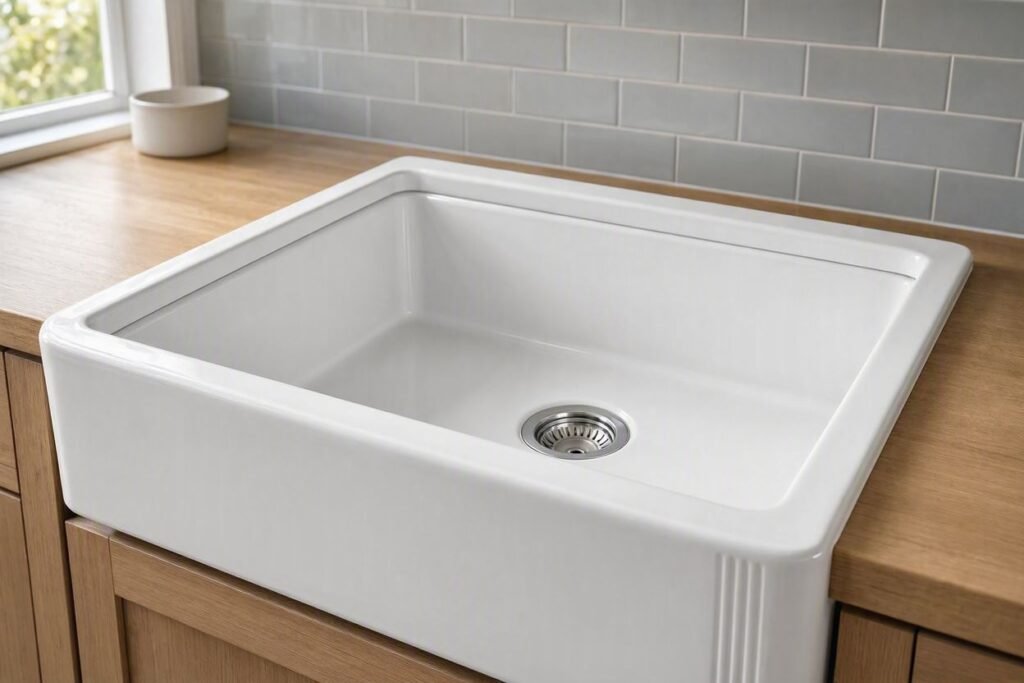
Logmey Key Details
- Brand: Logmey
- Material: Fireclay
- Color: White
- Size: 33 × 18 × 10 inches
- Minimum cabinet size: 36 inches
- Installation: Farmhouse/undermount
- Bowl: Large single bowl
- Front: Reversible flat/fluted design
- Main advantage: Reversible farmhouse appearance
- Important consideration: Requires a 36-inch minimum cabinet according to the listing
Fireclay Sink Comparison
| Product | Size | Installation | Bowl | Notable Feature | Cabinet Consideration |
|---|---|---|---|---|---|
| Miuara | 32 × 19 × 10 in | Undermount / Top-mount | Single | Dual-mount design | Verify support and fit |
| GETPRO | 30 × 18 × 10 in | Listed as undermount | Single | Compact farmhouse format | Verify cabinet requirements |
| Logmey | 33 × 18 × 10 in | Farmhouse / Undermount | Single | Reversible apron | 36-inch minimum cabinet |
These products are different sizes and configurations, so compare them against your own cabinet and installation requirements rather than choosing based only on overall width.
Which Fireclay Sink Style Should You Consider?
The right configuration depends on your kitchen layout.
Choose a Dual-Mount Design If:
You want more flexibility in how the sink is installed.
The Miuara model, for example, is described as supporting both undermount and top-mount installation.
Consider a 30-Inch Farmhouse Sink If:
You want an apron-front appearance but have less cabinet width available than a larger farmhouse sink requires.
The GETPRO 30 × 18-inch model is an example of this format.
Consider a Reversible Farmhouse Sink If:
You want the option of changing the visible apron style.
The Logmey model provides a flat side and fluted side, but its stated 36-inch minimum cabinet requirement should be checked carefully.
Fireclay Sink Installation Considerations
Fireclay installation requires careful planning.
Cabinet Support
A fireclay sink can be considerably heavier than a stainless steel sink.
The cabinet should be capable of supporting the sink securely, including the additional load created when the basin is filled with water and dishes.
If the manufacturer’s installation instructions call for additional support, don’t skip that step.
If you’re specifically considering an undermount fireclay sink, you can also compare the installation requirements with our guide to Best Undermount Small Kitchen Sinks for Compact Kitchens.
Undermount Installation
With an undermount sink, the countertop opening needs to be accurate.
The sink should be installed according to the manufacturer’s specifications for the particular model.
This is especially important with stone or solid-surface countertops.
Farmhouse Installation
Apron-front sinks can require cabinet modifications because part of the sink extends toward the front of the cabinet.
Measure carefully before cutting or modifying cabinetry.
Garbage Disposal
If you plan to use a garbage disposal, check the sink’s drain opening, bottom thickness, and clearance requirements.
The Miuara and Logmey listings provided for this article specifically mention requirements related to garbage-disposal installation.
Don’t assume every fireclay sink will work with every disposal configuration.
How to Maintain a Fireclay Kitchen Sink
A fireclay sink can be relatively easy to maintain when cleaned correctly.
Daily Cleaning
After using the sink:
- Remove food particles.
- Rinse the basin.
- Wipe the surface with a soft cloth or sponge.
- Remove standing water when practical.
- Follow the manufacturer’s recommended cleaning routine.
Avoid Harsh Abrasives
Avoid abrasive cleaners unless the manufacturer specifically recommends them.
Harsh products can affect the appearance of a glazed surface.
Deal With Stains Promptly
If food, tea, coffee, or other substances leave marks, clean them according to the manufacturer’s care instructions rather than immediately reaching for an aggressive cleaner.
Keep the Sink Dry When Possible
Wiping away excess water can help reduce water spots and mineral buildup, especially in areas with hard water.
Common Fireclay Sink Buying Mistakes
Mistake 1: Choosing Based Only on Width
A 30-inch sink does not necessarily require a 30-inch cabinet.
Always check the minimum cabinet requirement.
Mistake 2: Ignoring Sink Weight
Fireclay is heavy.
Make sure your cabinet and support structure are suitable.
Mistake 3: Forgetting Sink Depth
A 10-inch-deep basin can provide useful washing space, but it also occupies space below the countertop.
Check plumbing clearance.
Mistake 4: Assuming Existing Cutout Will Work
A replacement sink may require a different countertop opening.
Verify the manufacturer’s cutout requirements before modifying the countertop.
Mistake 5: Buying Before Checking Installation Type
Make sure you know whether the sink is:
- Undermount
- Top-mount
- Farmhouse/apron-front
- Dual-mount
The installation type can affect both the cabinet and countertop.
What to Look for When Buying a Fireclay Sink
Use this checklist before purchasing:
1. Overall Dimensions
Check the complete width, depth, and height.
2. Minimum Cabinet Size
This is especially important in a small kitchen.
3. Sink Weight
Confirm whether your cabinet requires additional support.
4. Installation Type
Choose a configuration that works with your countertop and cabinets.
5. Bowl Size
A single bowl may provide more useful washing space in a compact kitchen.
6. Bowl Depth
Make sure the depth works with your plumbing underneath.
7. Drain Position
Check whether the drain location works with your existing plumbing.
8. Garbage Disposal Compatibility
If you use a disposal, check the manufacturer’s requirements.
9. Countertop Compatibility
Verify the sink is appropriate for your countertop material and installation method.
10. Manufacturer Instructions
Always read the installation and care instructions for the exact model.
Fireclay vs. Other Sink Materials
Fireclay isn’t the only option for a small kitchen.
Depending on your priorities, you may also want to compare it with:
- Stainless steel
- Granite composite
- Porcelain/ceramic
- Cast iron
Fireclay is particularly attractive if appearance and traditional styling are important. Stainless steel may be worth considering if low weight and installation flexibility are higher priorities.
If you’re comparing different materials, don’t focus only on appearance. Consider weight, durability, maintenance, cabinet requirements, installation, and available space.
Fireclay Small Kitchen Sink Buying Checklist
Before purchasing, confirm:
☐ Sink width fits the available cabinet
☐ Minimum cabinet size has been verified
☐ Sink depth works with the countertop
☐ Sink height works with the cabinet
☐ Cabinet support is adequate
☐ Installation type matches your kitchen
☐ Countertop compatibility has been checked
☐ Cutout requirements have been verified
☐ Drain location works with existing plumbing
☐ Garbage-disposal compatibility has been checked
☐ Cleaning requirements are understood
☐ Product dimensions have been verified before ordering
Final Takeaway
A fireclay kitchen sink can be a practical choice for a small kitchen when you want a traditional appearance, smooth glazed surface, and substantial single-bowl design.
The main advantages are its classic appearance, smooth surface, solid construction, and suitability for farmhouse-style kitchens.
The main trade-offs are weight, cabinet support, installation requirements, and the need for careful measurements.
For a compact kitchen, don’t choose a fireclay sink based only on its advertised width. Start with your cabinet dimensions, then check the sink’s depth, height, minimum cabinet requirement, installation type, support requirements, and plumbing clearance.
If those measurements work, a smaller fireclay sink can give a compact kitchen the traditional look and generous washing space many homeowners want.
Frequently Asked Questions
Are fireclay sinks good for small kitchens?
Yes, but the cabinet and installation requirements must be checked carefully. A fireclay sink can work well in a small kitchen when its dimensions and support requirements fit the available space.
Are fireclay sinks heavy?
Yes, fireclay sinks are generally substantial and heavier than many stainless steel sinks. The exact weight varies by model, so check the manufacturer’s specifications before installation.
Do fireclay sinks need cabinet support?
They may require additional structural support depending on the model and installation method. Always follow the manufacturer’s installation instructions.
Are fireclay sinks easy to clean?
Their smooth glazed surfaces can make routine cleaning straightforward. Use the cleaning products and methods recommended by the manufacturer.
Can fireclay sinks scratch?
The glazed surface is designed for kitchen use, but improper cleaning products or abrasive materials can damage the finish. Follow the manufacturer’s care instructions.
Can I install a fireclay sink in an existing cabinet?
Possibly. It depends on the sink’s dimensions, installation type, cabinet construction, and support requirements. Farmhouse sinks may also require cabinet modifications.
Are fireclay sinks only available as farmhouse sinks?
No. Fireclay is commonly used for farmhouse sinks, but some models are designed for undermount or dual-mount installation as well.
Is a fireclay sink better than stainless steel?
The two materials have different characteristics. Fireclay offers a traditional glazed appearance and substantial construction, while stainless steel is generally lighter and available in a wide range of configurations.
The better choice depends on your kitchen layout and priorities.
What should I measure before buying a fireclay sink?
Measure the cabinet width, cabinet height, countertop depth, existing cutout if applicable, sink clearance, plumbing space, and available area underneath the countertop. Also check the manufacturer’s minimum cabinet requirement.
Can a fireclay sink work with a garbage disposal?
Some fireclay sinks are designed to work with garbage disposals, but requirements can vary. Check the drain opening, sink thickness, flange requirements, and manufacturer’s instructions for the specific model.

Khadija is the writer and founder of Tiny Sink Solution. She creates practical guides about small kitchen sinks, faucets, and compact kitchen maintenance, helping homeowners and renters choose solutions for limited spaces. Some articles contain affiliate links, and as an Amazon Associate, she earns from qualifying purchases at no extra cost to readers


![Top [count] Gardening Blogs - OnToplist.com](https://www.ontoplist.com/images/ontoplist32.png?id=6aa4d0c493161)
One Comment