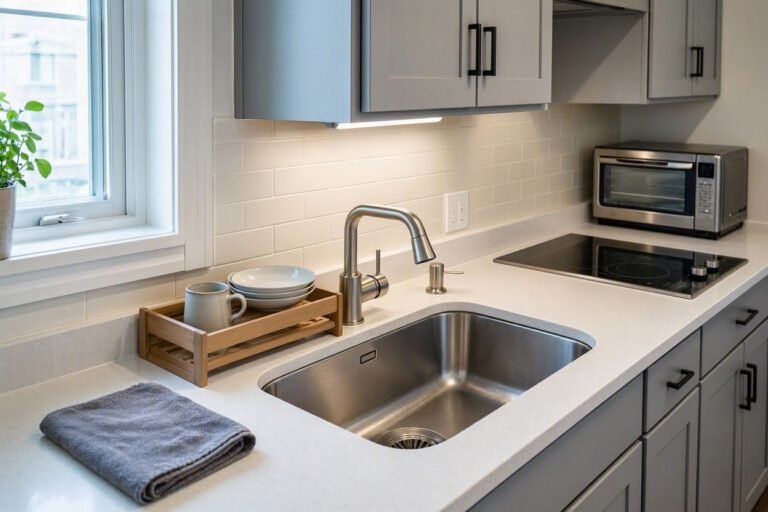
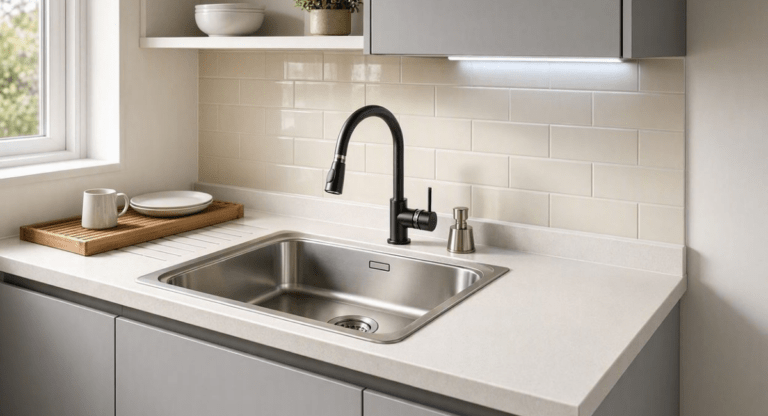
Choosing the right kitchen sink involves more than finding a size that fits your cabinet. Kitchen sink countertop compatibility depends on the countertop material, sink material, mounting style, and support requirements. A sink that works well with a quartz countertop may need a different installation approach on laminate or wood.
Quartz, granite, and some solid-surface countertops are commonly used with undermount sinks, while top-mount sinks are often a practical choice for laminate countertops. However, the correct installation depends on the specific products and their manufacturers’ instructions.
Before purchasing a sink, check the required cutout dimensions, mounting hardware, cabinet clearance, moisture protection, and support requirements. These details can help you avoid installation problems and choose a sink that works well with your kitchen.
Why Kitchen Sink and Countertop Compatibility Matters
Your countertop and sink work together every day. Water, cleaning products, heavy cookware, and regular use can affect both materials, particularly around the sink opening.
Choosing a compatible sink and countertop combination can help you:
- Reduce the risk of moisture damage around exposed edges.
- Select an appropriate mounting method.
- Ensure the sink has adequate support.
- Make cleaning and everyday maintenance easier.
- Avoid problems caused by incorrect cutout dimensions.
- Make better use of limited counter and cabinet space.
The most important step is to confirm compatibility before cutting the countertop or ordering a replacement sink.
Kitchen Sink Countertop Compatibility Chart
The following table provides general guidance on common countertop materials and sink installation options.
| Countertop Material | Common Sink Installation | Important Consideration |
|---|---|---|
| Quartz | Undermount or top-mount, depending on the product | Confirm fabrication, mounting, and support requirements |
| Granite | Undermount or top-mount | Check cutout dimensions and mounting hardware |
| Marble | Undermount or top-mount | Protect exposed edges and use suitable cleaners |
| Solid Surface | Undermount, integrated, or top-mount | Confirm manufacturer-approved installation methods |
| Laminate | Commonly top-mount | Protect exposed cut edges from moisture |
| Wood or Butcher Block | Often top-mount | Waterproofing and ongoing maintenance are important |
| Tile | Depends on the countertop construction | Consider grout lines, edge finishing, and structural support |
| Stainless Steel | Depends on the countertop design | Confirm the attachment and fabrication method |
These are general examples, not universal installation approvals. Always check the sink manufacturer’s instructions and consult your countertop fabricator when necessary.
1. Quartz Countertops
Quartz countertops are commonly paired with undermount stainless steel sinks. This combination creates a clean appearance because the sink sits beneath the countertop, allowing crumbs and small spills to be wiped toward the basin.
Top-mount sinks may also work with quartz, provided the sink and countertop are designed for that installation.
Before installing a sink in quartz, confirm the following:
- The required sink cutout dimensions.
- The countertop manufacturer’s fabrication requirements.
- The approved mounting hardware or attachment system.
- Whether additional sink support is necessary.
- The correct sealing method around the opening.
Do not assume that every quartz countertop or sink model uses the same installation method. The countertop fabricator and sink manufacturer should confirm the appropriate setup.
2. Granite Countertops
Granite is another popular countertop material for undermount kitchen sinks. When fabricated correctly, the finished countertop edge can provide an attractive transition between the stone and the sink.
However, granite does not eliminate the need for proper mounting and support. The sink must be secured using a suitable installation system designed for the particular countertop and sink.
Before installation, check the cutout dimensions, edge finish, mounting hardware, and any additional support requirements.
Granite also has its own care needs. Use cleaning products appropriate for the particular stone and avoid assuming that a cleaner suitable for the sink is automatically safe for the countertop.
3. Marble Countertops
Marble countertops can work with different sink styles when the countertop construction and sink design allow the installation.
One important consideration is protecting the marble from acidic substances and unsuitable cleaning products. Some common kitchen spills, including lemon juice and vinegar, can dull or etch marble surfaces.
For an undermount sink, ask the fabricator to confirm the cutout design, finished edges, mounting system, and support requirements.
Wipe up spills promptly and follow the stone supplier’s recommendations for cleaning and sealing. Sealing may help reduce staining, but it does not make marble resistant to every type of damage.
4. Solid-Surface Countertops
Solid-surface countertops can accommodate several sink designs, including undermount and integrated sinks, depending on the product.
An integrated sink may create a continuous-looking surface with fewer visible joints. An undermount sink can also provide a clean appearance when the countertop and sink are designed for that installation.
Before choosing a sink, confirm which mounting methods the countertop manufacturer permits. Ask about cutout preparation, joints, sealing, and any product-specific installation requirements.
Do not assume that all solid-surface products have identical properties or support the same sink configurations.
5. Laminate Countertops
Laminate countertops commonly use top-mount sinks. The sink’s rim rests on the countertop and covers the edge of the opening.
This can be a practical arrangement because the exposed cut edge of a laminate countertop may contain a moisture-sensitive substrate. If water enters an unprotected edge, the material can swell or deteriorate.
To reduce the risk of damage:
- Measure the cutout according to the sink manufacturer’s template.
- Make sure the sink rim covers the opening as intended.
- Protect exposed edges using the recommended sealing method.
- Install the sink according to the manufacturer’s instructions.
- Wipe away standing water around the rim.
A conventional laminate countertop should not automatically be considered suitable for an undermount sink. Such an installation requires a specifically designed and approved countertop construction and mounting solution.

6. Wood and Butcher-Block Countertops
Wood and butcher-block countertops add warmth and natural character to a kitchen. However, the area around a sink requires careful moisture management.
Water can enter exposed cut edges, joints, and seams. Over time, this may contribute to swelling, staining, or deterioration if the wood is not adequately protected.
A top-mount sink can be a practical option because its rim covers the opening, but the rim and cut edge still need appropriate sealing.
If you prefer an undermount sink, confirm that the countertop construction and finishing system are suitable for that installation. Follow the recommended maintenance schedule and inspect the protective finish regularly.
7. Tile Countertops
Tile countertops require attention to the sink opening, tile edges, grout lines, and underlying structure.
A top-mount sink may be easier to accommodate in some tile countertop designs. Other arrangements require careful planning to ensure the cutout and finished edge are suitable for the chosen sink.
Before installation, confirm that the countertop structure provides adequate support. The sink rim should fit as intended without creating problematic gaps or interfering with surrounding tiles.
The installation method should account for the specific tile layout and countertop construction rather than relying on a general rule.
8. Stainless Steel Countertops
Stainless steel countertops are used in commercial kitchens, utility spaces, and some modern residential kitchens.
Sink compatibility depends on the countertop’s design and fabrication. Some setups use specific attachment methods or integrated construction, while others accommodate separately mounted sinks.
Do not assume that a standard residential undermount sink can be installed in every stainless steel countertop. Confirm the countertop design, sink dimensions, attachment method, and fabrication requirements before purchasing materials.
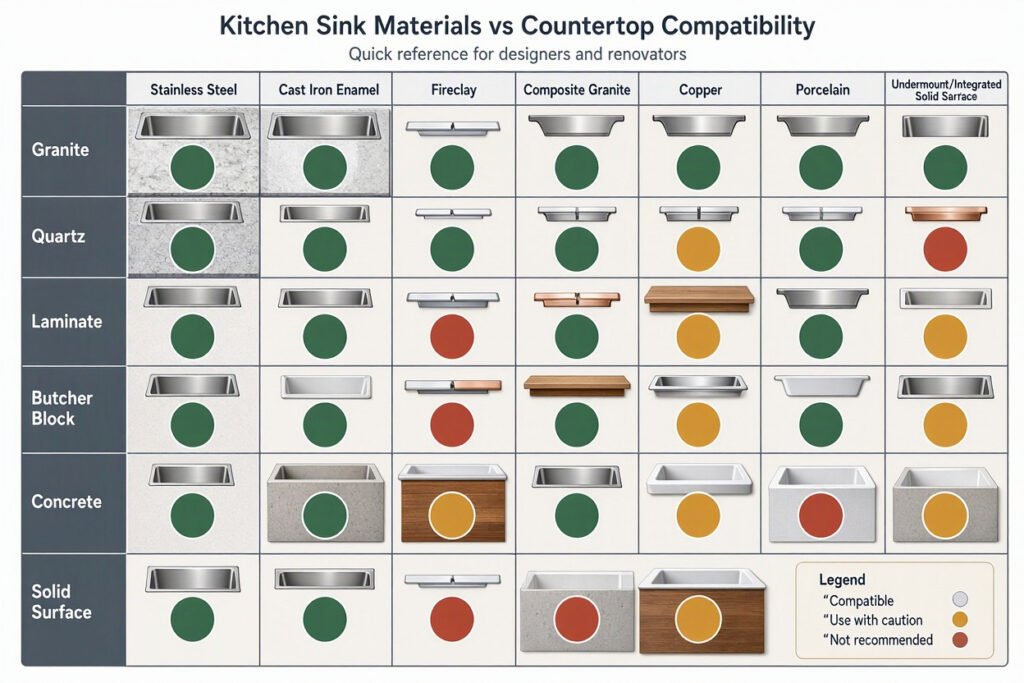
How Sink Material Affects Countertop Compatibility
The countertop is only one part of the decision. Sink material also affects weight, mounting requirements, and everyday care.
| Sink Material | What to Consider |
|---|---|
| Stainless Steel | Check the sink’s construction, mounting hardware, and support requirements. |
| Fireclay | Many models are heavy and may require additional support. |
| Cast Iron | Often heavy; confirm the required cabinet and sink support. |
| Granite or Quartz Composite | Weight and installation requirements vary by model. |
| Solid-Surface Sink | Compatibility depends on the specific product and mounting system. |
| Copper | Check the mounting design and follow material-specific care instructions. |
These are general descriptions. Actual weight, dimensions, and mounting requirements vary by product.
If you are still deciding which sink material suits your kitchen, explore the Kitchen Sink Material Selector if the tool is available on your website.
Undermount vs. Top-Mount Kitchen Sinks
Two common sink installation styles are undermount and top-mount. Understanding the difference can help you narrow down the options for your countertop.

Undermount Sinks
An undermount sink attaches beneath the countertop. The countertop edge remains visible around the opening, creating a clean transition between the work surface and the sink.
Potential advantages include:
- Easier wiping of crumbs and small spills into the basin.
- A streamlined appearance.
- No raised sink rim around the opening.
Important considerations include appropriate mounting hardware, adequate support, correct cutout fabrication, and a suitable countertop material.
Top-Mount Sinks
A top-mount sink, also called a drop-in sink, sits in the countertop opening with its rim resting on the surface.
Potential advantages include:
- Compatibility with many conventional laminate countertops.
- A visible rim that covers the cutout edge.
- A straightforward installation design for many sink models.
However, the rim and surrounding countertop still require correct sealing and regular cleaning.
Neither mounting style is automatically best for every kitchen. The right choice depends on the countertop, sink design, installation requirements, and available space.
For help checking the required opening, use the Sink Cutout Size Calculator. Always verify the final dimensions against the manufacturer’s template before cutting the countertop.
Does an Undermount Sink Need Extra Support?
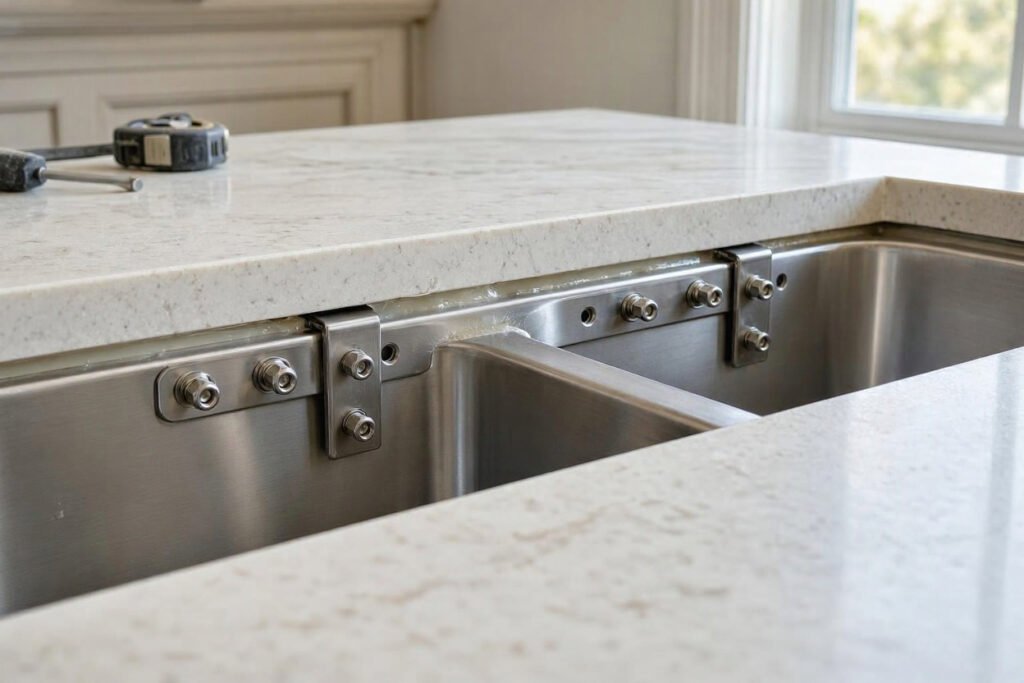
An undermount sink generally requires an approved mounting system and adequate support. The exact requirements depend on the sink’s weight, countertop material, installation design, and manufacturer instructions.
Depending on the product, an installation may use approved brackets, rails, frames, or another support system. The appropriate method should be confirmed by the sink manufacturer or qualified installer.
Before installation, check:
- The sink’s empty weight and expected load.
- The approved mounting hardware.
- Whether additional support is required.
- The cabinet’s structural strength and available clearance.
- Drain alignment and plumbing access.
- The recommended sealing method around the opening.
Avoid improvising a support system or assuming that adhesive alone is sufficient for every installation. Heavy sinks may require particular attention to cabinet and sink support.
Common Kitchen Sink and Countertop Compatibility Mistakes
Buying the Sink Before Checking the Countertop
A sink’s external dimensions do not necessarily match the opening required for installation. Check the manufacturer’s cutout template and mounting instructions before purchasing.
Assuming Every Stone Countertop Supports Every Undermount Sink
Quartz and granite are commonly paired with undermount sinks, but the specific countertop, sink, and mounting system must still be suitable for the installation.
Ignoring Exposed Edges
Laminate and wood countertops need particular attention to moisture protection around cut edges. Follow the material manufacturer’s sealing recommendations.
Overlooking Sink Weight
Heavy fireclay and cast-iron sinks may need additional support. Check the actual product specifications rather than relying on the material name alone.
Forgetting Cabinet Clearance
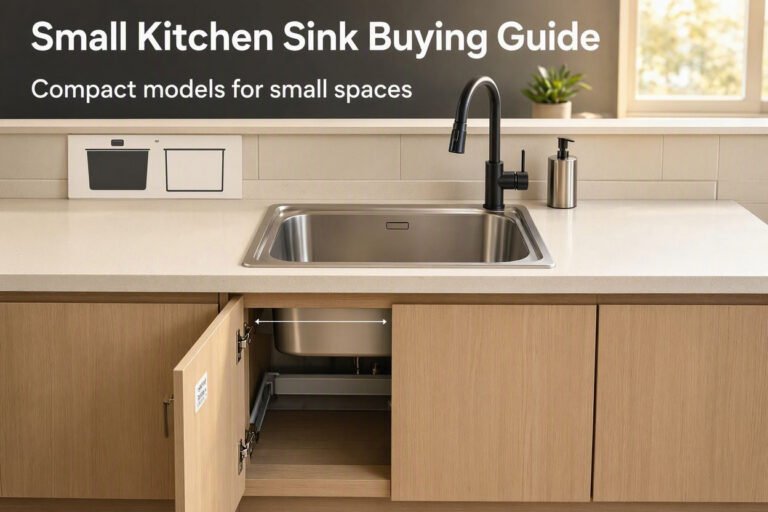
A sink may fit the countertop opening but conflict with cabinet walls, drawers, plumbing, or a garbage disposal underneath.
Measure the available space beneath the countertop before choosing a sink.
Using the Wrong Cleaning Products
Countertop and sink materials can have different cleaning requirements. A product suitable for stainless steel may not be appropriate for marble or another natural stone.
Follow the care instructions for both materials.
Kitchen Sink Countertop Compatibility Checklist
Before buying or installing your sink, confirm the following:
- The countertop material and thickness are known.
- The sink’s mounting style is approved for the countertop.
- The manufacturer’s cutout template has been checked.
- Cabinet clearance and plumbing space are sufficient.
- Sink weight and support requirements are understood.
- The correct sealing and moisture-protection methods are available.
- Cleaning and maintenance instructions are suitable for both materials.
- Any product-specific requirements have been confirmed with the manufacturer or fabricator.
Taking a few minutes to complete these checks can help prevent avoidable installation problems.
Frequently Asked Questions
Can you install an undermount sink on a quartz countertop?
Yes, many quartz countertops can accommodate undermount sinks. However, the specific sink, countertop fabrication, mounting system, and support requirements must be confirmed before installation.
Can an undermount sink be installed on a laminate countertop?
A conventional laminate countertop is generally not suitable for a standard undermount installation because the cut edge and substrate need appropriate protection and support. Only consider a system specifically designed and approved for that countertop construction.
Which sink material is best for a quartz countertop?
There is no single best material for every kitchen. Stainless steel is a common option, while other sink materials may also be suitable. Compare the product’s weight, mounting requirements, dimensions, care instructions, and overall fit before deciding.
Do heavy kitchen sinks need extra cabinet support?
Some heavy sinks, including many fireclay and cast-iron models, require additional support. Check the sink manufacturer’s instructions and confirm that the cabinet structure is adequate for the selected sink.
Does a top-mount sink protect laminate from water?
The rim can cover the cutout edge, but it does not guarantee waterproofing. Correct sealing, proper installation, and routine cleanup are still important.
Can a wood countertop work with an undermount sink?
It may be possible with an appropriately designed and approved installation. However, the exposed wood edge and surrounding joints need reliable moisture protection. Confirm the required construction and finishing method before proceeding.
Should I measure the sink or the countertop cutout?
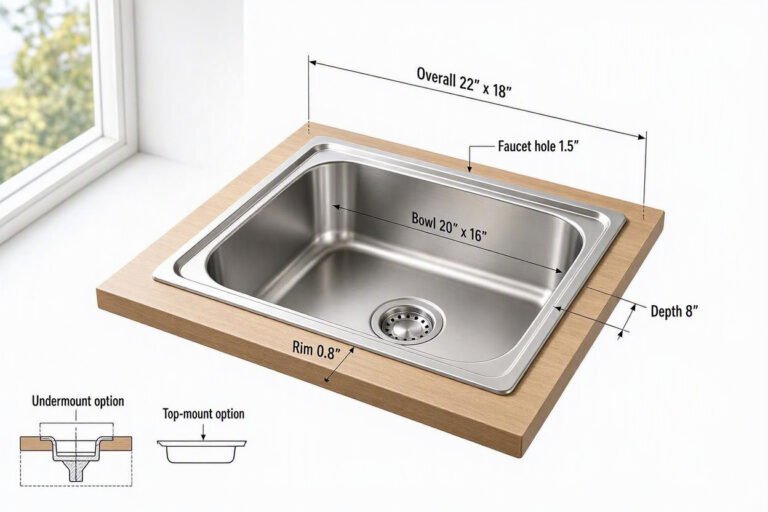
Check both where appropriate. External sink dimensions, bowl dimensions, and cutout dimensions are different measurements. Use the manufacturer’s installation template to determine the final opening.
Final Thoughts
The best kitchen sink and countertop combination is one that fits your space, suits your preferred mounting style, and meets the manufacturers’ installation requirements.
Quartz, granite, and some solid-surface countertops are commonly paired with undermount sinks, while top-mount sinks are often practical for laminate countertops. Wood, tile, stainless steel, and other surfaces require attention to their specific construction and finishing details.
Before purchasing a sink, verify its dimensions, countertop cutout, mounting system, support, sealing, and care requirements. Careful planning can help you avoid expensive installation mistakes and make everyday kitchen maintenance easier.
Sources and Further Reading
Use these manufacturer resources to review installation guidance and verify product-specific requirements before publishing:
- BLANCO — Sink Installation Types
- Elkay — Sink Guide
- Caesarstone — Installing an Undermount Sink to Quartz
Always follow the instructions for the actual sink and countertop products being installed.
Get Helpful Sink Tips
Subscribe for practical sink planning tips and helpful resources for small kitchens and compact spaces.

Khadija is the writer and founder of Tiny Sink Solution. She creates practical guides about small kitchen sinks, faucets, and compact kitchen maintenance, helping homeowners and renters choose solutions for limited spaces. Some articles contain affiliate links, and as an Amazon Associate, she earns from qualifying purchases at no extra cost to readers