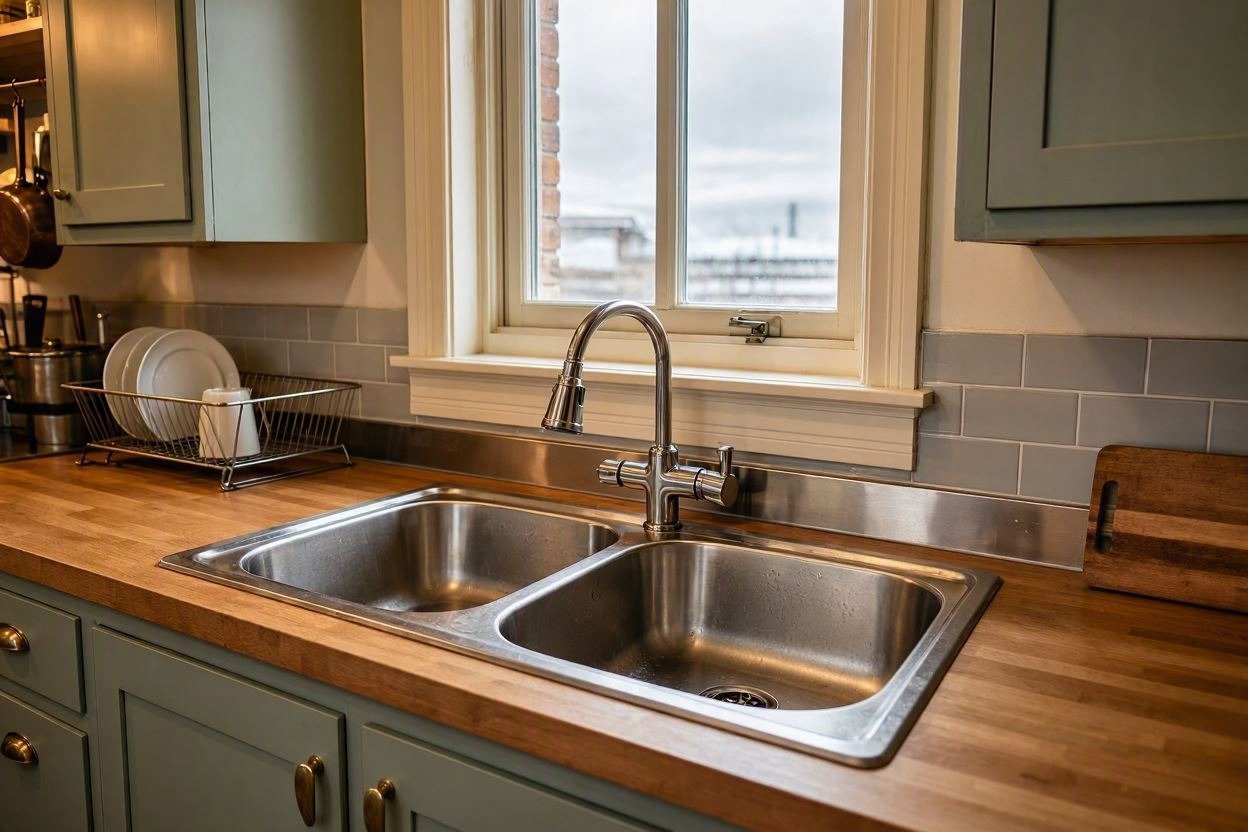
If you’re trying to fit two sink basins into a compact kitchen, small double bowl sink sizes need to be considered alongside cabinet width, sink depth, countertop space, and plumbing clearance.
There is no single standard size that defines a “small” double-bowl sink. Compact models can be found in the high-20s to low-30s inches in overall width, but exact dimensions and minimum cabinet requirements vary by model.
The important point is this: don’t choose a double-bowl sink based only on its advertised width. Check the complete sink dimensions, minimum cabinet size, cutout requirements, bowl configuration, depth, and installation type before buying.
Quick Answer: Small double bowl sinks can fit compact kitchens, but the right size depends on your cabinet and countertop layout. When comparing models, check overall width and depth, minimum cabinet size, bowl configuration, sink depth, countertop cutout, and plumbing clearance. A sink that looks small on paper may still require a larger cabinet.
What Counts as a Small Double-Bowl Sink?
A double-bowl sink has two separate basins within one sink unit. The bowls can be approximately equal in size or divided into one larger and one smaller basin.
There is no universal industry definition for a “small” double-bowl sink.
For compact kitchens, the practical question is whether the sink provides two usable basins without exceeding the available cabinet and countertop space.
When comparing models, look at:
- Overall sink width
- Overall sink depth
- Sink height
- Individual bowl dimensions
- Bowl configuration
- Minimum cabinet size
- Installation type
- Countertop cutout requirements
- Drain location
- Plumbing clearance
A smaller overall width does not automatically mean the sink will fit your cabinet.
Small Double Bowl Sink Sizes: A Practical Planning Range
Compact double-bowl sinks can be found in the high-20s to low-30s inches in overall width, although dimensions vary considerably between models.
These should be treated as planning ranges rather than official size categories.
For example, a double-bowl sink around 30 inches wide may sound suitable for a compact kitchen, but the manufacturer could specify a larger minimum cabinet size.
Some double-bowl models around 32½ to 33 inches wide may require a 36-inch minimum cabinet, depending on the particular design.
Double-bowl sinks provide two separate basins, while single-bowl sinks offer one continuous basin that can be more convenient for large cookware. The right choice depends on your available cabinet and countertop space. For more information on different kitchen sink options, see KOHLER Kitchen Sinks
That’s why the sink’s advertised width should only be your starting point.
What to Compare
| Measurement | Why It Matters |
|---|---|
| Overall width | Determines how much horizontal space the sink occupies |
| Overall depth | Affects countertop space and front-to-back fit |
| Height/depth | Affects cabinet and plumbing clearance |
| Bowl dimensions | Shows how much usable basin space you actually get |
| Minimum cabinet size | Determines whether the sink can physically be accommodated |
| Cutout dimensions | Important for countertop installation |
| Drain location | Can affect existing plumbing |
| Installation type | Determines countertop and cabinet requirements |
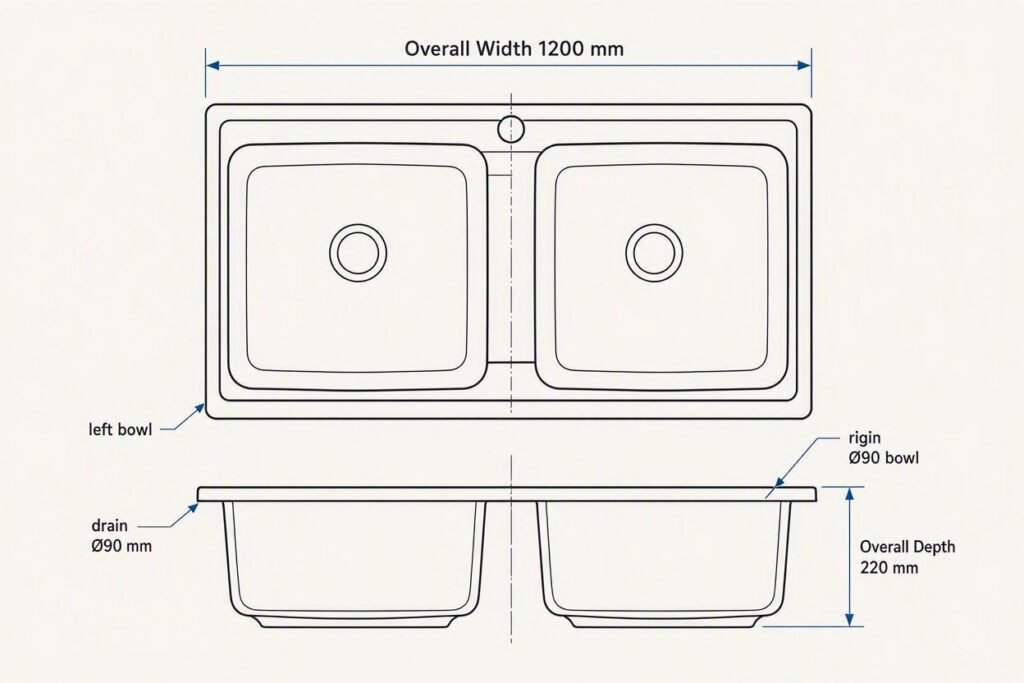
Overall Sink Dimensions vs. Bowl Dimensions
One common sizing mistake is confusing overall sink dimensions with the dimensions of each bowl.
Suppose a sink is advertised as approximately 30 inches wide. That does not mean each bowl is 15 inches wide.
The overall measurement includes:
- Both bowls
- Center divider
- Side rims or mounting areas
- Other structural portions of the sink
The usable bowl dimensions can therefore be considerably smaller than the overall sink width.
When comparing small double bowl sink sizes, look for both the overall dimensions and bowl dimensions whenever the manufacturer provides them.
This helps you determine whether the sink will actually accommodate the cookware and dishes you use regularly.
What Cabinet Size Does a Small Double Bowl Sink Need?
The cabinet is one of the most important measurements to check before buying.
A sink’s overall width and its minimum cabinet size are not necessarily the same number.
For example, a sink that is approximately 32 or 33 inches wide may require a 36-inch minimum cabinet depending on the model.
That requirement can come from the sink’s construction, mounting design, cabinet clearance, or other installation considerations.
Measure Your Cabinet First
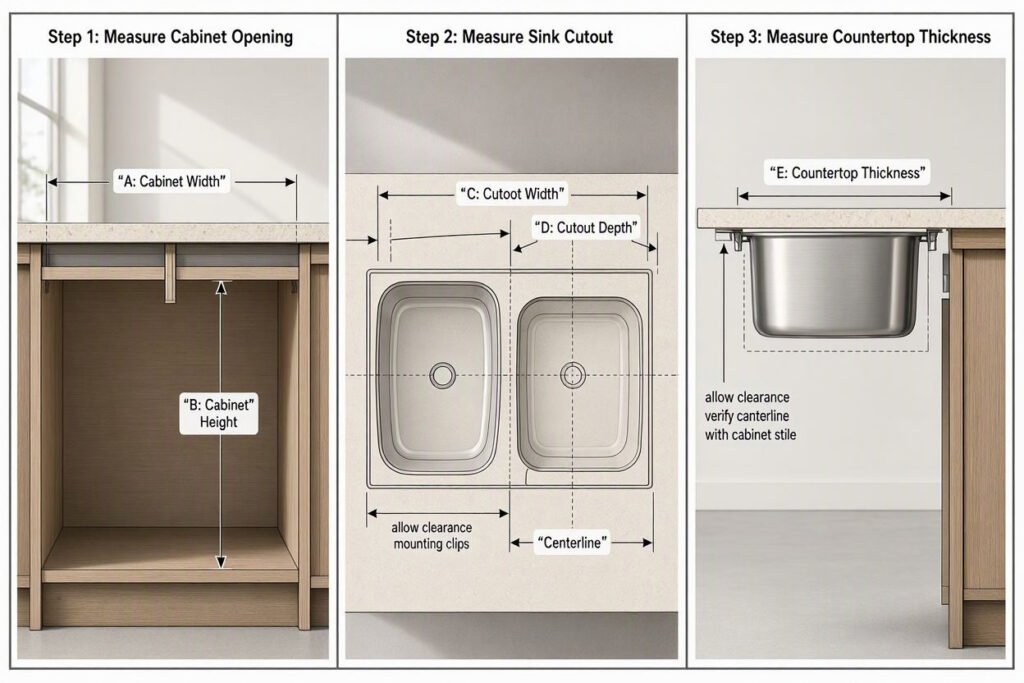
Before choosing a double-bowl sink, measure:
- Cabinet width
- Available cabinet depth
- Interior cabinet height
- Existing plumbing location
- Countertop depth
- Existing sink cutout, if replacing a sink
Then compare those measurements with the manufacturer’s specifications.
If you’re unsure about the size your cabinet can accommodate, our Cabinet Size Checker can help with preliminary planning.
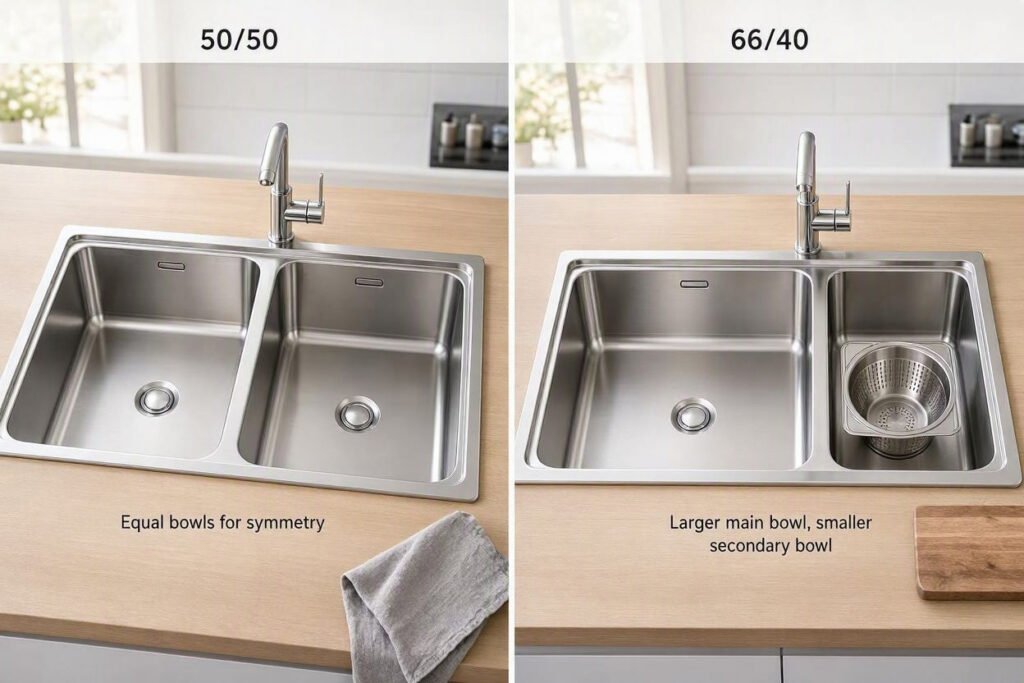
50/50 vs. 60/40 Double Bowl Sink Sizes
Not every double-bowl sink divides its space equally.
The two common configurations are 50/50 and 60/40.
What Is a 50/50 Double Bowl Sink?
A 50/50 sink has two approximately equal-sized bowls.
This configuration can be useful if you regularly use both basins for similar tasks.
For example, you might use one bowl for washing and the other for rinsing.
What Is a 60/40 Double Bowl Sink?
A 60/40 sink has one larger bowl and one smaller bowl.
The larger basin can provide more room for cookware, while the smaller basin can be used for rinsing, food preparation, or smaller items.
The exact bowl proportions vary between sink models, so don’t assume every 60/40 sink has identical dimensions.
Which Bowl Configuration Works Better in a Compact Kitchen?
The answer depends on how you use your sink.
A 50/50 Configuration May Suit You If:
- You use both bowls frequently
- You prefer two similarly sized basins
- You wash and rinse separately
- You don’t regularly wash very large cookware
A 60/40 Configuration May Suit You If:
- You want one larger washing basin
- You still want a second smaller basin
- You regularly wash larger pots or pans
- You use the second bowl for food preparation or rinsing
The key is to compare actual bowl dimensions, not just the “50/50” or “60/40” label.
How Deep Should a Small Double Bowl Sink Be?
Sink depth is another important consideration for a compact kitchen.
A deeper bowl can provide more vertical washing space, but it also extends farther into the cabinet area.
That can affect:
- Drain plumbing
- P-trap position
- Garbage disposal clearance
- Cabinet storage
- Other components underneath the sink
A double-bowl sink may also have a different bottom configuration from a single-bowl sink, so check the manufacturer’s dimensions rather than assuming that all sinks of the same width have the same depth.
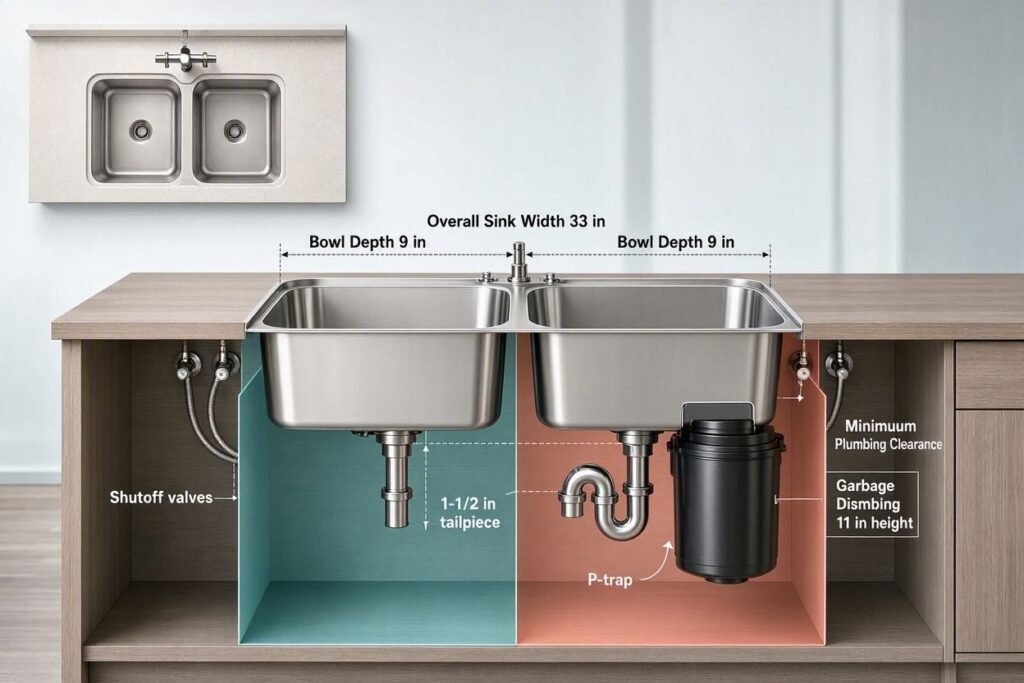
Don’t Ignore Under-Sink Clearance
Before buying a deeper sink, look underneath your existing countertop.
Check where the:
- Drain pipes
- Water supply lines
- P-trap
- Garbage disposal
- Cabinet shelves
are located.
A sink can fit the countertop opening but still create a plumbing-clearance problem underneath.
Measure in This Order Before Buying
For a replacement or new installation, use this sequence.
1. Measure the Cabinet
Start with the base cabinet width and available interior space.
2. Measure the Countertop
Check the available front-to-back depth and the space around the existing sink.
3. Check the Existing Cutout
If you’re replacing a sink, measure the current countertop opening.
Don’t assume the new sink will use exactly the same cutout.
4. Check Sink Dimensions
Compare the manufacturer’s overall width, depth, height, and bowl dimensions.
5. Check the Minimum Cabinet Requirement
This is especially important with larger double-bowl designs.
6. Check Plumbing
Look at drain locations and available clearance beneath the sink.
7. Verify the Manufacturer’s Cutout
For a new countertop opening, use the manufacturer’s template and installation instructions whenever available.
For planning, you can also use our Sink Cutout Size Calculator.
Small Double Bowl Sink vs. Single Bowl Sink
A double-bowl sink isn’t automatically the most space-efficient option.
A single-bowl sink uses the available sink width as one continuous basin, while a double-bowl sink divides that space into two sections.
| Feature | Double Bowl | Single Bowl |
|---|---|---|
| Number of basins | Two | One |
| Separation for washing/rinsing | Yes | No |
| Large cookware | Depends on bowl size | Often easier in one open basin |
| Organization | Two separate areas | One continuous area |
| Compact-kitchen fit | Depends on cabinet and model | Often offers more basin width flexibility |
| Best consideration | Bowl configuration | Available basin space |
For a compact kitchen, think about how you actually use the sink, not simply whether two bowls sound more useful.
When Does a Small Double Bowl Sink Make Sense?
A double-bowl sink may make sense when you regularly benefit from having two separate washing areas.
For example:
- You prefer washing and rinsing separately.
- You frequently use one bowl for food preparation.
- You want a dedicated area for smaller dishes.
- You share sink tasks between different activities.
- You don’t need one very large uninterrupted basin.
However, if you regularly wash large pots, baking trays, or oversized cookware, check the actual bowl dimensions carefully.
A compact double-bowl sink can have significantly less usable space in each basin than a similarly sized single-bowl sink.
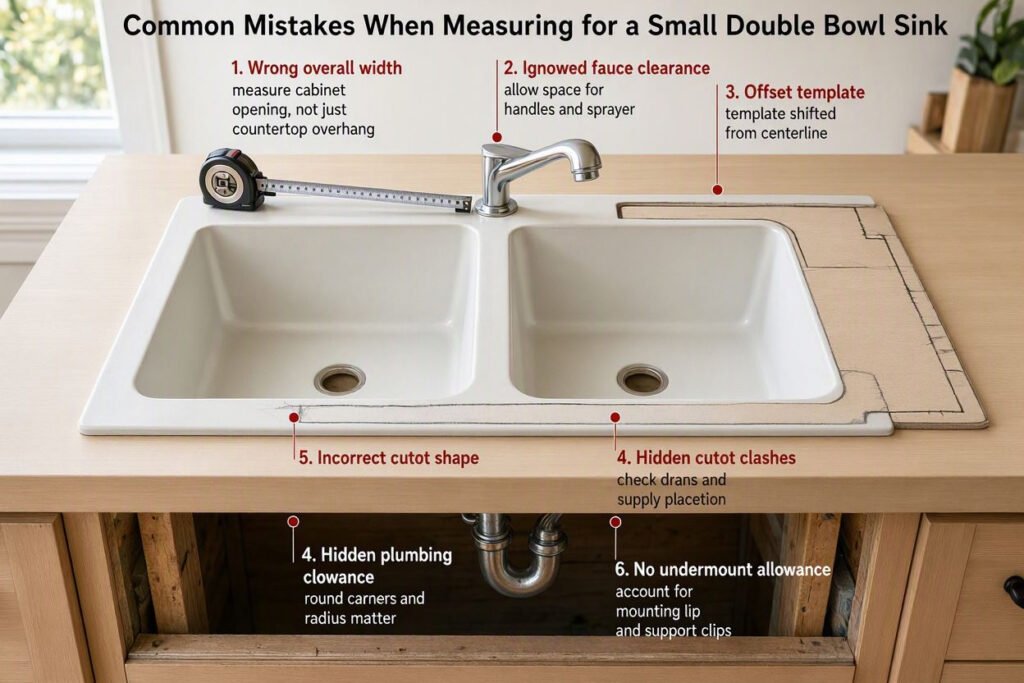
Common Small Double Bowl Sink Sizing Mistakes
Mistake 1: Assuming Sink Width Equals Cabinet Size
A 30-inch sink does not necessarily require a 30-inch cabinet.
Always check the manufacturer’s minimum cabinet requirement.
Mistake 2: Looking Only at Overall Width
Overall width doesn’t tell you how large each bowl is.
Compare the individual bowl dimensions when available.
Mistake 3: Ignoring Sink Depth
A deeper sink can affect plumbing and cabinet clearance.
Mistake 4: Assuming the Existing Cutout Will Work
A new sink may require different cutout dimensions.
Always check the installation specifications for the exact model.
Mistake 5: Forgetting Drain Location
The drain position can affect how easily the sink connects to existing plumbing.
Mistake 6: Choosing a Configuration Without Considering Cookware
A 50/50 sink may divide the available space differently from a 60/40 model.
Think about the largest items you regularly wash.
How to Choose the Right Small Double Bowl Sink Size
Use this simple decision process.
Step 1: Start With Cabinet Width
Don’t begin with the sink catalog.
Begin with your available cabinet.
Step 2: Identify the Maximum Practical Sink Width
Compare your cabinet dimensions with the manufacturer’s minimum cabinet requirements.
Step 3: Compare Bowl Configurations
Decide whether you want:
- 50/50
- 60/40
- Another split configuration
Step 4: Check Bowl Dimensions
Make sure each basin is large enough for the tasks you expect to perform.
Step 5: Check Sink Depth
Confirm that the sink won’t create problems with plumbing or cabinet storage.
Step 6: Verify the Countertop Cutout
Never cut the countertop based only on the sink’s overall dimensions.
Use the manufacturer’s installation template.
Step 7: Check Plumbing Clearance
Make sure the drain and other plumbing components can work with the new sink.
Use Our Sink Measurement Tools
Choosing a small double-bowl sink becomes easier when you separate the process into cabinet fit, countertop fit, and sink fit.
You can use these Tiny Sink Solutions tools for preliminary planning:
- Cabinet Size Checker — Check what sink size may work with your cabinet.
- Sink Cutout Size Calculator — Estimate a countertop cutout for planning purposes.
For broader sink measurement information, see our guide to Small Kitchen Sink Dimensions.
Remember that these tools are planning aids. Always verify final measurements against the manufacturer’s specifications and installation template.
Key Takeaways
- There is no universal definition of a small double bowl sink.
- Compact double-bowl models can be found in the high-20s to low-30s inches in overall width, but dimensions vary.
- Overall sink width is different from individual bowl dimensions.
- A sink’s minimum cabinet requirement may be larger than its advertised width.
- Some double-bowl models around 32½–33 inches wide may specify a 36-inch minimum cabinet, depending on the model.
- 50/50 sinks have approximately equal bowls.
- 60/40 sinks divide the space into one larger and one smaller bowl.
- Sink depth can affect plumbing clearance.
- Countertop cutouts should be based on the manufacturer’s requirements.
- Always measure the cabinet before choosing the sink.
Final Takeaway
Choosing among small double bowl sink sizes starts with your cabinet, not the sink listing.
Measure the cabinet width and available depth first. Then compare the sink’s overall dimensions, minimum cabinet requirement, bowl configuration, depth, cutout, and plumbing clearance.
A compact double-bowl sink can provide the convenience of two separate basins, but the available space in each bowl may be more limited than with a single-bowl design.
For a compact kitchen, the best fit is determined by the complete measurement chain: cabinet → countertop → cutout → sink → plumbing.
Frequently Asked Questions
What is the smallest size for a double bowl kitchen sink?
There is no single minimum size that applies to every double-bowl kitchen sink. Compact models can be found in smaller widths, but the exact dimensions and cabinet requirements vary by manufacturer and model.
Are 30-inch double bowl sinks available?
Yes, double-bowl sinks around 30 inches wide are available, but the exact dimensions and installation requirements vary. Check the manufacturer’s specifications rather than assuming a particular cabinet size will work.
What cabinet size is needed for a double bowl sink?
The required cabinet size depends on the specific sink. Some models require a minimum cabinet that is larger than the sink’s overall width. Always check the manufacturer’s stated minimum cabinet requirement.
Is a 50/50 or 60/40 sink better for a small kitchen?
Neither configuration is universally right for every compact kitchen. A 50/50 sink provides two similarly sized bowls, while a 60/40 sink provides one larger and one smaller bowl. Choose based on how you use the sink and the actual bowl dimensions.
Are double bowl sinks good for small kitchens?
They can be, especially if you regularly use two separate basins. However, dividing the sink into two bowls also reduces the uninterrupted space available for large cookware.
How deep are small double bowl sinks?
Depth varies by model. Check the manufacturer’s overall sink depth and bowl depth, then compare those measurements with the plumbing clearance available underneath your countertop.
Does a double bowl sink need a larger cabinet?
It may. The required cabinet size depends on the sink’s design and manufacturer specifications. Never assume that the sink’s overall width equals its minimum cabinet requirement.
Do double bowl sinks need a special countertop cutout?
The required cutout depends on the sink model and installation type. Always use the manufacturer’s cutout dimensions or installation template when preparing a countertop.
Should I choose a single or double bowl sink for a compact kitchen?
Consider how you use the sink. A double bowl provides separation between two tasks, while a single bowl provides one uninterrupted washing area. Compare the available cabinet space and the size of the cookware you regularly wash.
Khadija is the writer and founder of Tiny Sink Solution. She creates practical guides about small kitchen sinks, faucets, and compact kitchen maintenance, helping homeowners and renters choose solutions for limited spaces. Some articles contain affiliate links, and as an Amazon Associate, she earns from qualifying purchases at no extra cost to readers
![Top [count] Gardening Blogs - OnToplist.com](https://www.ontoplist.com/images/ontoplist32.png?id=6aa4d0c493161)
2 Comments