Choosing the right kitchen faucet starts with understanding your sink’s mounting holes. A faucet may look like a perfect fit, but the mounting hole diameter, number of holes, spacing, and available clearance all affect installation.
This guide explains standard kitchen sink faucet hole sizes, how to measure existing openings, and how to determine whether a new faucet will fit your current sink or countertop.
Quick Answer: What Is the Standard Kitchen Sink Faucet Hole Size?
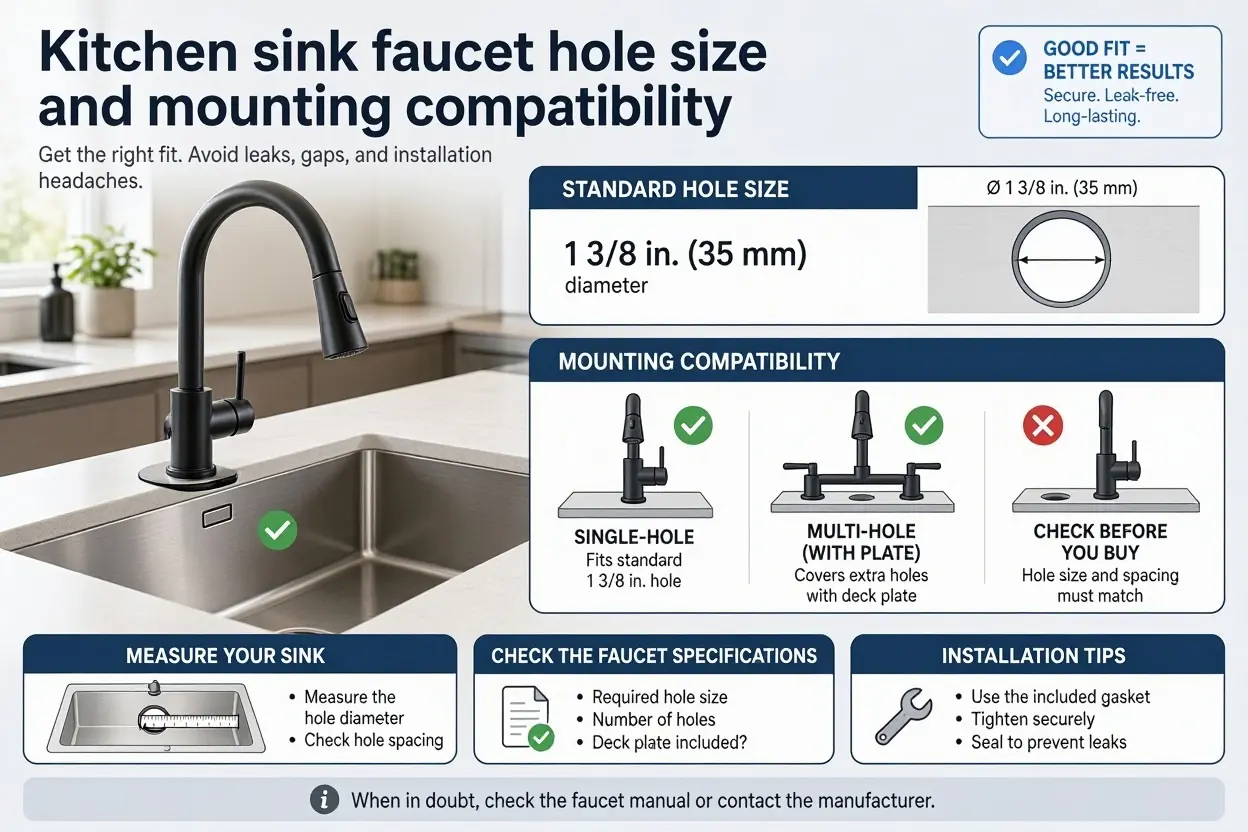
A common kitchen faucet mounting-hole diameter is 1⅜ inches (35 mm). However, the required opening varies by faucet model, so always check the manufacturer’s installation specifications before purchasing or drilling.
Many kitchen sinks have one, three, or four mounting holes. A single-hole faucet may also work with a sink that has additional holes when a compatible deck plate or separate accessories cover or use those openings.
Remember that hole diameter and hole spacing are different measurements. You need to check both when replacing an existing faucet.
Standard Kitchen Faucet Hole Sizes
Kitchen faucet openings are not identical across all manufacturers and sink designs. Use the following table as a starting point rather than a substitute for the product’s installation instructions.
| Measurement | What It Means | What to Check |
|---|---|---|
| Hole diameter | Width of an individual mounting opening | Required faucet cutout diameter |
| Hole count | Number of openings in the sink or countertop | Faucet and accessory requirements |
| Hole spacing | Distance between separate openings | Faucet base and accessory dimensions |
| Mounting depth | Space available beneath the mounting surface | Threaded shank length and mounting hardware |
| Deck thickness | Thickness of the sink or countertop at the opening | Maximum supported mounting thickness |
Different kitchen sink materials may have different installation considerations when modifying or enlarging faucet openings.
Why Faucet Hole Diameter Matters
The mounting opening must accommodate the faucet’s mounting shank and hardware. If the hole is too small, the faucet may not fit. If it is too large, the mounting hardware may not secure the faucet correctly.
Measure the opening itself rather than the outside diameter of the faucet base.
For an existing installation, measure the exposed opening with the faucet removed when practical. If the faucet is still installed, use the manufacturer’s specifications or inspect the opening from below where accessible.
Kitchen Faucet Hole Configurations
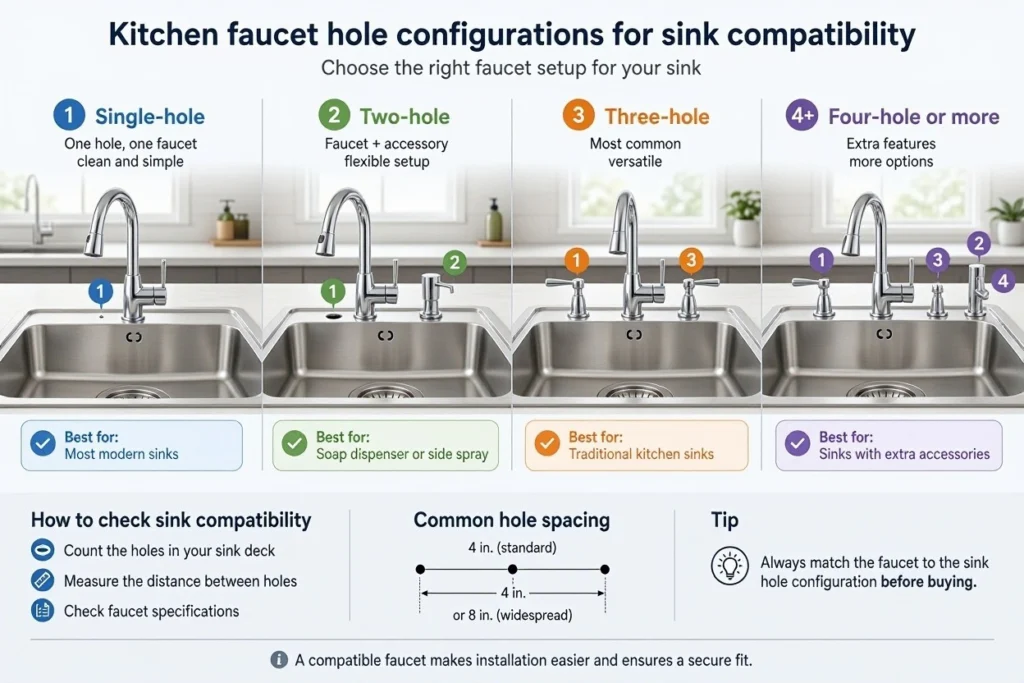
One-Hole Faucets
A single-hole faucet typically uses one opening for the faucet body. Many modern pull-down and pull-out kitchen faucets use this configuration.
Before choosing one, confirm the required hole diameter, mounting depth, and available clearance for the handle and spout.
Two-Hole Faucets
Two-hole configurations may accommodate a faucet and a separate accessory, depending on the sink layout. The arrangement is not universal, so identify what each opening is intended to support.
Three-Hole Faucets
Three-hole sinks are common in kitchens with traditional faucet layouts or separate handles. Some sinks also use three openings for a faucet and an accessory.
A compatible deck plate can allow certain single-hole faucets to cover extra openings, provided the plate is wide enough and the mounting arrangement is supported.
Four-Hole Faucets
Four-hole layouts may accommodate a faucet, separate handles, a side sprayer, a soap dispenser, or other accessories. The exact arrangement depends on the sink and faucet design.
Count the holes and identify their positions before buying replacement hardware.
How to Measure Kitchen Sink Faucet Holes
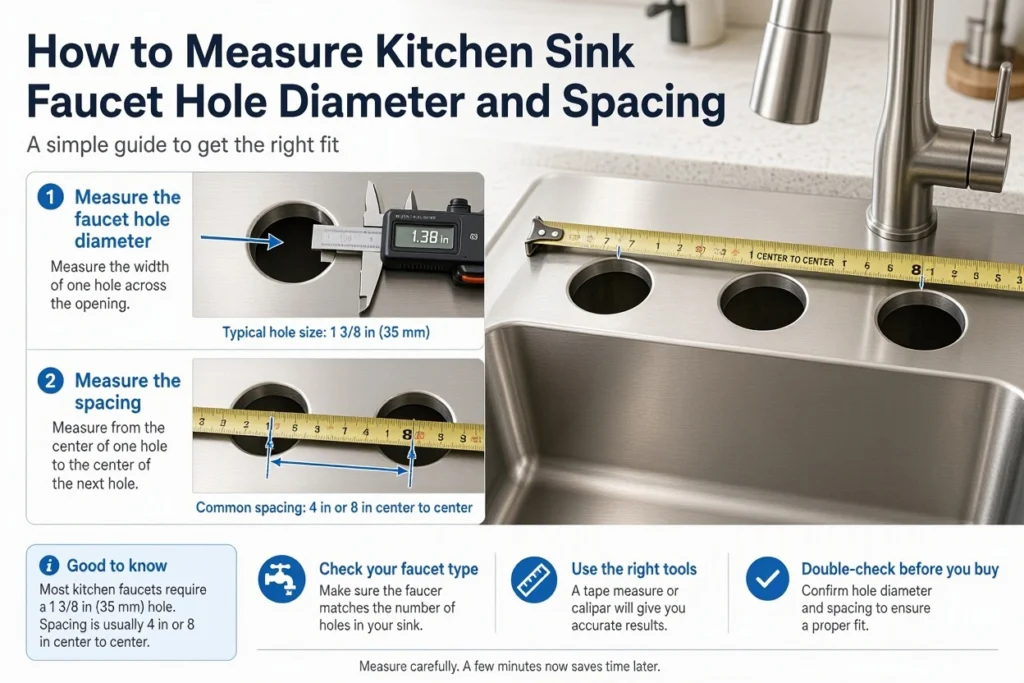
Follow these steps before purchasing a replacement faucet.
- Identify the mounting surface. Determine whether the faucet is installed through the sink deck or the countertop behind the sink.
- Count the holes. Record the total number of openings and identify any accessories using them.
- Measure the diameter. If the opening is accessible, measure straight across its center. Use a ruler for an estimate or calipers for a more precise measurement.
- Measure hole spacing. For separate openings, measure from the center of one hole to the center of the next. If the centers are difficult to identify, measure the outside distance and subtract the appropriate radii.
- Check mounting depth. Look underneath for obstructions, available thread length, and room for mounting hardware.
- Read the faucet installation manual. Confirm the required hole diameter, supported deck thickness, and any spacing requirements.
- Check handle clearance. Make sure the faucet handle can move fully without hitting a backsplash, wall, or window trim.
Important: Do not drill or enlarge an opening until you have confirmed that the sink material, countertop, and faucet manufacturer permit the modification.
Kitchen Faucet Compatibility Chart
| Existing Sink Setup | Potential Faucet Choice | What to Verify |
|---|---|---|
| One mounting hole | Single-hole faucet | Hole diameter and mounting depth |
| Three holes | Single-hole faucet with deck plate | Plate coverage and mounting compatibility |
| Three holes | Faucet designed for a three-hole layout | Required spacing and hole arrangement |
| Four holes | Faucet plus compatible accessories | Which accessories use each opening |
| Unusual or widely spaced holes | Faucet with a suitable mounting solution | Manufacturer’s dimensions and available coverage |
This chart describes common possibilities, not guaranteed compatibility. Always compare the actual sink measurements with the faucet’s installation requirements.
Can You Install a Single-Hole Faucet on a Three-Hole Sink?
Yes, in many cases. A single-hole faucet can often be installed in a three-hole sink using a compatible deck plate, sometimes called an escutcheon plate.
Before proceeding, check the following:
- The faucet fits the primary mounting hole.
- The deck plate covers the unused openings completely.
- The mounting hardware works with the sink’s thickness.
- The plate sits flat on the mounting surface.
- The installation instructions allow this configuration.
Some faucet models include a deck plate, while others require a separately purchased accessory. Do not assume one is included.
If the existing holes are unusually large or widely spaced, a standard plate may not provide sufficient coverage.
What Is a Kitchen Faucet Deck Plate?
A deck plate is a flat piece installed beneath or around the faucet base to cover additional mounting holes. It can provide a cleaner appearance when a sink has more openings than the replacement faucet needs.
Before selecting a plate, check its overall length and width, the location of the faucet mounting opening, and the number of holes it is designed to cover.
A deck plate does not automatically make every faucet compatible with every sink. It must fit the mounting arrangement and provide secure support.
Common Faucet Hole Measurement Mistakes
Measuring the Faucet Base Instead of the Hole
The decorative base may be much wider than the actual mounting opening. Measure the opening or check the manufacturer’s required cutout size.
Confusing Hole Diameter With Hole Spacing
Diameter describes the width of one opening. Spacing describes the distance between separate openings. Both may be important for replacement installations.
Ignoring the Countertop Thickness
A faucet may fit through the hole but still fail to secure correctly if the mounting hardware cannot accommodate the deck thickness.
Forgetting the Faucet Handle Clearance
A faucet may fit the opening but have a handle that hits a wall or backsplash. Check the complete handle movement before installation.
Assuming Every Deck Plate Fits
Deck plates vary in size and design. Compare the plate dimensions with the unused holes before ordering.
Frequently Asked Questions
1. What is the standard kitchen sink faucet hole size?
A common mounting-hole diameter is 1⅜ inches (35 mm), but the correct size depends on the faucet model. Verify the manufacturer’s required cutout dimensions.
2. Are all kitchen faucet holes the same size?
No. Hole dimensions can vary by faucet design, sink material, and manufacturer. Check the installation specifications before purchasing a replacement.
3. How do I measure a faucet hole without removing the faucet?
You can estimate the opening from accessible edges or inspect it from underneath. However, the installed faucet can obstruct accurate measurement. If precision is important, consult the manufacturer’s specifications or remove the faucet when safe and practical.
4. Can I install a one-hole faucet in a three-hole sink?
Often, yes, if the faucet fits the primary hole and a compatible deck plate covers the remaining openings. Check the faucet’s instructions and the plate’s dimensions.
5. What is the difference between faucet hole size and spacing?
Hole size refers to the diameter of an individual opening. Spacing refers to the distance between separate holes, commonly measured from center to center.
6. Do kitchen faucets come with deck plates?
Some do, and others do not. Check the included components and product installation manual before ordering additional parts.
7. Can I enlarge a kitchen sink faucet hole?
Possibly, but it depends on the sink or countertop material and the manufacturer’s instructions. Modifying stainless steel, composite, stone, or other surfaces requires different precautions. Confirm that modification is permitted before proceeding.
8. How many holes does a kitchen faucet need?
That depends on the faucet and its accessories. A single-hole faucet needs one suitable mounting opening, while other layouts may require additional holes for separate handles or accessories.
Final Faucet Compatibility Checklist
Before purchasing a replacement kitchen faucet, confirm:
- The mounting-hole diameter matches the faucet requirements.
- The number and positions of existing holes are suitable.
- Any required deck plate covers unused openings.
- The mounting hardware supports the deck thickness.
- The faucet handle has enough clearance.
- The water supply connections and mounting instructions are compatible.
After installing your new faucet, inspect the area underneath for any signs of a kitchen sink leak during the first few uses.
Taking these measurements before buying can help prevent installation delays and unnecessary modifications.
Helpful Resources
For model-specific requirements, consult the manufacturer’s official documentation:
Always prioritize the installation manual for the exact faucet model you choose.
Get Helpful Sink Tips
Subscribe for practical sink planning tips and helpful resources for small kitchens and compact spaces.

Khadija is the writer and founder of Tiny Sink Solution. She creates practical guides about small kitchen sinks, faucets, and compact kitchen maintenance, helping homeowners and renters choose solutions for limited spaces. Some articles contain affiliate links, and as an Amazon Associate, she earns from qualifying purchases at no extra cost to readers