Sink Size & Type Finder – Find the Right Kitchen Sink
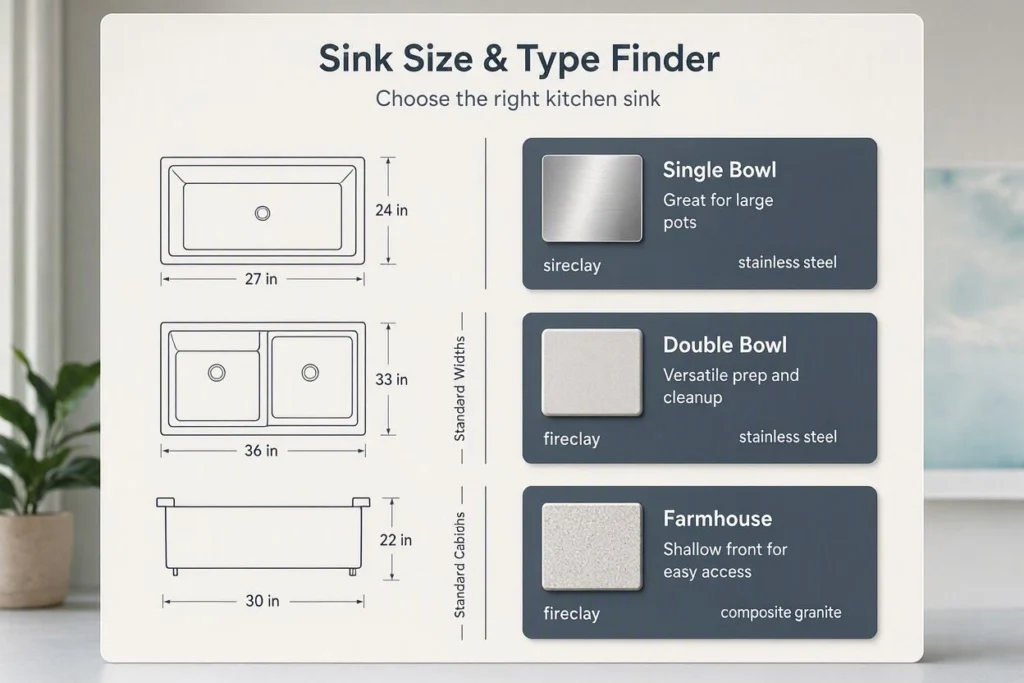
Not sure what size or type of kitchen sink is right for your space? Use this Sink Size & Type Finder to narrow down your options based on cabinet dimensions, installation style, kitchen size, bowl configuration, and everyday use.
Enter a few details about your kitchen and get a practical starting recommendation for your sink type and planning size range.
Important: This tool provides general planning guidance. It does not guarantee that a specific sink will fit your cabinet or countertop. Always verify the exact manufacturer’s specifications before purchasing.
Sink Size & Type Finder
Sink Size & Type Finder
Answer a few quick questions to find a practical sink type and planning size range for your kitchen.
How the Sink Size & Type Finder Works
Choosing a kitchen sink involves more than selecting a width from a product listing. The available cabinet space, installation method, bowl configuration, and the way you use your kitchen can all affect which sink makes sense for your space.
This finder uses the information you provide to create a practical starting point.
It considers:
- Cabinet width
- Cabinet depth
- Preferred installation type
- Kitchen size
- Single- or double-bowl preference
- Your primary sink use
The result provides a suggested sink type and a planning size range to help you narrow your search.
The recommendation should be treated as a starting point rather than a guaranteed fit.
What Should You Consider When Choosing a Kitchen Sink?
Before buying a sink, look beyond the advertised sink dimensions. The sink must work with the cabinet, countertop, plumbing, and installation method.
1. Cabinet Width
Cabinet width is one of the most important measurements when selecting a kitchen sink.
A sink that looks suitable in a product listing may still be too large for the available cabinet space. The cabinet must also provide enough room for the sink’s installation requirements and supporting components.
Measure the cabinet carefully before choosing a sink, especially if you are replacing an existing model.
2. Cabinet Depth
Cabinet depth can affect how much front-to-back space is available for the sink and its installation.
A standard-looking sink may not work the same way in every cabinet configuration. Plumbing, countertop thickness, sink depth, and other components can also affect the available space underneath the countertop.
For this reason, do not rely on cabinet width alone.
3. Installation Type
The three common installation styles included in this finder are:
- Undermount
- Drop-in
- Farmhouse or apron-front
Each installation type has different requirements.
An undermount sink is installed beneath the countertop and generally requires compatible countertop construction and an appropriate cutout.
A drop-in sink sits on top of the countertop and can be practical for some replacement projects.
A farmhouse or apron-front sink has a visible front apron and may require cabinet modifications depending on the existing setup.
4. Bowl Configuration
You also need to decide whether a single or double bowl makes more sense for your kitchen.
A single-bowl sink provides one continuous basin and can be useful when washing larger cookware or when you want to keep the sink configuration simple.
A double-bowl sink separates the basin into two sections and may be useful for washing and rinsing tasks separately.
For compact kitchens, the available cabinet and countertop space may make one configuration more practical than another.
5. Sink Material
Sink material affects appearance, durability, maintenance, and overall design.
Common kitchen sink materials include:
- Stainless steel
- Granite composite
- Fireclay
- Cast iron
- Other specialty materials
The best material depends on your budget, kitchen style, cleaning preferences, and expected use.
Do not choose a material based on appearance alone. Consider its installation requirements and care instructions as well.
6. Countertop Compatibility
Countertop material can affect which sink installation methods are practical.
Undermount installations, for example, require the countertop and cutout to support the installation method.
Before purchasing, check the sink manufacturer’s installation instructions and confirm that your countertop construction is compatible.
7. Plumbing and Under-Sink Clearance
The sink bowl occupies space inside the cabinet, but the area underneath it also needs to accommodate plumbing and other components.
A deeper sink can change the available clearance beneath the basin.
Before replacing an existing sink, inspect the plumbing arrangement and available cabinet space. Make sure the new sink will not create clearance problems.
Which Sink Type Is Best for a Small Kitchen?
There is no single sink type that is best for every small kitchen.
The right choice depends on your cabinet dimensions, countertop, installation requirements, and how you use the sink.
Undermount Sinks
An undermount sink can create a clean countertop appearance because the sink rim is positioned beneath the counter.
This style can work well when the countertop and cabinet configuration support undermount installation.
For a compact kitchen, an undermount sink may also help maintain a streamlined countertop area.
However, installation requirements should be checked carefully before purchasing.
Drop-In Sinks
Drop-in sinks have a rim that rests on top of the countertop.
They can be a practical option for certain replacement projects because the installation style differs from an undermount sink.
When considering a drop-in sink, check the actual sink dimensions and countertop cutout requirements rather than relying only on the nominal sink size.
Farmhouse / Apron-Front Sinks
Farmhouse sinks have a visible front apron and can provide a distinctive kitchen appearance.
Some models also offer a large basin that can be useful for washing cookware.
However, farmhouse sinks often require more planning because the cabinet may need modification to accommodate the apron and sink structure.
For a compact kitchen, carefully check cabinet dimensions before choosing this style.
How Much Sink Size Do You Need?
The appropriate sink size depends on the cabinet and installation requirements rather than a universal rule.
As a general planning approach, a smaller cabinet usually limits the sink size you can consider, while wider cabinets may provide more flexibility.
For example, a homeowner with a 24-inch cabinet should not assume that every sink advertised as a compact model will fit.
Likewise, a 36-inch cabinet may provide more options, but the largest possible sink is not automatically the best choice.
Consider:
- Cabinet width
- Cabinet depth
- Sink exterior dimensions
- Cutout dimensions
- Bowl depth
- Installation requirements
- Plumbing clearance
- Manufacturer’s minimum cabinet recommendation
The actual sink specifications should always be checked before making a purchase.
Check Your Cabinet Before Buying
If you are replacing an existing kitchen sink, accurate measurements can save you from choosing a sink that does not work with your cabinet.
Start by measuring the available cabinet width and depth.
You should also check the existing countertop cutout if you are replacing a sink rather than installing a new one.
Pay attention to the difference between:
- Cabinet dimensions
- Sink dimensions
- Cutout dimensions
- Bowl dimensions
These measurements are not interchangeable.
For a detailed measurement process, see our guide:
How to Measure a Cabinet for a Replacement Kitchen Sink
Use that guide before making a final purchasing decision.
Sink Size vs. Cabinet Size: What’s the Difference?
One common mistake is assuming that a sink’s advertised width is the same as the cabinet space it requires.
It is not.
A sink listing may describe the sink’s overall exterior dimensions, while the installation instructions may specify a different cutout size or minimum cabinet requirement.
For example, a sink described as a particular width does not automatically mean it can be installed in a cabinet of exactly the same width.
Always check the manufacturer’s:
- Overall sink dimensions
- Minimum cabinet size
- Cutout dimensions
- Installation instructions
- Required clearances
This is especially important for undermount and farmhouse installations.
Frequently Asked Questions
What size sink should I get for a 30-inch cabinet?
A 30-inch cabinet can support several sink sizes, depending on the specific model.
Always check the sink’s minimum cabinet requirement and exact dimensions before buying.
Is an undermount sink good for a small kitchen?
Yes, an undermount sink can work well in a small kitchen when the cabinet and countertop support it.
Check the cutout, cabinet space, and manufacturer’s installation requirements first.
Are single-bowl sinks better for compact kitchens?
A single-bowl sink can be practical when you want to maximize usable basin space.
However, the best choice depends on your kitchen layout and everyday washing needs.
Can a farmhouse sink fit any cabinet?
No, farmhouse sinks do not automatically fit every cabinet.
Check the sink’s width, apron height, depth, support requirements, and cabinet modification needs.
Does this tool guarantee that a sink will fit?
No, this tool provides general planning guidance rather than a guaranteed fit.
Always verify the exact sink dimensions and manufacturer’s installation requirements before buying.
Final Tip
The best kitchen sink is not necessarily the largest sink that can fit your cabinet.
A good choice balances available cabinet space, sink dimensions, installation type, bowl configuration, countertop compatibility, plumbing clearance, and everyday use.
Use this finder to narrow down your options, then verify the exact sink specifications before buying.
For replacement projects, accurate measurements should always come before product selection.
Need help measuring your cabinet? Read our guide:
![Top [count] Gardening Blogs - OnToplist.com](https://www.ontoplist.com/images/ontoplist32.png?id=6aa4d0c493161)